
















 Stay in a Mongolian Ger
Discover the magic of Mongolia, from the Gobi Desert to Khövsgöl Lake, and experience traditional nomadic life in a Ger under starlit skies.
The average annual maximum temperature in Baruun Urt, Mongolia is 9°C (48°F), with daytime highs ranging from -14°C (7°F) in January to 28°C (82°F) in July. This page covers monthly averages, day-night differences, and how Baruun Urt compares to cities worldwide.
In Baruun Urt, temperatures can shift dramatically between warm in summer and very cold in winter. Nights follow the same pattern, with lows ranging from 15°C (59°F) in July to -25°C (-13°F) in January.
The chart below illustrates the average maximum day and minimum night temperatures in Baruun Urt by month:
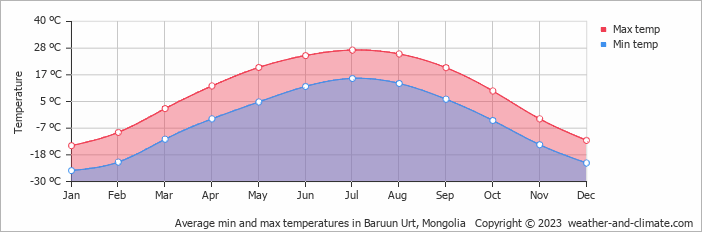
Daily lows are most common between 4 AM and 6 AM. By 3 PM temperatures reach their daily high, driven by peak solar heating. July, the warmest month of the year, receives 299 hours of sunshine.
The chart below shows the average temperature throughout the year:
Average high and low temperatures for each day of the month based on long-term records. 49-year average (1976-2025)
Browse day-by-day temperature records for Baruun Urt spanning 51 years. Select any month and year to see actual high and low temperatures recorded on each day.
The map below shows the annual temperature across Mongolia. You can also select individual months if you want to compare a specific time of year.
Baruun Urt's average annual maximum temperature is 9°C (48°F). To put that in context, here's how it compares to a few well-known destinations:
Athens, Greece sits at 23°C (73°F) on average, with hot dry summers and mild winters characteristic of the Mediterranean.
On the cooler end, Oslo, Norway averages just 10°C (50°F) annually, with pleasant summers but long, cold winters.
Shanghai, China averages 21°C (70°F) a year, with warm summers, mild winters, and a noticeable spring and autumn.
Tokyo, Japan averages 21°C (70°F) a year, with hot summers, cool winters, and a well-defined cherry blossom spring.
Climate temperature data is typically calculated as a 30-year average. This smooths out year-to-year variability and gives a more reliable picture of what a place is actually like, rather than what happened in any single unusual year.
The readings come from a range of sources, land-based weather stations, ocean buoys, ships, and satellites. That data is collected by weather services around the world, then pooled, quality-checked, and averaged to produce the climate records you see here.
For cities and regions with significant elevation, altitude is one of the biggest factors shaping local temperatures. As a rule of thumb, temperatures fall by around 6°C for every 1,000 metres gained, so a city at 2,000 metres will typically be around 12°C cooler than a city at sea level in the same region. Higher ground also tends to see more dramatic day-to-night temperature swings, since thinner air loses heat faster after sunset.
For more on Baruun Urt's weather, including monthly rainfall, sunshine hours, and humidity, visit our Baruun Urt climate page.
Pick a month to see the average temperature, rainfall and sunshine in Baruun Urt - and find the best time to visit.
Temperature Rainfall Sunshine Wind Speed
See the full Baruun Urt climate overview or explore weather in Mongolia.
Where to go in October - average daytime high across popular destinations.
Zamiin Ude 14°C (57°F) Dalanzadgad12°C (54°F) Saikhan-ovoo12°C (54°F) Gobi desert11°C (52°F) Baruun Urt
 10°C (50°F) Baitag9°C (48°F) Ulan Gom7°C (45°F) Ulaanbaatar7°C (45°F)
 Need travel inspiration? Check out our bucket list articles and be inspired.
Stay in a Mongolian Ger
Discover the magic of Mongolia, from the Gobi Desert to Khövsgöl Lake, and experience traditional nomadic life in a Ger under starlit skies.
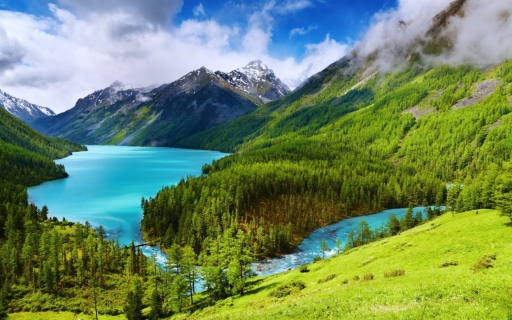
 Be amazed by the Altai mountains
The Atlai mountains are a sparsely populated area that most tourists have not yet discovered. Definitely bucket list material for the adventurous travelers among us.
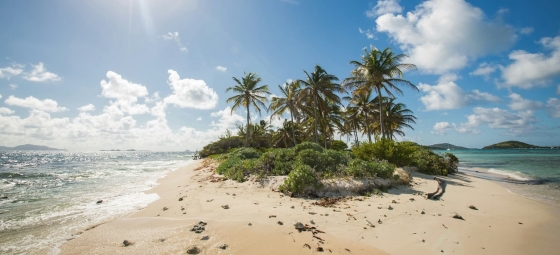
 10 Hidden gems in Asia you need to visit
Explore 10 hidden gems in Asia offering authentic experiences, from pristine beaches and remote islands to cultural treks and peaceful mountain villages.
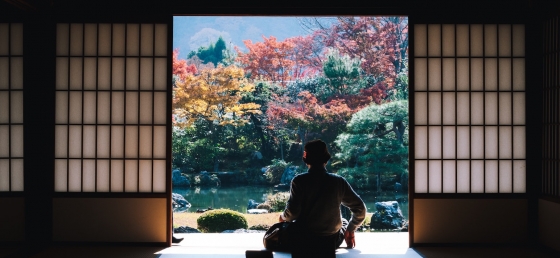
 Chase the autumn leaves in Japan
Japan is one of these cases which turns into a gold, yellow and orange fairy tale starting from September. And we can honestly say: We cannot imagine a more beautiful season to visit Japan.