

















 Where to Go for Christmas: Sun, Value and Fewer Crowds
Where can you find warm Christmas weather without peak-season prices and huge crowds? Compare Marsa Alam, The Gambia, Vietnam, Agadir and Cap Skirring.
This page shows both the average monthly rainfall and the number of rainy days in Mājid Abū Zayd, Alexandria Governorate, Egypt. These averages rely on historical data collected over 30 years, from 1990 to 2020. Let's now guide you through the details for a complete overview.
Mājid Abū Zayd is known for its low rainfall, with yearly precipitation amounts around 85 mm (3.3 in).
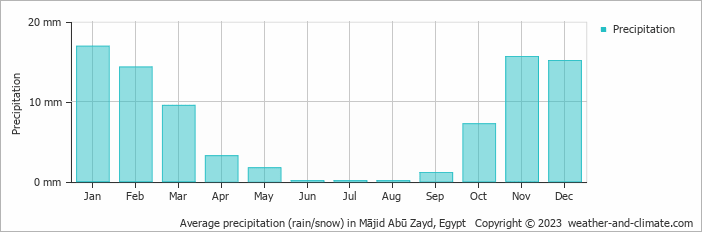
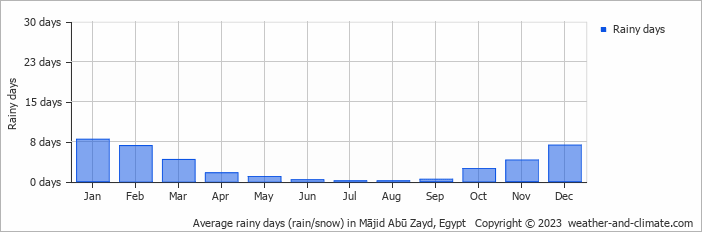
Mājid Abū Zayd can be quite wet during January, receiving approximately 17 mm (0.7 in) of precipitation over 8 rainy days.
In contrast June, experiences much drier conditions, with 0.1 mm (0 in) of rainfall, spread across 0 rainy days.
January, the wettest month, has a maximum daytime temperature of 19°C (66°F). During the driest month June you can expect a temperature of 30°C (86°F). For more detailed insights into the city's temperatures, visit our Mājid Abū Zayd Temperature page.
Browse day-by-day precipitation records for Mājid Abū Zayd spanning 28 years. Select any month and year to see actual rainfall and snowfall recorded on each day.
The map below shows the annual precipitation across Egypt. You can also select the different months in case you are interested in a specific month.
Mājid Abū Zayd's average annual precipitation is 85 mm (3.3 in). Let's compare this to some popular worldwide tourist destinations:
Seville, Spain, experiences 541 mm (21 in) of rainfall annually, with wet winters and dry summers typical of southern Spain.
Osaka, Japan, experiences 1507 mm (59 in) of rainfall annually, spread across the year with wetter summers.
Adelaide, Australia, enjoys 511 mm (20 in) of annual precipitation, with dry summers and wet winters.
Mumbai, India, experiences a tropical monsoon climate with 1860 mm (73 in) of annual rainfall, with the majority of precipitation happening during the monsoon season from June to September.
Precipitation amounts are measured using specific gauges installed at weather stations, collecting both rain and snow and any other type of precipitation. Rainfall is measured directly in millimeters, while that from snow and ice is obtained by melting it. Automated systems often incorporate heaters to make this easier.
Information from these stations is transmitted via Wi-Fi, satellite, GPS, or telephone connections to central monitoring networks. This information is immediately updated and integrated into weather models and forecasts.
Climate change is affecting precipitation patterns worldwide, including Mājid Abū Zayd:
For more detailed information about Mājid Abū Zayd's weather, including sunshine hours, humidity levels, and temperature data, visit our Mājid Abū Zayd Climate page.
Pick a month to see the average temperature, rainfall and sunshine in Mājid Abū Zayd - and find the best time to visit.
Temperature Rainfall
See the full Mājid Abū Zayd climate overview or explore weather in Egypt.
Where to go in October - average daytime high across popular destinations.
Need travel inspiration? Check out our bucket list articles and be inspired.
Where to Go for Christmas: Sun, Value and Fewer Crowds
Where can you find warm Christmas weather without peak-season prices and huge crowds? Compare Marsa Alam, The Gambia, Vietnam, Agadir and Cap Skirring.
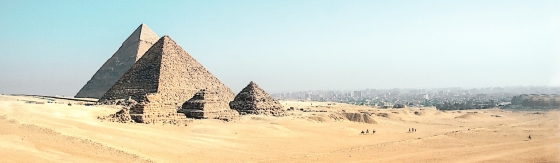 The Pyramids of Giza are impressive and absolutely worth a visit
The pyramids are considered to be one of the seven wonders of the world in ancient times and they are the only one that still exist and can be visited today.
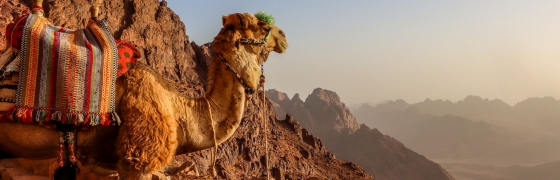 The Sinai Peninsula: Nowhere on earth is as quiet as this place
The Sinai Peninsula has an extraordinary and enchanting landscape. The peace and space in this region is overwhelming. Nowhere on earth is as quiet as this place.
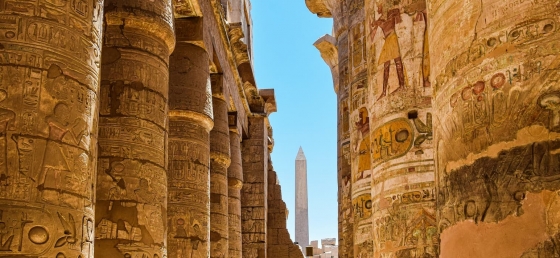 The Timeless Wonders of Luxor
Discover Luxor’s ancient marvels, from the grand Karnak temple and royal tombs of Thebes to the historic charm of the Old Winter Palace.