
















 Visit Sapa in Vietnam
Balancing on the edges of a rice field with endless views. A trek through the valley of Sapa is definitely a must for the bucket list.
This page shows both the average monthly rainfall and the number of rainy days in Hàm Ninh, Kien Giang, Vietnam. These values are calculated using 30 years of data (1990–2020) to ensure accuracy. Let's explore the details to provide you with a complete overview.
Hàm Ninh experiences significant rainfall throughout the year, averaging 2659 mm (105 in) of precipitation annually. However, this abundant rainfall is not evenly distributed, with a distinct dry and rainy season during certain months. You can clearly see this in our monthly precipitation graphs below.

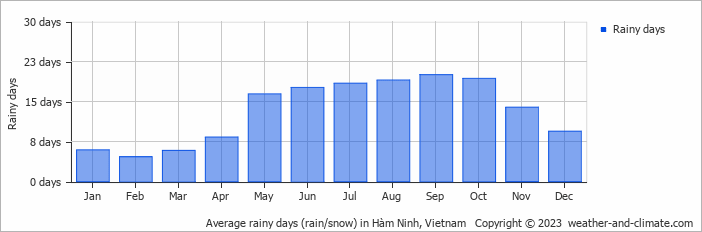
Significant seasonal changes in precipitation occur throughout the year. During the wettest month, September receives substantial rainfall, averaging 410 mm (16 in) of precipitation, recorded across 20 rainy days.
In contrast, the driest month, February brings less rainfall, with 32 mm (1.3 in) over 5 rainy days.
September, the wettest month, has a maximum daytime temperature of 29°C (84°F). The city receives 148 hours of sunshine in this period. During the driest month February you can expect a temperature of 29°C (84°F). For more detailed insights into the city's temperatures, visit our Hàm Ninh Temperature page.
The map below shows the annual precipitation across Vietnam. You can also select the different months in case you are interested in a specific month.
Hàm Ninh's average annual precipitation is 2659 mm (105 in). Let's compare this to some popular worldwide tourist destinations:
In Lisbon, Portugal, the average annual precipitation is 774 mm (30 in), characterized by wet winters and dry summers typical of the Mediterranean climate.
In Seoul, South Korea, the average annual precipitation is 1237 mm (49 in), with most rain falling during the summer monsoon season.
In Brisbane, Australia, the annual precipitation is 979 mm (39 in), making it wetter than Sydney.
Ho Chi Minh City, Vietnam, receives 1955 mm (77 in) of annual rainfall, with a pronounced wet season from May to November, typical of its tropical monsoon climate.
Precipitation amounts are measured using specific gauges installed at weather stations, collecting both rain and snow and any other type of precipitation. Rainfall is measured directly in millimeters, while that from snow and ice is obtained by melting it. Automated systems often incorporate heaters to make this easier.
Information from these stations is transmitted via Wi-Fi, satellite, GPS, or telephone connections to central monitoring networks. This information is immediately updated and integrated into weather models and forecasts.
The proximity of a location to a large body of water can significantly affect its rainfall patterns:
For more detailed information about Hàm Ninh's weather, including sunshine hours, humidity levels, and temperature data, visit our Hàm Ninh Climate page.
Pick a month to see the average temperature, rainfall and sunshine in Hàm Ninh - and find the best time to visit.
Temperature Rainfall Sunshine
See the full Hàm Ninh climate overview or explore weather in Vietnam.
Where to go in October - average daytime high across popular destinations.
Ho Chi Minh City 32°C (90°F) Hanoi
 31°C (88°F) Vung Tau30°C (86°F) Duong Dong29°C (84°F) Hoi An29°C (84°F) Nha Trang30°C (86°F) Da Nang29°C (84°F) Da Lat26°C (79°F)
 Need travel inspiration? Check out our bucket list articles and be inspired.
Visit Sapa in Vietnam
Balancing on the edges of a rice field with endless views. A trek through the valley of Sapa is definitely a must for the bucket list.

 Where to Go for Christmas: Sun, Value and Fewer Crowds
Where can you find warm Christmas weather without peak-season prices and huge crowds? Compare Marsa Alam, The Gambia, Vietnam, Agadir and Cap Skirring.
 Peace, beauty and silence in Vietnam
Vedana is located along the shores of a secluded, peaceful and serene lagoon, surrounded in lushly forested peaks. This ensures an isolated appeal and stunning views across a vast immense lagoon.
 Vietnam in February: North, Central or South?
Compare Vietnam's February weather in Hanoi, Da Nang, Nha Trang, Ho Chi Minh City and Phu Quoc to find the warmest, driest and sunniest region.