Presicce Temperature by Month
The average annual maximum temperature in Presicce, Puglia (Apulia), Italy is 21°C (70°F), with daytime highs ranging from 14°C (57°F) in January to 30°C (86°F) in August. This page covers monthly averages, day-night differences, and how Presicce compares to cities worldwide.
Presicce Monthly Temperatures
In Presicce, temperatures can shift dramatically between very warm in summer and mild in winter. Nights follow the same pattern, with lows ranging from 24°C (75°F) in August to 10°C (50°F) in January.
The chart below illustrates the average maximum day and minimum night temperatures in Presicce by month:
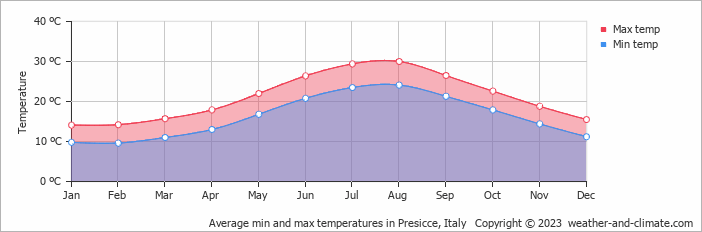
Low temperatures are most often recorded between 4 AM and 6 AM, while highs typically occur around 3 PM. August, the city's warmest month, sees 305 hours of sunshine.
The chart below shows the average temperature throughout the year:
Temperature: Presicce vs Italy
The map below shows the annual temperature across Italy. You can also select individual months if you want to compare a specific time of year.
 very warm
 warm
warm
 pleasant
 moderate
 cold
cold
 very cold
Presicce vs World: Temperature Compared
Presicce's average annual maximum temperature is 21°C (70°F). To put that in context, here's how it compares to a few well-known destinations:
Athens, Greece sits at 23°C (73°F) on average, with hot dry summers and mild winters characteristic of the Mediterranean.
On the cooler end, Oslo, Norway averages just 10°C (50°F) annually, with pleasant summers but long, cold winters.
Seoul, South Korea averages 18°C (64°F) a year, with four clear seasons, cold winters, and hot humid summers.
Perth, Australia averages 25°C (77°F) annually, with a classic Mediterranean climate — hot dry summers and mild wet winters.
Climate temperature data is typically calculated as a 30-year average. This smooths out year-to-year variability and gives a more reliable picture of what a place is actually like, rather than what happened in any single unusual year.
The readings come from a range of sources — land-based weather stations, ocean buoys, ships, and satellites. That data is collected by weather services around the world, then pooled, quality-checked, and averaged to produce the climate records you see here.
For cities and regions with significant elevation, altitude is one of the biggest factors shaping local temperatures. As a rule of thumb, temperatures fall by around 6°C for every 1,000 metres gained — so a city at 2,000 metres will typically be around 12°C cooler than a city at sea level in the same region. Higher ground also tends to see more dramatic day-to-night temperature swings, since thinner air loses heat faster after sunset.
For more on Presicce's weather — including monthly rainfall, sunshine hours, and humidity — visit our Presicce climate page.