















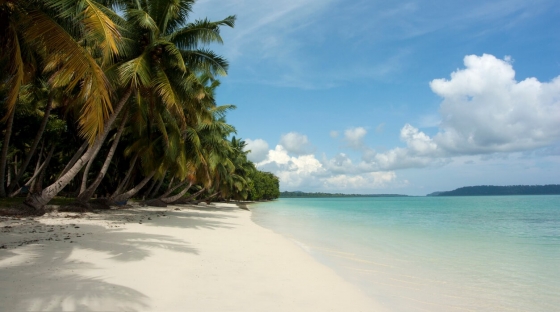
 A paradise called Andaman Islands
Though officially Indian, the Andamans are nearer Myanmar, Indonesia, and Thailand, resulting in amazing, budget-friendly white-sand beaches.
This page shows both the average monthly rainfall and the number of rainy days in Varca, Goa, India. These values are calculated using 30 years of data (1990–2020) to ensure accuracy. Now, let's break down all the details for a clearer picture.
Varca has a relatively rainy climate with high precipitation levels, averaging 2707 mm (107 in) of rainfall annually. Despite the high annual total, it does experience a distinct dry and rainy season during certain months. Examine our detailed charts below to understand these seasonal patterns.
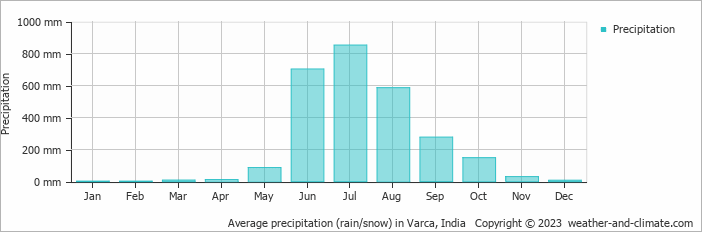
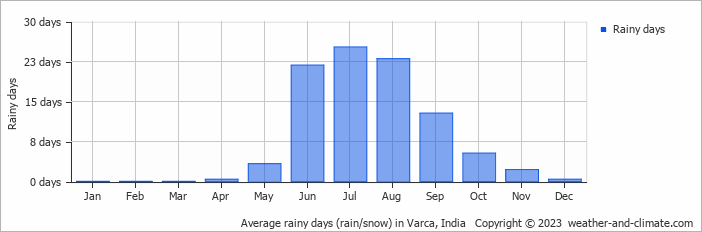
Varca can be quite wet during July, receiving approximately 852 mm (34 in) of precipitation over 25 rainy days.
In contrast February, experiences much drier conditions, with 1.1 mm (0.04 in) of rainfall, spread across 0 rainy days.
July, the wettest month, has a maximum daytime temperature of 29°C (84°F). The city receives 106 hours of sunshine in this period. During the driest month February you can expect a temperature of 31°C (88°F). For more detailed insights into the city's temperatures, visit our Varca Temperature page.
The map below shows the annual precipitation across India. You can also select the different months in case you are interested in a specific month.
Varca's average annual precipitation is 2707 mm (107 in). Let's compare this to some popular worldwide tourist destinations:
Seville, Spain, experiences 541 mm (21 in) of rainfall annually, with wet winters and dry summers typical of southern Spain.
Meanwhile, Buenos Aires, Argentina, enjoys a humid subtropical climate with 1000 mm (39 in) of annual rainfall, mostly in the summer.
Adelaide, Australia, enjoys 511 mm (20 in) of annual precipitation, with dry summers and wet winters.
Bangkok, Thailand, experiences a tropical monsoon climate with 1668 mm (66 in) of annual rainfall, with the heaviest precipitation occurring during September and October.
Precipitation amounts are measured using specific gauges installed at weather stations, collecting both rain and snow and any other type of precipitation. Rainfall is measured directly in millimeters, while that from snow and ice is obtained by melting it. Automated systems often incorporate heaters to make this easier.
Information from these stations is transmitted via Wi-Fi, satellite, GPS, or telephone connections to central monitoring networks. This information is immediately updated and integrated into weather models and forecasts.
Precipitation has a very strong role in determining the local climate and ecosystem:
For more detailed information about Varca's weather, including sunshine hours, humidity levels, and temperature data, visit our Varca Climate page.
Pick a month to see the average temperature, rainfall and sunshine in Varca - and find the best time to visit.
Temperature Rainfall Sunshine Humidity
See the full Varca climate overview or explore weather in India.
Where to go in September - average daytime high across popular destinations.
Jaipur 35°C (95°F) Gurugram35°C (95°F) New Delhi
 35°C (95°F) Chennai33°C (91°F) Hyderabad
 31°C (88°F) Bengaluru29°C (84°F) Mumbai
 30°C (86°F) Kochi28°C (82°F)
 Need travel inspiration? Check out our bucket list articles and be inspired.
A paradise called Andaman Islands
Though officially Indian, the Andamans are nearer Myanmar, Indonesia, and Thailand, resulting in amazing, budget-friendly white-sand beaches.
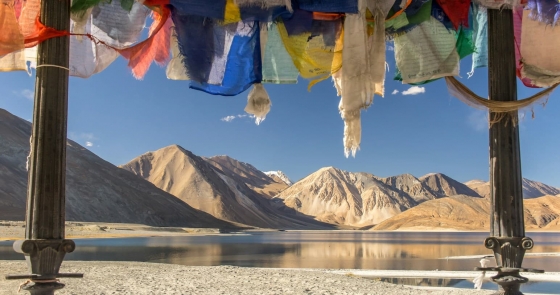 The 5 most beautiful monasteries in Ladakh
Explore Ladakh's spiritual essence through its incredible Buddhist monasteries. See architectural wonders, rich traditions, and serene landscapes in this guide.
 Sleeping under the stars and riding camels in Rajasthan
A desert safari in Jaisalmer is definitely one of the highlights during a visit to India. Spending a night in the desert is a great adventurous bucket list experience.
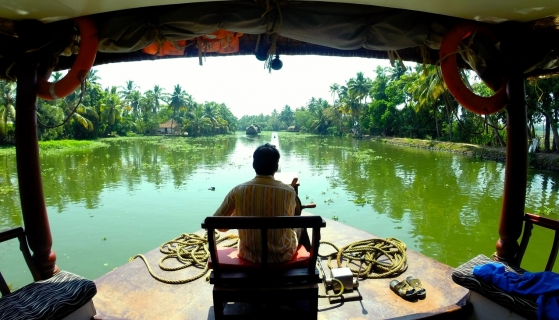 Avoid mass tourism on an eco boat in the backwaters of Kerala
We can tell you now how you can avoid being surrounded by tourists and at the same time minimize your impact on the environment.