
















 Go to Bovec in Slovenia
With mountains that linger in the blue sky, an emerald-green river Bovec offers picturesque scenes that are a must see for your bucket list.
The average annual maximum temperature in Tolmin, Slovenian Littoral (Primorska), Slovenia is 14°C (57°F), with daytime highs ranging from 4°C (39°F) in January to 25°C (77°F) in July. This page covers monthly averages, day-night differences, and how Tolmin compares to cities worldwide.
Depending on the time of the year, temperatures range from comfortable to cold in Tolmin. At night, minimum temperatures range from 15°C (59°F) in July to -3°C (27°F) in January.
The chart below illustrates the average maximum day and minimum night temperatures in Tolmin by month:
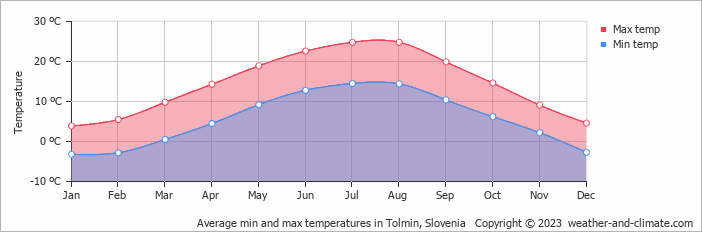
From around 4 AM to 6 AM temperatures are at their lowest; by 3 PM they've climbed to their daily peak. July, the warmest month, averages 242 hours of sunshine.
The chart below shows the average temperature throughout the year:
Average high and low temperatures for each day of the month based on long-term records. 50-year average (1976-2025)
Browse day-by-day temperature records for Tolmin spanning 51 years. Select any month and year to see actual high and low temperatures recorded on each day.
The map below shows the annual temperature across Slovenia. You can also select individual months if you want to compare a specific time of year.
Tolmin's average annual maximum temperature is 14°C (57°F). To put that in context, here's how it compares to a few well-known destinations:
Seville, Spain averages 23°C (73°F) a year, one of the warmer cities in Western Europe, with long hot summers.
Zermatt, Switzerland averages just 4°C (39°F) annually due to its altitude, with very cold winters and cool summers even at its warmest.
San Francisco, USA averages 19°C (66°F) annually, but with little seasonal variation, summers are often cool and foggy, winters mild.
Tokyo, Japan averages 21°C (70°F) a year, with hot summers, cool winters, and a well-defined cherry blossom spring.
Temperature alone doesn't tell the whole story, humidity plays a big role in how warm or cold it actually feels. High humidity in summer makes the heat feel more intense, particularly once temperatures climb above 25°C. In winter, the same humidity can make cold air feel sharper than the thermometer suggests.
In the cooler months, when temperatures drop below 10°C, high humidity makes the cold feel more cutting than it would in dry conditions.
In Tolmin, January is the coolest month, with average highs of 4°C (39°F) and humidity around 74%, considered high. In July, the warmest month, temperatures average 25°C (77°F) with 70% humidity, conditions that feel high. For a full picture, see our humidity page.
Climate temperature data is typically calculated as a 30-year average. This smooths out year-to-year variability and gives a more reliable picture of what a place is actually like, rather than what happened in any single unusual year.
The readings come from a range of sources, land-based weather stations, ocean buoys, ships, and satellites. That data is collected by weather services around the world, then pooled, quality-checked, and averaged to produce the climate records you see here.
Whether a city sits on the coast or deep inland makes a significant difference to its climate. Coastal areas tend to have more stable temperatures year-round, large bodies of water absorb heat slowly in summer and release it gradually in winter, keeping extremes in check. Cities far from the sea don't benefit from that buffer, which is why continental climates tend to have hotter summers and colder winters than their coastal counterparts at the same latitude.
For more on Tolmin's weather, including monthly rainfall, sunshine hours, and humidity, visit our Tolmin climate page.
Pick a month to see the average temperature, rainfall and sunshine in Tolmin - and find the best time to visit.
Temperature Rainfall Sunshine Humidity
See the full Tolmin climate overview or explore weather in Slovenia.
Where to go in October - average daytime high across popular destinations.
Piran 19°C (66°F) Portorož19°C (66°F) Maribor
 16°C (61°F) Ljubljana16°C (61°F) Bovec14°C (57°F) Bled14°C (57°F) Bohinj14°C (57°F) Kranjska Gora13°C (55°F)
 Need travel inspiration? Check out our bucket list articles and be inspired.
Go to Bovec in Slovenia
With mountains that linger in the blue sky, an emerald-green river Bovec offers picturesque scenes that are a must see for your bucket list.
 Experience Dazzling Fairy Tales In The Lake Bled Of Slovenia
Slovenia's most well-known tourist destination is Lake Bled, which is still relatively undiscovered when compared to other European attractions despite its growing notoriety.
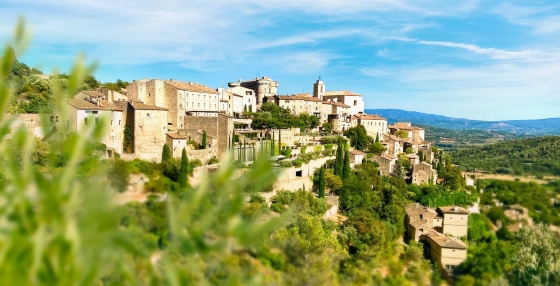
 The 10 most charming villages in France
Discover France's top 10 beautiful villages. From Normandy to the Côte d'Azur, experience quaint squares and cobbled streets. Which one will you visit this summer?

 The train journey from Bucharest to Brasov is one of the most beautiful in Romania
In three hours, you'll get from Bucharest to Brasov by train. It is one of the most beautiful routes in Romania, certainly the most beautiful that can be done by express train.