
















 7 of the most budget-friendly destinations in Europe
Discover Europe's top budget-friendly destinations including Budapest, Kotor, Krakow, and more, perfect for affordable and exciting travel.
Ślesin, Greater Poland, Poland has an average annual maximum temperature of 14°C (57°F), ranging from 3°C (37°F) in January to 26°C (79°F) in July. Below you'll find a full monthly breakdown and a comparison with cities worldwide.
The weather in Ślesin experiences significant differences between warm and cold seasons, with big shifts in temperature. At night, minimum temperatures range from 14°C (57°F) in July to -3°C (27°F) in January.
The chart below illustrates the average maximum day and minimum night temperatures in Ślesin by month:
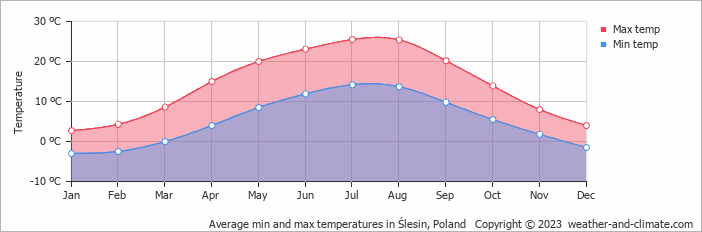
The coldest point of the day usually falls between 4 AM and 6 AM, with temperatures peaking around 3 PM. July, the city's warmest month, gets 220 hours of sunshine.
The chart below shows the average temperature throughout the year:
The map below shows the annual temperature across Poland. You can also select individual months if you want to compare a specific time of year.
Ślesin's average annual maximum temperature is 14°C (57°F). To put that in context, here's how it compares to a few well-known destinations:
Seville, Spain averages 23°C (73°F) a year, one of the warmer cities in Western Europe, with long hot summers.
Glasgow, Scotland averages 13°C (55°F) a year, mild but often grey, with cold winters and rarely hot summers.
Beijing, China averages 20°C (68°F) annually, but with big seasonal swings, very cold winters and hot summers.
Brisbane, Australia averages 26°C (79°F) a year, with warm winters and hot, humid summers.
Climate temperature data is typically calculated as a 30-year average. This smooths out year-to-year variability and gives a more reliable picture of what a place is actually like, rather than what happened in any single unusual year.
The readings come from a range of sources, land-based weather stations, ocean buoys, ships, and satellites. That data is collected by weather services around the world, then pooled, quality-checked, and averaged to produce the climate records you see here.
Whether a city sits on the coast or deep inland makes a significant difference to its climate. Coastal areas tend to have more stable temperatures year-round, large bodies of water absorb heat slowly in summer and release it gradually in winter, keeping extremes in check. Cities far from the sea don't benefit from that buffer, which is why continental climates tend to have hotter summers and colder winters than their coastal counterparts at the same latitude.
For more on Ślesin's weather, including monthly rainfall, sunshine hours, and humidity, visit our Ślesin climate page.
Pick a month to see the average temperature, rainfall and sunshine in Ślesin - and find the best time to visit.
See the full Ślesin climate overview or explore weather in Poland.
Where to go in October - average daytime high across popular destinations.
 Poznań
 14°C (57°F) Kraków14°C (57°F) Gdańsk13°C (55°F) Warsaw14°C (57°F) Sopot
 13°C (55°F) Kołobrzeg14°C (57°F) Gdynia13°C (55°F) Zakopane12°C (54°F)
 Need travel inspiration? Check out our bucket list articles and be inspired.
7 of the most budget-friendly destinations in Europe
Discover Europe's top budget-friendly destinations including Budapest, Kotor, Krakow, and more, perfect for affordable and exciting travel.
 Bialowieza, the Last Primeval Forest
Being the last remaining segment of the once sprawling lowland forest that covered Europe, Bialowieza stands as the final stronghold of true wilderness on the continent.

 The 10 most charming villages in France
Discover France's top 10 beautiful villages. From Normandy to the Côte d'Azur, experience quaint squares and cobbled streets. Which one will you visit this summer?
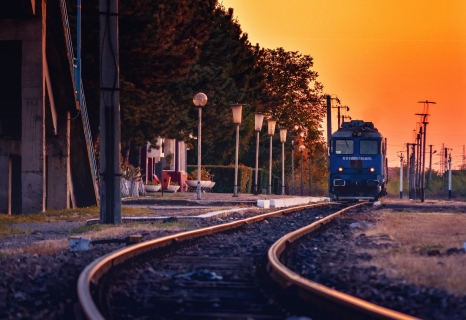
 The train journey from Bucharest to Brasov is one of the most beautiful in Romania
In three hours, you'll get from Bucharest to Brasov by train. It is one of the most beautiful routes in Romania, certainly the most beautiful that can be done by express train.