


















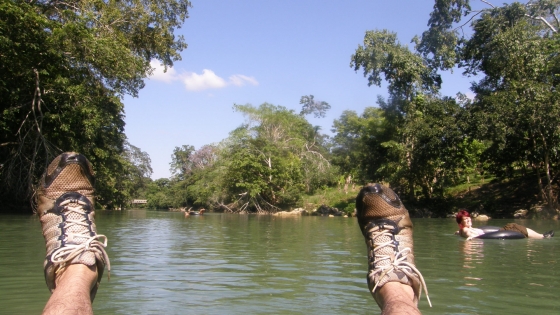
 River Tube in Belize
The best time to visit Belize and to River Tube is from December to mid-April, this is the dry season. If you like to avoid the crowds we recommend visiting May and early June.
San Ignacio in Cayo, Belize enjoys a stable climate, with daytime temperatures staying close to 32°C (90°F) throughout the year. Explore the full monthly breakdown below.
The climate in San Ignacio remains fairly constant, offering very warm temperatures throughout the year. Maximum daytime temperatures reach a very warm 35°C (95°F) in April, dropping to a comfortable 29°C (84°F) in January. Nighttime lows stay between 22°C (72°F) and 19°C (66°F).
The chart below illustrates the average maximum day and minimum night temperatures in San Ignacio by month:
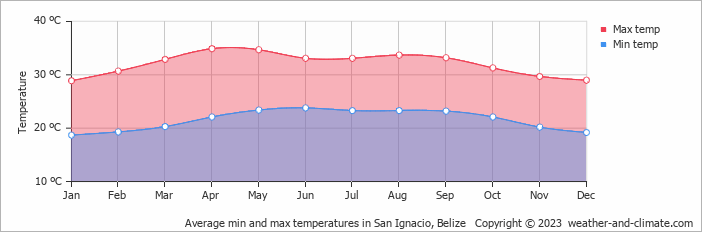
Daily lows are most common between 4 AM and 6 AM. By 3 PM temperatures reach their daily high, driven by peak solar heating. April, the warmest month of the year, receives 256 hours of sunshine.
The chart below shows the average temperature throughout the year:
Browse day-by-day temperature records for San Ignacio spanning 21 years. Select any month and year to see actual high and low temperatures recorded on each day.
The map below shows the annual temperature across Belize. You can also select individual months if you want to compare a specific time of year.
San Ignacio's average annual maximum temperature is 32°C (90°F). To put that in context, here's how it compares to a few well-known destinations:
Barcelona, Spain has an annual average of around 21°C (70°F), with warm summers and mild, fairly short winters.
Zermatt, Switzerland averages just 4°C (39°F) annually due to its altitude, with very cold winters and cool summers even at its warmest.
Boston, USA averages 16°C (61°F) annually, with four distinct seasons and cold winters that rival northern Europe.
Melbourne, Australia averages 20°C (68°F) annually, known for unpredictable weather, with four seasons sometimes happening in one day.
Climate temperature data is typically calculated as a 30-year average. This smooths out year-to-year variability and gives a more reliable picture of what a place is actually like, rather than what happened in any single unusual year.
The readings come from a range of sources, land-based weather stations, ocean buoys, ships, and satellites. That data is collected by weather services around the world, then pooled, quality-checked, and averaged to produce the climate records you see here.
Seasonal temperature shifts influence more than just how warm it feels, they also drive changes in rainfall, cloud cover, and wind patterns throughout the year.
Warmer air holds more moisture, which tends to mean heavier or more frequent rain during the warmer months. When temperatures drop in winter, any precipitation that does fall is more likely to come as snow or sleet, though in San Ignacio this rarely lasts long on the ground.
For more on San Ignacio's weather, including monthly rainfall, sunshine hours, and humidity, visit our San Ignacio climate page.
Pick a month to see the average temperature, rainfall and sunshine in San Ignacio - and find the best time to visit.
See the full San Ignacio climate overview or explore weather in Belize.
Where to go in October - average daytime high across popular destinations.
San Ignacio 31°C (88°F) Dangriga30°C (86°F) Belize City30°C (86°F) Hopkins30°C (86°F) Maya Beach30°C (86°F) Caye Caulker30°C (86°F) Placencia Village30°C (86°F) San Pedro29°C (84°F)
 Need travel inspiration? Check out our bucket list articles and be inspired.
River Tube in Belize
The best time to visit Belize and to River Tube is from December to mid-April, this is the dry season. If you like to avoid the crowds we recommend visiting May and early June.
 Best Spring Break Destinations for Great Weather and Fewer Crowds
Skip crowded spring break resorts. Compare March weather and travel style in Puerto Escondido, San Juan del Sur, Roatán, Caye Caulker and Curaçao.
 Cockscomb basin wildlife sanctuary
The Cockscomb Basin Wildlife Sanctuary is located in the south of Belize and is said to be the best place on earth to encounter a jaguar. Something you migh want to add to your bucket list.
 Dive and feel like Robinson Crusoe at Glover’s Reef
Belize has an amazing number of beautiful small islands. Many of these islands are unaffordable for the average backpacker. Glovers Reef is an exception to this.