



















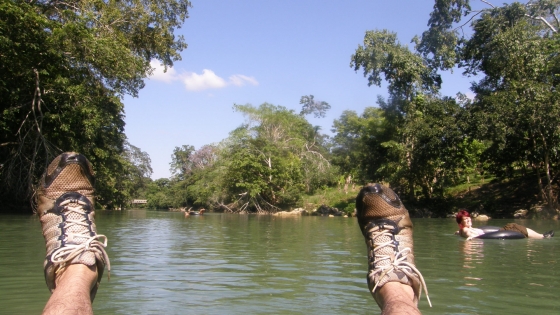
 River Tube in Belize
The best time to visit Belize and to River Tube is from December to mid-April, this is the dry season. If you like to avoid the crowds we recommend visiting May and early June.
This page shows both the average monthly rainfall and the number of rainy days in San Ignacio, Cayo, Belize. These values are calculated using 30 years of data (1990–2020) to ensure accuracy. Now, let's explore all the details to give you a full picture.
San Ignacio has a notably wet climate with abundant precipitation, recording 1148 mm (45 in) of rainfall per year. It does, however, have a distinct dry season during certain months. Have a look at our detailed charts below to see how precipitation varies throughout the year.
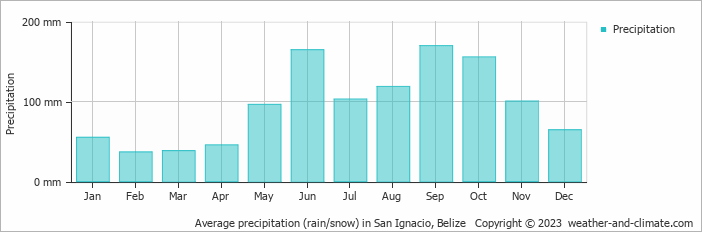
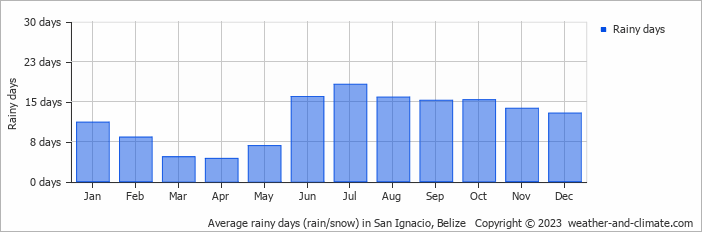
The climate in San Ignacio shows significant variation throughout the year. Expect 170 mm (6.7 in) of precipitation during the wettest month September, distributed over 15 rainy days.
In contrast, February offers drier and sunnier days, with around 37 mm (1.5 in) of rainfall over 8 rainy days.
September, the wettest month, has a maximum daytime temperature of 33°C (91°F). The city receives 175 hours of sunshine in this period. During the driest month February you can expect a temperature of 31°C (88°F). For more detailed insights into the city's temperatures, visit our San Ignacio Temperature page.
Browse day-by-day precipitation records for San Ignacio spanning 21 years. Select any month and year to see actual rainfall and snowfall recorded on each day.
The map below shows the annual precipitation across Belize. You can also select the different months in case you are interested in a specific month.
San Ignacio's average annual precipitation is 1148 mm (45 in). Let's compare this to some popular worldwide tourist destinations:
Chicago, USA, sees an annual precipitation of 1062 mm (42 in), with rain and snow contributing to its humid climate.
Meanwhile, Buenos Aires, Argentina, enjoys a humid subtropical climate with 1000 mm (39 in) of annual rainfall, mostly in the summer.
In Tokyo, Japan, the average annual precipitation is 1528 mm (60 in), with significant summer rains due to typhoon season.
Mumbai, India, experiences a tropical monsoon climate with 1860 mm (73 in) of annual rainfall, with the majority of precipitation happening during the monsoon season from June to September.
Precipitation amounts are measured using specific gauges installed at weather stations, collecting both rain and snow and any other type of precipitation. Rainfall is measured directly in millimeters, while that from snow and ice is obtained by melting it. Automated systems often incorporate heaters to make this easier.
Information from these stations is transmitted via Wi-Fi, satellite, GPS, or telephone connections to central monitoring networks. This information is immediately updated and integrated into weather models and forecasts.
The proximity of a location to a large body of water can significantly affect its rainfall patterns:
For more detailed information about San Ignacio's weather, including sunshine hours, humidity levels, and temperature data, visit our San Ignacio Climate page.
Pick a month to see the average temperature, rainfall and sunshine in San Ignacio - and find the best time to visit.
Temperature Rainfall Sunshine
See the full San Ignacio climate overview or explore weather in Belize.
Where to go in September - average daytime high across popular destinations.
San Ignacio 33°C (91°F) Dangriga31°C (88°F) Belize City31°C (88°F) Hopkins31°C (88°F) Maya Beach31°C (88°F) Caye Caulker30°C (86°F) Placencia Village31°C (88°F) San Pedro30°C (86°F)
 Need travel inspiration? Check out our bucket list articles and be inspired.
River Tube in Belize
The best time to visit Belize and to River Tube is from December to mid-April, this is the dry season. If you like to avoid the crowds we recommend visiting May and early June.
 Cockscomb basin wildlife sanctuary
The Cockscomb Basin Wildlife Sanctuary is located in the south of Belize and is said to be the best place on earth to encounter a jaguar. Something you migh want to add to your bucket list.
 Dive and feel like Robinson Crusoe at Glover’s Reef
Belize has an amazing number of beautiful small islands. Many of these islands are unaffordable for the average backpacker. Glovers Reef is an exception to this.
 The Cayo District is Belize's most adventurous region
This area has all the perfect ingredients for many different adventure activities. We are sure that the dramatic mix of this beautiful scenery made by Mother nature will capture your heart.