

















 Visit Sapa in Vietnam
Balancing on the edges of a rice field with endless views. A trek through the valley of Sapa is definitely a must for the bucket list.
Average temperatures, rainfall, sunshine and the best time to visit Thanh Hóa.
 –
–
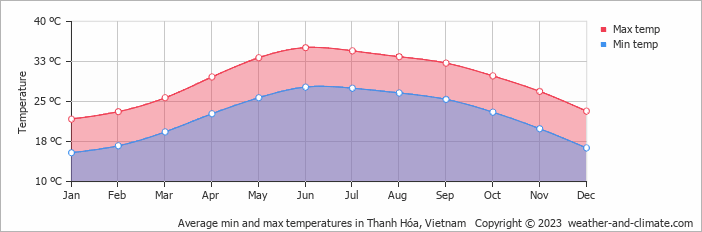
The climate in Thanh Hóa, Vietnam, is marked by large temperature swings across the seasons, ranging from 35°C (95°F) in June to 22°C (72°F) in January.
The city receives considerable rainfall, with around 1648 mm (65 in) annually. August is the wettest month. It has distinct dry (December to February) and wet (May to October) seasons, with very hot summers and pleasant winters. Sunshine peaks in July, when the city sees around 7.0 hours of sunshine per day.
Pick a month to see the average temperature, rainfall and sunshine in Thanh Hóa - and find the best time to visit.
In Thanh Hóa, temperatures differ significantly between summer and winter months. Typically, average maximum daytime temperatures range from a very hot 35°C (95°F) in June to a pleasant 22°C (72°F) in the coolest month, January.
Nights vary from 28°C (82°F) in June to around 15°C (59°F) during the colder months.
Check out our detailed temperature page for more information.
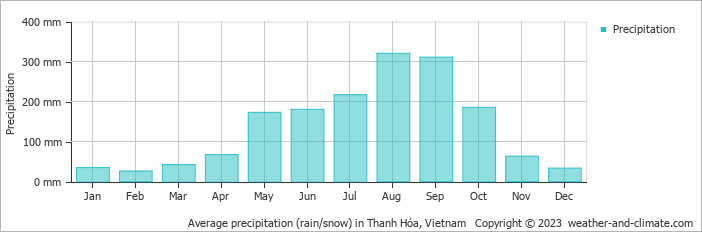
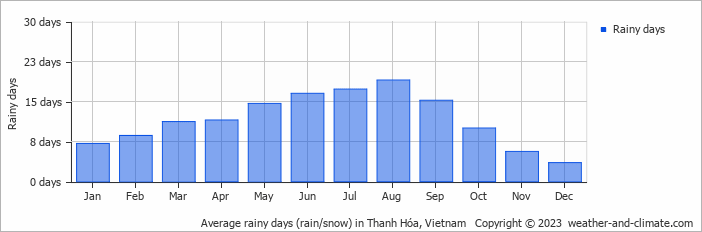
Thanh Hóa experiences significant rainfall throughout the year, averaging 1648 mm (65 in) of precipitation annually. The climate in Thanh Hóa shows significant variation throughout the year. Expect heavy rainfall in August, the wettest month, with an average of 320 mm (13 in) of precipitation over 19 rainy days.
In contrast, the driest month February offers drier and sunnier days, with around 26 mm (1 in) of rainfall over 9 rainy days. For more details, please visit our Thanh Hóa Precipitation page.
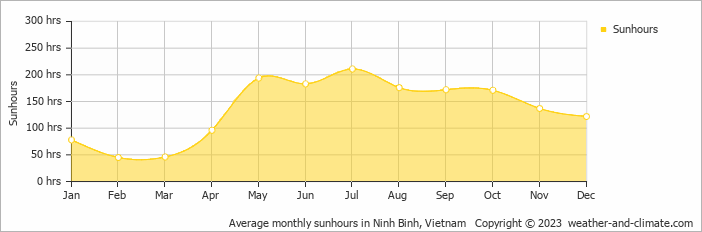
For those who appreciate different seasons, Thanh Hóa serves as an ideal destination. Expect longer, more sun-filled days in July with an average of 7.0 hours of sunshine daily, and embrace the darker days in February, offering only 1.5 hours of daily sunlight.
Visit our detailed sunshine hours page for more information.
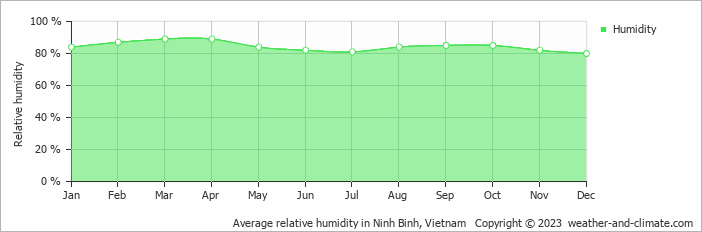
The city experiences its highest humidity in March, reaching 89%. In December, the humidity drops to its lowest level at 80%. What does this mean? Read our detailed page on humidity levels for further details.
Monthly ratings reflect general weather comfort, based on daytime temperature and rainfall. Swimming and winter conditions are highlighted separately where relevant.
January, February, March, November and December typically offer the most optimal weather in Thanh Hóa. In contrast, May, June, July, August, September and October tend to have less optimal conditions. Thanh Hóa has distinct dry (December to February) and wet (May to October) seasons, with very hot summers and pleasant winters.
Daytime highs range from 22°C (72°F) in January to 35°C (95°F) in June. Nighttime lows range from 15°C (59°F) to 28°C (82°F). Temperatures vary considerably through the year.
Annual rainfall is around 1648 mm (65 in). August is the wettest month with 320 mm (13 in), while February is the driest with 26 mm (1 in).
Thanh Hóa receives around 1,631 hours of sunshine per year. July is the sunniest month with 211 hours, while February is the cloudiest with just 45 hours.
Thanh Hóa is highlighted - select any city to see its climate.
Where to go in September - average daytime high across popular destinations.
Ho Chi Minh City 32°C (90°F) Hanoi33°C (91°F) Nha Trang31°C (88°F) Hoi An32°C (90°F) Da Nang31°C (88°F) Vung Tau30°C (86°F) Duong Dong29°C (84°F) Da Lat26°C (79°F)
 Need travel inspiration? Check out our bucket list articles and be inspired.
Visit Sapa in Vietnam
Balancing on the edges of a rice field with endless views. A trek through the valley of Sapa is definitely a must for the bucket list.
 Peace, beauty and silence in Vietnam
Vedana is located along the shores of a secluded, peaceful and serene lagoon, surrounded in lushly forested peaks. This ensures an isolated appeal and stunning views across a vast immense lagoon.
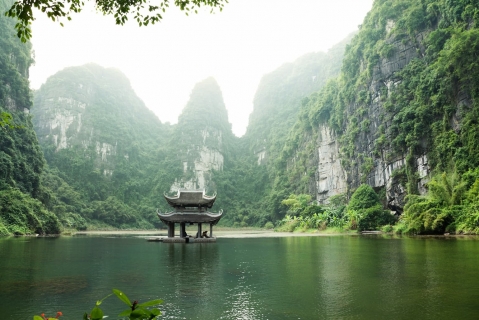 Vietnam in February: North, Central or South?
Compare Vietnam's February weather in Hanoi, Da Nang, Nha Trang, Ho Chi Minh City and Phu Quoc to find the warmest, driest and sunniest region.
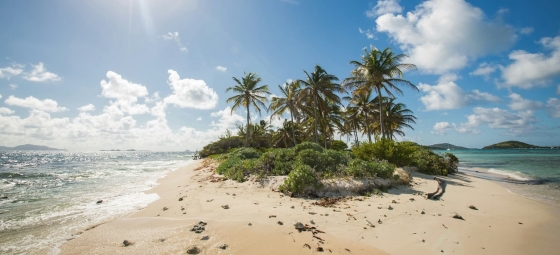
 10 Hidden gems in Asia you need to visit
Explore 10 hidden gems in Asia offering authentic experiences, from pristine beaches and remote islands to cultural treks and peaceful mountain villages.