
















 The 10 most charming villages in France
Discover France's top 10 beautiful villages. From Normandy to the Côte d'Azur, experience quaint squares and cobbled streets. Which one will you visit this summer?
Average temperatures, rainfall, sunshine and the best time to visit Glesborg.
 –
–
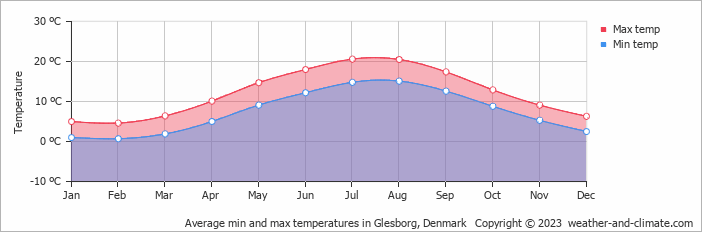
The climate in Glesborg, Midtjylland, Denmark, is marked by large temperature swings across the seasons, ranging from 21°C (70°F) in July to 5°C (41°F) in February.
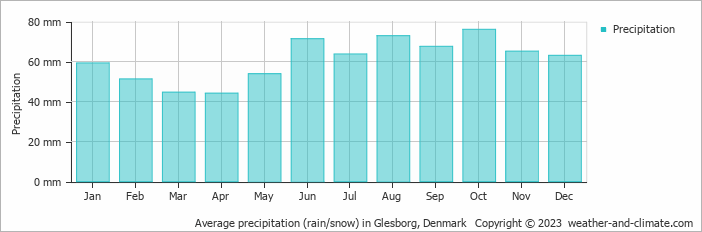
The city receives around 732 mm (29 in) of rain/snowfall per year. It experiences pleasant summers and cold winters. October is the wettest month and April the driest. Sunshine peaks in May, when the city sees around 8.5 hours of sunshine per day.
Pick a month to see the average temperature, rainfall and sunshine in Glesborg - and find the best time to visit.
In Glesborg, temperatures differ significantly between summer and winter months. On average, daytime temperatures range from a pleasant 21°C (70°F) in July to a chilly 5°C (41°F) in February.
Nighttime temperatures range from 15°C (59°F) in July to 1°C (34°F) in February.
Check out our detailed temperature page for more information.
On average, Glesborg receives a reasonable amount of rain/snowfall, with an annual precipitation of 732 mm (29 in). The amount of precipitation varies moderately throughout the year. The wettest month, October, sees around 76 mm (3 in) of rainfall, perfect for those who enjoy a bit of rain now and then. The driest month, April, still receives a respectable 44 mm (1.7 in) of rainfall. For more details, please visit our Glesborg Precipitation page.
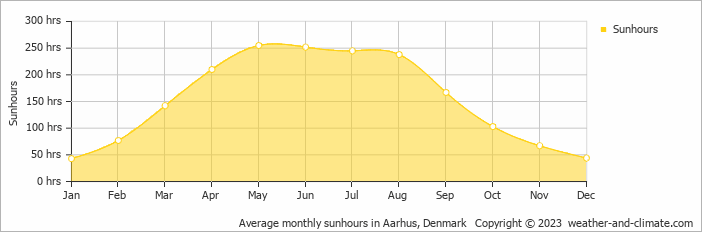
In Glesborg, summer days are longer and more sunny, with daily sunshine hours peaking at 8.5 hours in May. As the darker season arrives, the brightness of the sun becomes less. January sees a soft sun for only 1.4 hours per average day.
Visit our detailed sunshine hours page for more information.
Monthly ratings reflect general weather comfort, based on daytime temperature and rainfall. Swimming and winter conditions are highlighted separately where relevant.
July and August typically offer the most optimal weather in Glesborg. In contrast, January, February, March, April, November and December tend to have less optimal conditions. Glesborg has pleasant summers and cold winters.
Daytime highs range from 5°C (41°F) in February to 21°C (70°F) in July. Nighttime lows range from 1°C (34°F) to 15°C (59°F). Temperatures vary considerably through the year.
Annual rainfall is around 732 mm (29 in). October is the wettest month with 76 mm (3 in), while April is the driest with 44 mm (1.7 in).
Glesborg receives around 1,843 hours of sunshine per year. May is the sunniest month with 255 hours, while January is the cloudiest with just 43 hours.
Glesborg is highlighted - select any city to see its climate.
Where to go in October - average daytime high across popular destinations.
 Bolilmark
 14°C (57°F) Søndervig14°C (57°F) Løkken13°C (55°F) Rømø Kirkeby14°C (57°F) Ebeltoft13°C (55°F) Bøtø By13°C (55°F) Blåvand14°C (57°F) Lønstrup13°C (55°F)
 Need travel inspiration? Check out our bucket list articles and be inspired.
The 10 most charming villages in France
Discover France's top 10 beautiful villages. From Normandy to the Côte d'Azur, experience quaint squares and cobbled streets. Which one will you visit this summer?

 The train journey from Bucharest to Brasov is one of the most beautiful in Romania
In three hours, you'll get from Bucharest to Brasov by train. It is one of the most beautiful routes in Romania, certainly the most beautiful that can be done by express train.
 An alternative way to discover Paris
From street art, vintage shops, vegetarian cafes, to amazing cultural events, Paris has much to offer for the creative traveler. An overview of sights that you must see if you want to visit this city in an alternative way.

 The 10 most beautiful historical towns in Italy
Discover Italy's top 10 historic towns, featuring breathtaking medieval architecture and deep-rooted history, ideal for enthusiasts of extraordinary cities.