


















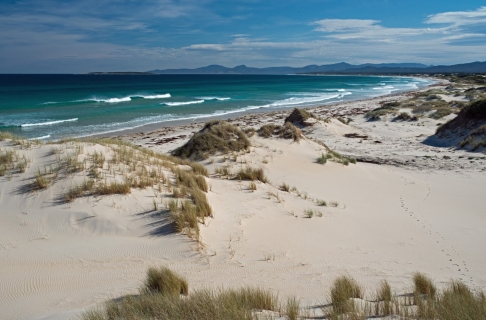
 Visit Tasmania
Tasmania, an amazing rugged and green island you want to visit once in you life. The island state south of Australia is one of the most picturesque islands in the world.
Average temperatures, rainfall, sunshine and the best time to visit Hobart.
 –
–
Hobart is the capital and largest city of Tasmania, an Australian island. Originally founded as a prison colony, the city has since grown into a vibrant cultural and historical center.
Hobart has a mild oceanic climate. In winter, temperatures can occasionally drop below freezing, and the peaks of Mount Wellington are often covered in snow. The city experiences the most snowfall in Australia and, after Melbourne, has the fewest average daily sunshine hours. Summers are mild, with average temperatures just above 20°C (68°F), though occasional heatwaves can push temperatures above 30°C (86°F). The highest recorded temperature exceeds 40°C (104°F).
During winter, winds typically blow from the south, bringing cold air from Antarctica.
Pick a month to see the average temperature, rainfall and sunshine in Hobart - and find the best time to visit.
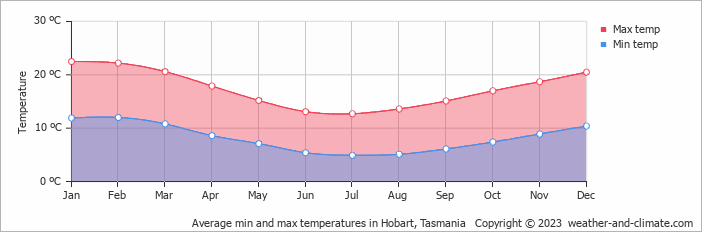
The weather in Hobart changes moderately throughout the year, offering enough variation to appreciate each season. On average, daytime temperatures range from a comfortable 23°C (73°F) in January to a moderate 13°C (55°F) in July.
Nighttime temperatures range from 12°C (54°F) in January to 5°C (41°F) in July.
Check out our detailed temperature page for more information.
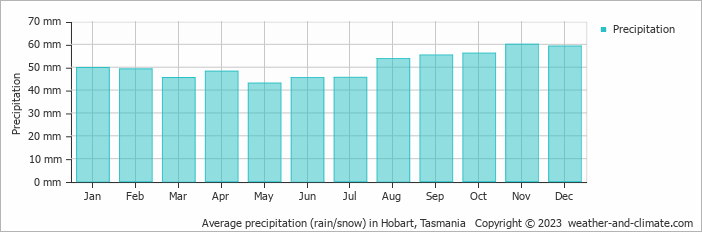
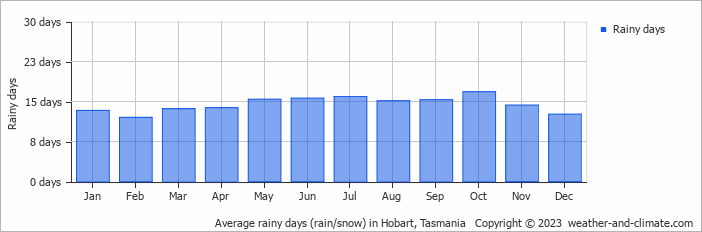
On average, Hobart receives a reasonable amount of rainfall, with an annual precipitation of 611 mm (24 in). The wettest period in Hobart occurs in November, which receives around 60 mm (2.4 in) of precipitation. During the driest month, May, Hobart experiences moderate rainfall, totaling 43 mm (1.7 in). The consistent precipitation levels throughout the year contribute to a relatively stable climate. For more details, please visit our Hobart Precipitation page.
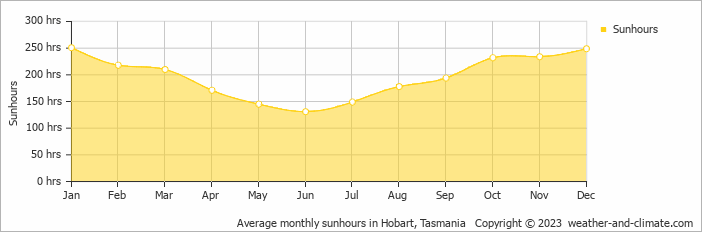
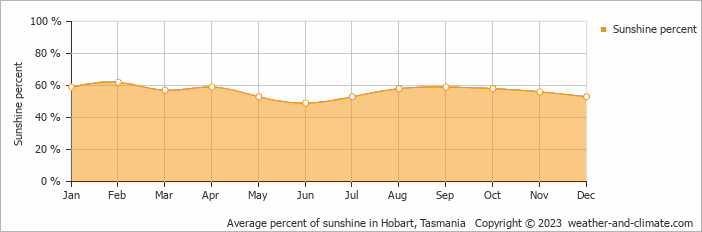
In Hobart, summer days are longer and more sunny, with daily sunshine hours peaking at 8.4 hours in January. As the darker season arrives, the brightness of the sun becomes less. June sees a soft sun for only 4.4 hours per average day.
Visit our detailed sunshine hours page for more information.
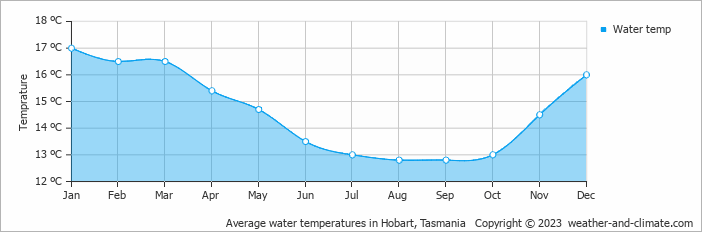
The mean water temperature over the year ranges from 13°C (55°F) in August to 17°C (63°F) in January.
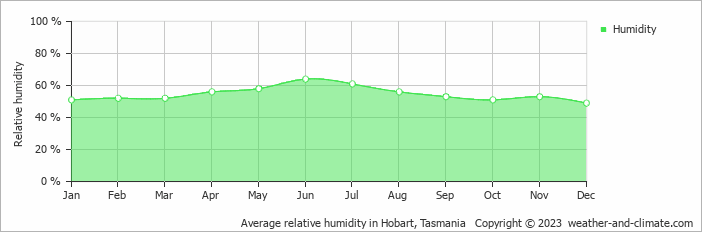
The relative humidity is moderate throughout the year in Hobart.
The city experiences its highest humidity in June, reaching 64%. In December, the humidity drops to its lowest level at 49%. What does this mean? Read our detailed page on humidity levels for further details.
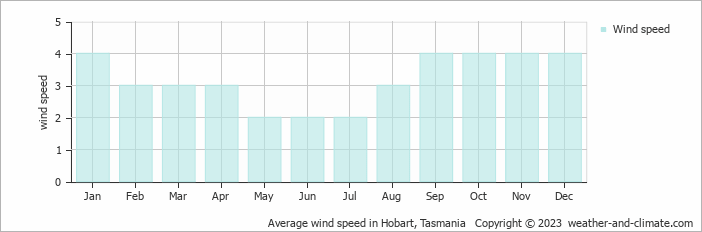
The mean wind speed varies between 2 m/s (4 knots) and 4 m/s (8 knots) throughout the year. It is lowest in May, June and July and highest during January, September, October, November and December. What does this mean?
Monthly ratings reflect general weather comfort, based on daytime temperature and rainfall. Swimming and winter conditions are highlighted separately where relevant.
January, February, March and December typically offer the most optimal weather in Hobart. In contrast, June and July tend to have less optimal conditions.
Daytime highs range from 13°C (55°F) in July to 23°C (73°F) in January. Nighttime lows range from 5°C (41°F) to 12°C (54°F).
Annual rainfall is around 611 mm (24 in). November is the wettest month with 60 mm (2.4 in), while May is the driest with 43 mm (1.7 in).
Hobart receives around 2,362 hours of sunshine per year. January is the sunniest month with 251 hours, while June is the cloudiest with just 131 hours. Overall, Hobart enjoys abundant sunshine.
Hobart is highlighted - select any city to see its climate.
Where to go in September - average daytime high across popular destinations.
Need travel inspiration? Check out our bucket list articles and be inspired.
Visit Tasmania
Tasmania, an amazing rugged and green island you want to visit once in you life. The island state south of Australia is one of the most picturesque islands in the world.
 One of the highlights of Tasmania
One of the highlights of Tasmania is the world famous Cradle Mountain-Lake St Clair National Park. You walk through rough mountains surrounded by beautiful, peaceful lakes.

 An alternative way to discover Sydney
We have made an overview of the sights in Sydney that you must see if you want to visit Sydney in an alternative way.
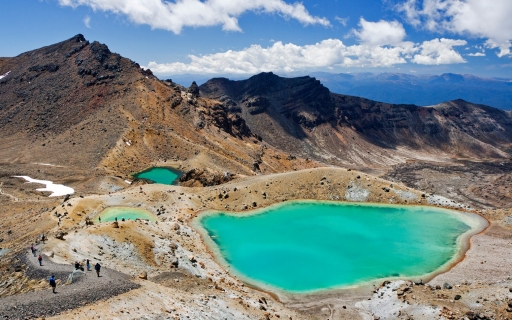
 The Tongariro Crossing in New Zealand
It is called the most beautiful walk in New Zealand, the Tongariro Crossing. The official hiking season starts late October until end of April.