















 Stay in a Mongolian Ger
Discover the magic of Mongolia, from the Gobi Desert to Khövsgöl Lake, and experience traditional nomadic life in a Ger under starlit skies.
Average temperatures, rainfall, sunshine and the best time to visit Gobi desert.
 –
–
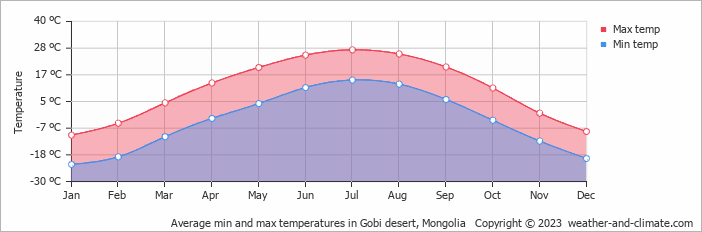
Gobi desert, Mongolia, sees big temperature differences between seasons, with July peaking at 28°C (82°F) and January dropping to -10°C (14°F).
Rain/snowfall is extremely rare, with only 180 mm (7.1 in) falling across the entire year.
Pick a month to see the average temperature, rainfall and sunshine in Gobi desert - and find the best time to visit.
Visitors to Gobi desert can expect significant temperature changes throughout the year. Average maximum daytime temperatures range from a comfortable 28°C (82°F) in July, the warmest time of the year, to a very cold -10°C (14°F) during cooler months like January.
At night, you can expect temperatures ranging from 14°C (57°F) in July to around -23°C (-9°F) during January.
Check out our detailed temperature page for more information.
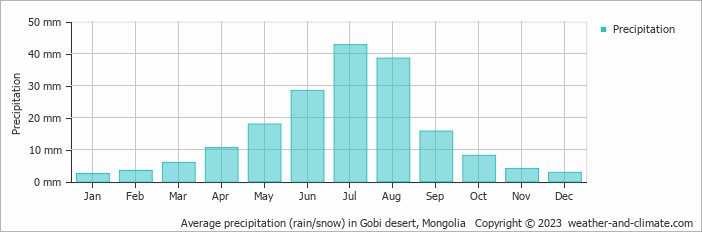
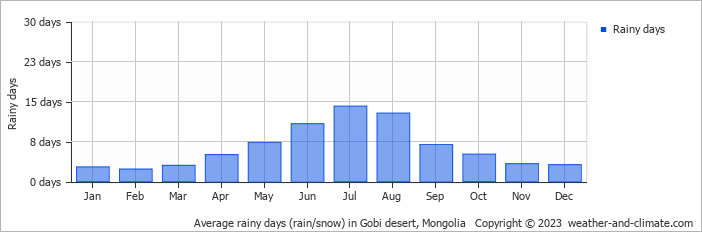
Gobi desert experiences desert-like conditions in terms of precipitation with almost no rain/snowfall, generally receiving 180 mm (7.1 in) annually. Significant seasonal changes in precipitation occur throughout the year. In the wettest month, July it receives moderate rainfall, averaging 43 mm (1.7 in) of precipitation, recorded across 14 rainy days. In contrast, the driest month January brings less snowfall, with 2.4 mm (0.1 in) over 3 snowy days. For more details, please visit our Gobi desert Precipitation page.
Monthly ratings reflect general weather comfort, based on daytime temperature and rainfall. Swimming and winter conditions are highlighted separately where relevant.
May, June, July, August and September typically offer the most optimal weather in Gobi desert. In contrast, January, February, March, November and December tend to have less optimal conditions. Gobi desert has very little rainfall for most of the year, with warm summers and very cold winters.
Daytime highs range from -10°C (14°F) in January to 28°C (82°F) in July. Nighttime lows range from -23°C (-9°F) to 14°C (57°F). Temperatures vary considerably through the year.
Annual rainfall is around 180 mm (7.1 in). July is the wettest month with 43 mm (1.7 in), while January is the driest with 2.4 mm (0.1 in).
Gobi desert is highlighted - select any city to see its climate.
Where to go in October - average daytime high across popular destinations.
Zamiin Ude14°C (57°F) Dalanzadgad12°C (54°F) Saikhan-ovoo12°C (54°F) Gobi desert11°C (52°F) Baruun Urt 10°C (50°F) Baitag9°C (48°F) Ulan Gom7°C (45°F) Ulaanbaatar7°C (45°F)
 Need travel inspiration? Check out our bucket list articles and be inspired.
Stay in a Mongolian Ger
Discover the magic of Mongolia, from the Gobi Desert to Khövsgöl Lake, and experience traditional nomadic life in a Ger under starlit skies.
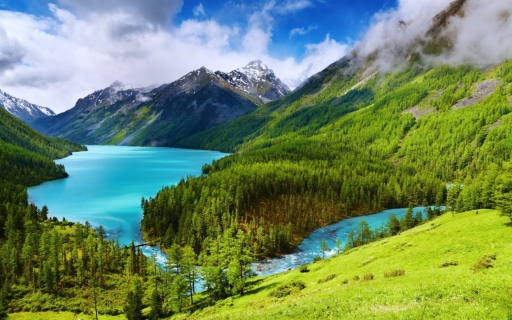
 Be amazed by the Altai mountains
The Atlai mountains are a sparsely populated area that most tourists have not yet discovered. Definitely bucket list material for the adventurous travelers among us.
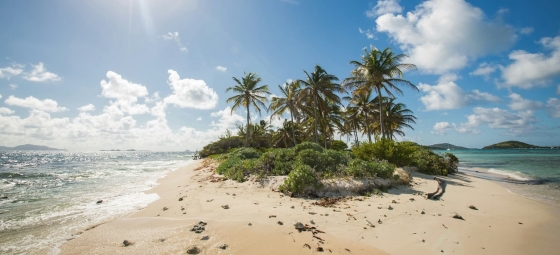
 10 Hidden gems in Asia you need to visit
Explore 10 hidden gems in Asia offering authentic experiences, from pristine beaches and remote islands to cultural treks and peaceful mountain villages.
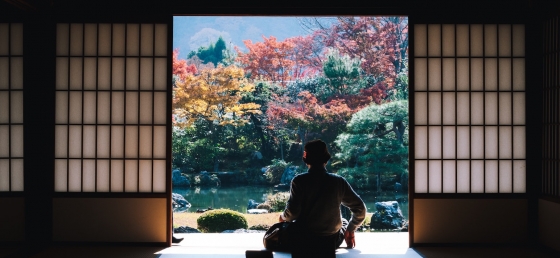
 Chase the autumn leaves in Japan
Japan is one of these cases which turns into a gold, yellow and orange fairy tale starting from September. And we can honestly say: We cannot imagine a more beautiful season to visit Japan.