
















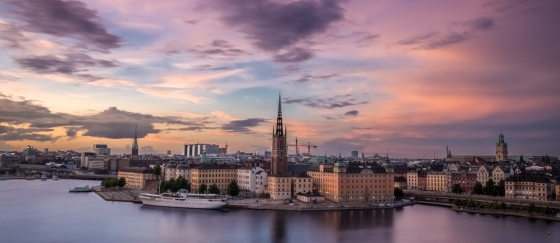
 Stockholm is one of the most beautiful cities in the world
The Swedish capital is special because of the mix of culture, nature and city. It's a city that should be on everyone's bucket list.
This page shows both the average monthly rainfall and the number of rainy days in Ubbalt, Skåne, Sweden. This average is based on long-term data collected between 1990 and 2020. Let's now guide you through the details for a complete overview.
Generally, Ubbalt receives mid-range precipitation levels, with 860 mm (34 in) annually.
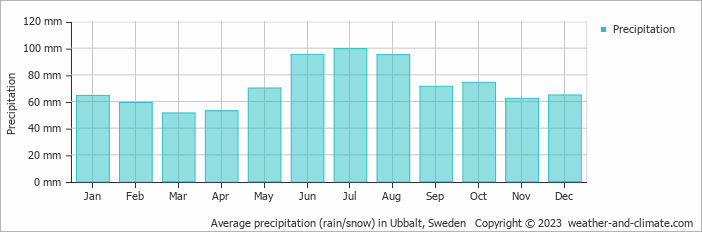
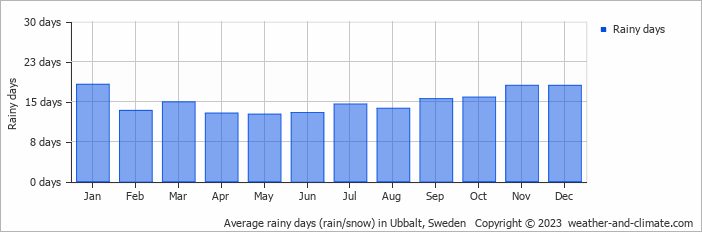
While rainfall varies throughout the year, each season offers its own charm. July brings wetter days averaging 100 mm (3.9 in) of precipitation, spread over 15 rainy days.
In contrast, March experiences a drier climate, with about 51 mm (2 in) of snow/rainfall spread across 15 snowy/rainy days.
July, the wettest month, has a maximum daytime temperature of 22°C (72°F). During the driest month March you can expect a temperature of 7°C (45°F). For more detailed insights into the city's temperatures, visit our Ubbalt Temperature page.
The map below shows the annual precipitation across Sweden. You can also select the different months in case you are interested in a specific month.
Ubbalt's average annual precipitation is 860 mm (34 in). Let's compare this to some popular worldwide tourist destinations:
In Toronto, Canada, annual precipitation averages 964 mm (38 in), with snowy winters and rainy summers.
Meanwhile, Buenos Aires, Argentina, enjoys a humid subtropical climate with 1000 mm (39 in) of annual rainfall, mostly in the summer.
In Tokyo, Japan, the average annual precipitation is 1528 mm (60 in), with significant summer rains due to typhoon season.
Bangkok, Thailand, experiences a tropical monsoon climate with 1668 mm (66 in) of annual rainfall, with the heaviest precipitation occurring during September and October.
Precipitation amounts are measured using specific gauges installed at weather stations, collecting both rain and snow and any other type of precipitation. Rainfall is measured directly in millimeters, while that from snow and ice is obtained by melting it. Automated systems often incorporate heaters to make this easier.
Information from these stations is transmitted via Wi-Fi, satellite, GPS, or telephone connections to central monitoring networks. This information is immediately updated and integrated into weather models and forecasts.
For more detailed information about Ubbalt's weather, including sunshine hours, humidity levels, and temperature data, visit our Ubbalt Climate page.
Pick a month to see the average temperature, rainfall and sunshine in Ubbalt - and find the best time to visit.
Temperature Rainfall
See the full Ubbalt climate overview or explore weather in Sweden.
Where to go in September - average daytime high across popular destinations.
Lund 18°C (64°F) Malmö19°C (66°F) Gothenburg
 18°C (64°F) Karlskrona17°C (63°F) Falkenberg18°C (64°F) Simrishamn17°C (63°F) Stockholm17°C (63°F) Visby
 17°C (63°F)
 Need travel inspiration? Check out our bucket list articles and be inspired.
Stockholm is one of the most beautiful cities in the world
The Swedish capital is special because of the mix of culture, nature and city. It's a city that should be on everyone's bucket list.
 Nordic skating in Sweden
In between the snowy hills and dense pine forests you will find an innumerable amount of lakes in Sweden, large and small ones on which you can skate wonderfully.
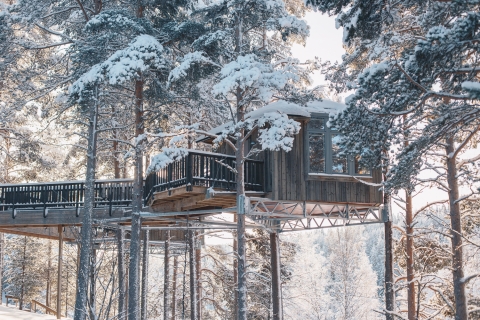 Sleep among the trees in Sweden
If you are looking for a tranquil retreat in Swedish Lapland we recommend to stay at Granó Beckasin. It has a fantastic location on the Ume river where you will experience silence and tranquility.
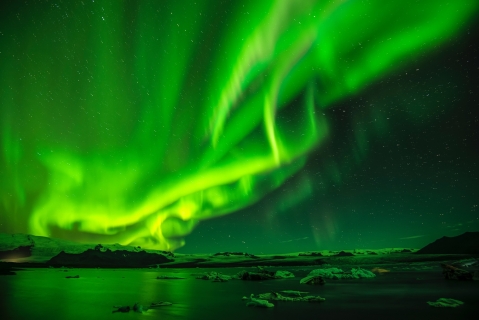
 See the northern lights
The northern lights, polar light or Aarora Borealis is a true spectacle of nature! Green, sometimes purple, red and yellow streaks of light colors the dark skies.