















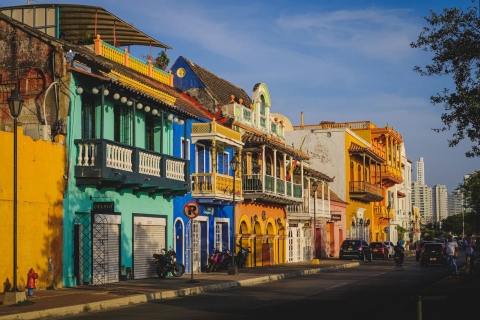
 The 10 most alternative cities in South America
Discover South America's top 10 alternative cities! From Valparaíso's vibrant streets to La Paz's high-altitude charm and Medellín's innovative spirit.
This page shows both the average monthly rainfall and the number of rainy days in San Felipe, Chile. This average is based on long-term data collected between 1990 and 2020. Now, let's break down all the details for a clearer picture.
Generally, San Felipe has a moderate amount of precipitation, averaging 509 mm (20 in) of rain/snowfall annually. However, it does experience a distinct dry season during certain months. Take a look at our detailed charts below to see the seasonal variation.
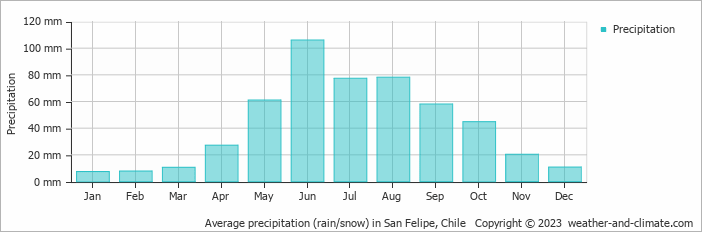
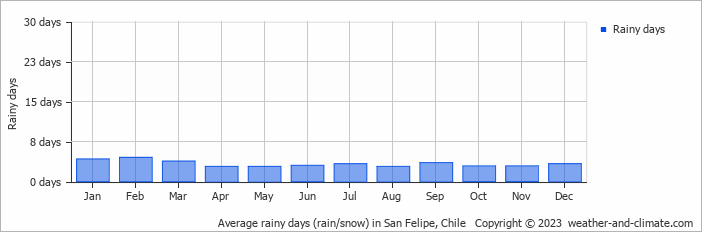
The climate in San Felipe shows significant variation throughout the year. Expect 106 mm (4.2 in) of precipitation during the wettest month June, distributed over 3 rainy days.
In contrast, January offers drier and sunnier days, with around 7.3 mm (0.3 in) of rainfall over 4 rainy days.
June, the wettest month, has a maximum daytime temperature of 16°C (61°F). During the driest month January you can expect a temperature of 29°C (84°F). For more detailed insights into the city's temperatures, visit our San Felipe Temperature page.
The map below shows the annual precipitation across Chile. You can also select the different months in case you are interested in a specific month.
San Felipe's average annual precipitation is 509 mm (20 in). Let's compare this to some popular worldwide tourist destinations:
New York City, USA, receives 1276 mm (50 in) of rainfall annually, with precipitation evenly distributed throughout the year.
Beijing, China, receives 560 mm (22 in) of annual precipitation, concentrated in the summer months.
Melbourne, Australia, has 690 mm (27 in) of rainfall annually, spread fairly evenly throughout the year.
Singapore, situated near the equator, gets 2581 mm (102 in) of rainfall annually, with no distinct dry season and consistent monthly precipitation.
Precipitation amounts are measured using specific gauges installed at weather stations, collecting both rain and snow and any other type of precipitation. Rainfall is measured directly in millimeters, while that from snow and ice is obtained by melting it. Automated systems often incorporate heaters to make this easier.
Information from these stations is transmitted via Wi-Fi, satellite, GPS, or telephone connections to central monitoring networks. This information is immediately updated and integrated into weather models and forecasts.
The proximity of a location to a large body of water can significantly affect its rainfall patterns:
For more detailed information about San Felipe's weather, including sunshine hours, humidity levels, and temperature data, visit our San Felipe Climate page.
Pick a month to see the average temperature, rainfall and sunshine in San Felipe - and find the best time to visit.
Temperature Rainfall
See the full San Felipe climate overview or explore weather in Chile.
Where to go in September - average daytime high across popular destinations.
 San Pedro de Atacama
 21°C (70°F) Hanga Roa
 21°C (70°F) La Serena19°C (66°F) Santiago18°C (64°F) Viña del Mar16°C (61°F) Concón16°C (61°F) Valparaíso15°C (59°F) Pucón
 13°C (55°F)
 Need travel inspiration? Check out our bucket list articles and be inspired.
The 10 most alternative cities in South America
Discover South America's top 10 alternative cities! From Valparaíso's vibrant streets to La Paz's high-altitude charm and Medellín's innovative spirit.
 Torres del Paine
Torres del Paine is an huge national park on the border with Argentina. It is possible to walk here along craters, high-rising mountain ridges, over glaciers and through vast majestic tundra.
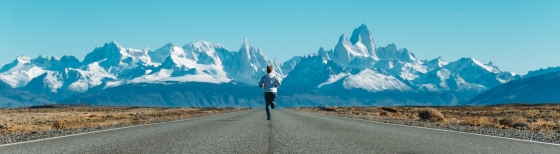 Explore Patagonia
A tour through Patagonia brings you to the end of the world. That’s why Patagonia is a bucket list destination for many. We recommend to visit Patagonia from November to early March.
 Enjoy the silence and peace in a spectacular landscape
This lodge guarantees privacy and exclusivity for those seeking to get away from mass tourism and enjoy the silence and peace in a spectacular landscape.