



















 Balloon in Cappadocia Turkey
The best view of the special landscape of Cappadocia is from the air. It is a great idea to take a balloon trip at sunrise. An experience that belongs on your bucket list.
This page shows both the average monthly rainfall and the number of rainy days in Cappadocia, Central Anatolia Region, Turkey. This average is based on long-term data collected between 1990 and 2020. Let's explore the details to provide you with a complete overview.
Cappadocia has a relatively dry climate with low precipitation, averaging 444 mm (17 in) of rain/snowfall annually. It experiences a distinct dry season during certain months. Refer to our detailed charts below to see the seasonal variation.
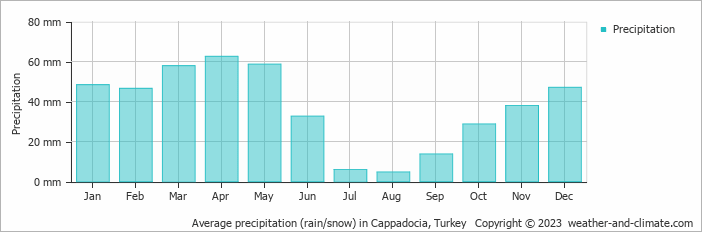
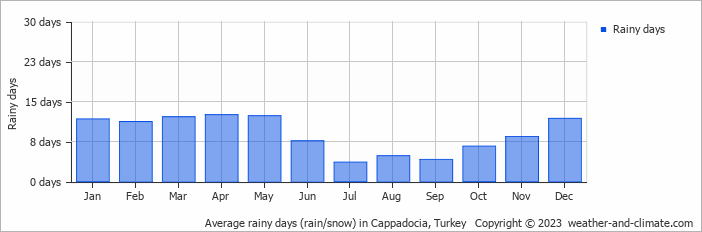
The seasons in Cappadocia, bring significant changes in precipitation. The wettest month, April, receives moderate rainfall, with an average of 63 mm (2.5 in) of precipitation. This rainfall is distributed across 13 rainy days.
In contrast, the driest month, August, experiences much less rainfall, totaling 4.7 mm (0.2 in) over 5 rainy days. These distinct seasonal differences provide diverse experiences throughout the year.April, the wettest month, has a maximum daytime temperature of 18°C (64°F). The city receives 183 hours of sunshine in this period. During the driest month August you can expect a temperature of 32°C (90°F). For more detailed insights into the city's temperatures, visit our Cappadocia Temperature page.
Average daily rainfall for each day of the month based on long-term records. 48-year average (1976-2025)
Browse day-by-day precipitation records for Cappadocia spanning 51 years. Select any month and year to see actual rainfall and snowfall recorded on each day.
The map below shows the annual precipitation across Turkey. You can also select the different months in case you are interested in a specific month.
Cappadocia's average annual precipitation is 444 mm (17 in). Let's compare this to some popular worldwide tourist destinations:
In Toronto, Canada, annual precipitation averages 964 mm (38 in), with snowy winters and rainy summers.
In Seoul, South Korea, the average annual precipitation is 1237 mm (49 in), with most rain falling during the summer monsoon season.
In Brisbane, Australia, the annual precipitation is 979 mm (39 in), making it wetter than Sydney.
Bangkok, Thailand, experiences a tropical monsoon climate with 1668 mm (66 in) of annual rainfall, with the heaviest precipitation occurring during September and October.
Precipitation amounts are measured using specific gauges installed at weather stations, collecting both rain and snow and any other type of precipitation. Rainfall is measured directly in millimeters, while that from snow and ice is obtained by melting it. Automated systems often incorporate heaters to make this easier.
Information from these stations is transmitted via Wi-Fi, satellite, GPS, or telephone connections to central monitoring networks. This information is immediately updated and integrated into weather models and forecasts.
Precipitation has a very strong role in determining the local climate and ecosystem:
For more detailed information about Cappadocia's weather, including sunshine hours, humidity levels, and temperature data, visit our Cappadocia Climate page.
Pick a month to see the average temperature, rainfall and sunshine in Cappadocia - and find the best time to visit.
Temperature Rainfall Sunshine Humidity
See the full Cappadocia climate overview or explore weather in Turkey.
Where to go in October - average daytime high across popular destinations.
Need travel inspiration? Check out our bucket list articles and be inspired.
Balloon in Cappadocia Turkey
The best view of the special landscape of Cappadocia is from the air. It is a great idea to take a balloon trip at sunrise. An experience that belongs on your bucket list.
 An idyllic and beautiful place to stay and eat near Saklikent National Park in Turkey
Serene Saklikent National Park near Fethiye, Turkey, with breathtaking gorges, tranquil restaurant, and unique experiences in nature. Perfect for a peaceful escape.
 Sailing the Turquoise Coast: Discovering Turkey's Blue Voyage
Discover the beauty of Turkey's Turquoise Coast on a sailboat adventure, exploring ancient ruins, sun-soaked beaches, and lively harbor towns.
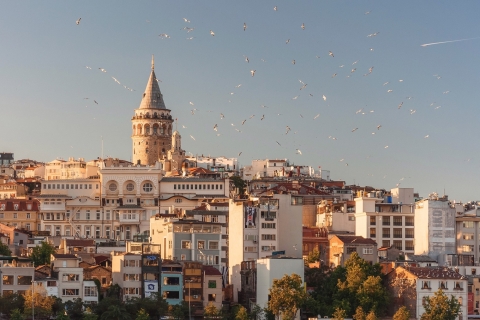 Istanbul, where East meets West
Istanbul, one of the most amazing cities in the world. It's a buzzing city and a mix of European and Asian, like a summer day in Madrid with a touch of Bangkok.