Mexicali Monthly Rainfall & Precipitation
This page shows both the average monthly rainfall and the number of rainy days in Mexicali, Baja California, Mexico. This average is based on long-term data collected between 1990 and 2020. Now, let's explore all the details to give you a full picture.
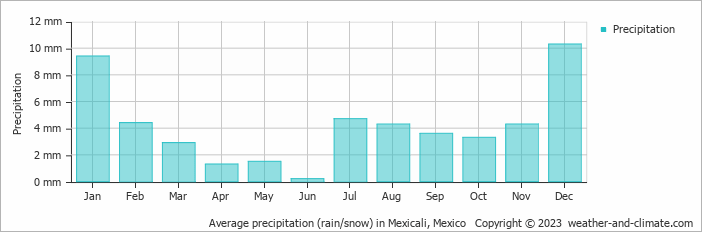
Mexicali sits in an arid zone with minimal moisture, averaging 50 mm (2 in) of rainfall per year.
Monthly Rainfall & Rainy Days
Monthly Precipitation Levels
The average number of days each month with precipitation (> 0.2 mm (0.01 in))
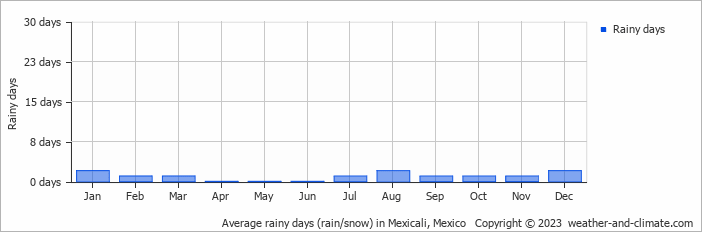
Precipitation levels in Mexicali remain relatively steady throughout the year. December has the most rain, with 10 mm (0.4 in) over 2 days. In June, this drops slightly to 0.2 mm (0.01 in), making the city's climate fairly predictable.
December, the wettest month, has a maximum daytime temperature of 20°C (68°F). During the driest month June you can expect a temperature of 40°C (104°F). For more detailed insights into the city's temperatures, visit our Mexicali Temperature page.
Annual Rainfall in Mexico: City Comparison
The map below shows the annual precipitation across Mexico. You can also select the different months in case you are interested in a specific month.
Mexicali vs World: Rainfall Compared
Mexicali's average annual precipitation is 50 mm (2 in). Let's compare this to some popular worldwide tourist destinations:
In Lisbon, Portugal, the average annual precipitation is 774 mm (30 in), characterized by wet winters and dry summers typical of the Mediterranean climate.
Osaka, Japan, experiences 1507 mm (59 in) of rainfall annually, spread across the year with wetter summers.
In Brisbane, Australia, the annual precipitation is 979 mm (39 in), making it wetter than Sydney.
Kuala Lumpur, Malaysia, receives 2529 mm (100 in) of annual rainfall, characteristic of its equatorial tropical rainforest climate, with consistent rainfall throughout the year and peak months during March and November.
Precipitation amounts are measured using specific gauges installed at weather stations, collecting both rain and snow and any other type of precipitation. Rainfall is measured directly in millimeters, while that from snow and ice is obtained by melting it. Automated systems often incorporate heaters to make this easier.
Information from these stations is transmitted via Wi-Fi, satellite, GPS, or telephone connections to central monitoring networks. This information is immediately updated and integrated into weather models and forecasts.
- The U.S. has a significant number of thunderstorms every year, with over 14.6 million taking place across the world annually.
- Approximately 70% of lightning bolts strike land rather than oceans.
- A storm named John was the longest-lasting Pacific tropical storm, continuing for 31 days. As it crossed the dateline twice, it changed status from a hurricane to a typhoon and back to a hurricane.
For more detailed information about Mexicali's weather, including sunshine hours, humidity levels, and temperature data, visit our Mexicali Climate page.
Mexicali Weather by Month
Pick a month to see the average temperature, rainfall and sunshine in Mexicali - and find the best time to visit.
Mexicali 3-Day Forecast
Temperature Rainfall
See the full Mexicali climate overview or explore weather in Mexico.
Popular this month
Where to go in August - average daytime high across popular destinations.
 Puerto Peñasco
 35°C (95°F) Los Cabos34°C (93°F) Playa del Carmen
 31°C (88°F) Tulum31°C (88°F) Cancún
 31°C (88°F) Puerto Vallarta
 30°C (86°F) San Miguel de Allende28°C (82°F) Mexico City23°C (73°F)















Bucket list
Need travel inspiration? Check out our bucket list articles and be inspired.
Explore the Majestic Copper Canyons of Mexico
Explore the vast Copper Canyons in Chihuahua, Mexico—larger than the Grand Canyon. Discover scenic train rides, hikes, and the Tarahumara people.
These are the most beautiful Mayan ruins and Mayan temples in Mexico
Mexico is a destination where you can immerse yourself in ancient cultures and civilizations. In this article we have listed our favorite Mayan ruins.
Tips, to-do's and nicest restaurants in Mexico City
Mexico City, one of the most famous and notorious cities of the world. The best time to visit is between March and May, but it can be visited year round.
Zihuatanejo: A Pacific paradise with beautiful beaches
Zihuatanejo has some of Mexico's top beaches. Unlike other off-the-beaten-path destinations in Mexico, Zihua is very accessible and sustainable.