















 Warm Sea Without Extreme Heat: 8 Beach Destinations With Comfortable Weather
Love warm seawater but not extreme heat? Compare eight beach destinations where the sea stays warm while daytime temperatures remain comfortable.
Average temperatures, rainfall, sunshine and the best time to visit Puerto Peñasco.
 –
–
Puerto Peñasco, Sonora, Mexico, often referred to as "Rocky Point," is a rapidly growing coastal destination where the desert meets the sea. Popular with both Mexican and U.S. travelers, it offers sun-soaked beaches and a relaxed vibe just a short drive from the Arizona border. The temperature in Puerto Peñasco can vary quite a bit throughout the year, ranging from very warm in the summer to pleasantly mild in the cooler months. The city has a dry climate with very little rainfall. Let’s take a closer look at the climate to help you plan your visit.
Pick a month to see the average temperature, rainfall and sunshine in Puerto Peñasco - and find the best time to visit.
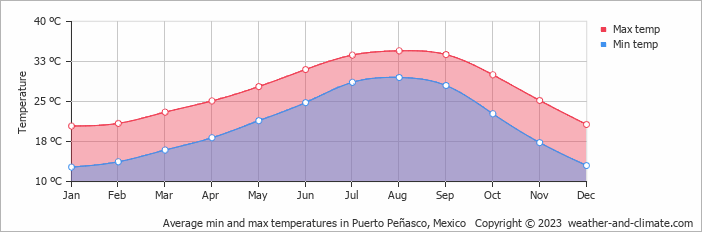
Visitors to Puerto Peñasco can expect significant temperature changes throughout the year. On average, daytime temperatures range from a very warm 35°C (95°F) in August to a pleasant 20°C (68°F) in January.
Nighttime temperatures range from 30°C (86°F) in August to 13°C (55°F) in January.
Check out our detailed temperature page for more information.
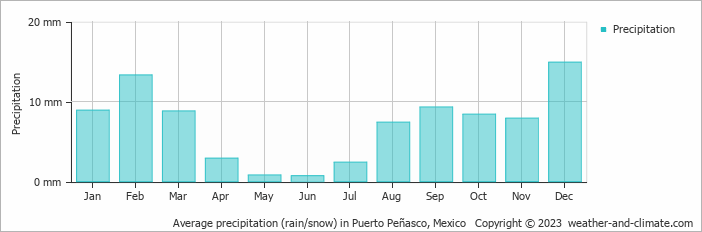
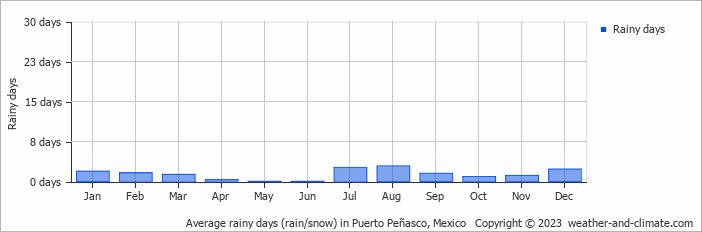
Puerto Peñasco experiences desert-like conditions in terms of precipitation with almost no rainfall, generally receiving 86 mm (3.4 in) annually. The wettest period in Puerto Peñasco occurs in December, which receives around 15 mm (0.6 in) of precipitation. During the driest month, June, Puerto Peñasco experiences almost no rainfall, totaling 0.7 mm (0.03 in). The consistent precipitation levels throughout the year contribute to a relatively stable climate. For more details, please visit our Puerto Peñasco Precipitation page.
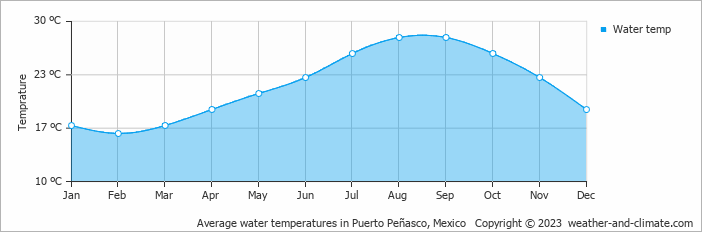
The mean water temperature over the year ranges from 16°C (61°F) in February to 28°C (82°F) in August.
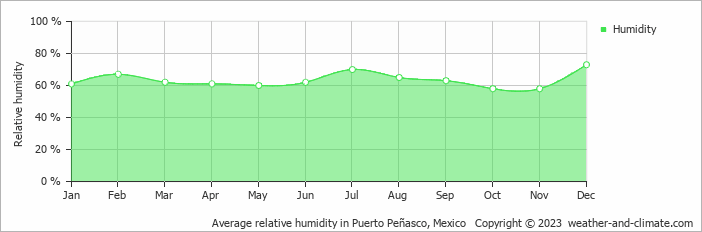
The relative humidity is high throughout the year in Puerto Peñasco.
The city experiences its highest humidity in December, reaching 73%. In October, the humidity drops to its lowest level at 58%. What does this mean? Read our detailed page on humidity levels for further details.
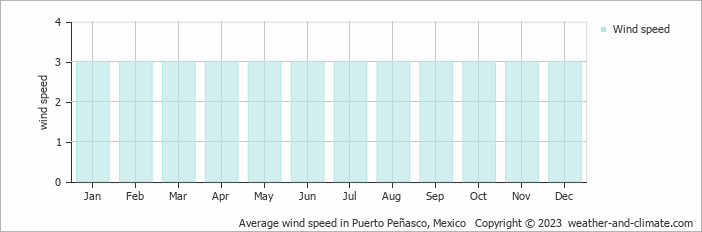
The average wind speed over the year ranges from 3 m/s (6 knots) to 3 m/s (6 knots). It is lower in January, February, March, April, May, June, July, August, September, October, November and December and higher in January, February, March, April, May, June, July, August, September, October, November and December. What does this mean?
Monthly ratings reflect general weather comfort, based on daytime temperature and rainfall. Swimming and winter conditions are highlighted separately where relevant.
January, February, March, April, May, November and December typically offer the most optimal weather in Puerto Peñasco. In contrast, July, August and September tend to have less optimal conditions. Puerto Peñasco has very little rainfall year-round, with very warm summers and pleasant winters.
Daytime highs range from 20°C (68°F) in January to 35°C (95°F) in August. Nighttime lows range from 13°C (55°F) to 30°C (86°F). Temperatures vary considerably through the year.
Annual rainfall is around 86 mm (3.4 in). December is the wettest month with 15 mm (0.6 in), while June is the driest with 0.7 mm (0.03 in).
Puerto Peñasco is highlighted - select any city to see its climate.
Where to go in September - average daytime high across popular destinations.
 Puerto Peñasco34°C (93°F) Los Cabos
 32°C (90°F) Tulum31°C (88°F) Cancún30°C (86°F) Playa del Carmen31°C (88°F) Puerto Vallarta29°C (84°F) San Miguel de Allende
 27°C (81°F) Mexico City23°C (73°F)
 Need travel inspiration? Check out our bucket list articles and be inspired.
Warm Sea Without Extreme Heat: 8 Beach Destinations With Comfortable Weather
Love warm seawater but not extreme heat? Compare eight beach destinations where the sea stays warm while daytime temperatures remain comfortable.

 Best Spring Break Destinations for Great Weather and Fewer Crowds
Skip crowded spring break resorts. Compare March weather and travel style in Puerto Escondido, San Juan del Sur, Roatán, Caye Caulker and Curaçao.
 Where to Travel in July and August: Mexico, Thailand, Indonesia or Somewhere Else?
Compare July and August weather in Mexico, Thailand, Indonesia, Zanzibar and Sri Lanka, using historical climate data for temperature, rainfall and sunshine.
 Explore the Majestic Copper Canyons of Mexico
Explore the vast Copper Canyons in Chihuahua, Mexico—larger than the Grand Canyon. Discover scenic train rides, hikes, and the Tarahumara people.