Giurdignano Sunshine Hours by Month
When exploring climate, sunlight hours tell an important story. This page shows the total number of hours of direct sunlight per month and the average hours per day in Giurdignano, Puglia (Apulia), Italy. Long-term data from 1990 to 2020 was used to calculate these averages.
Monthly hours of sunshine
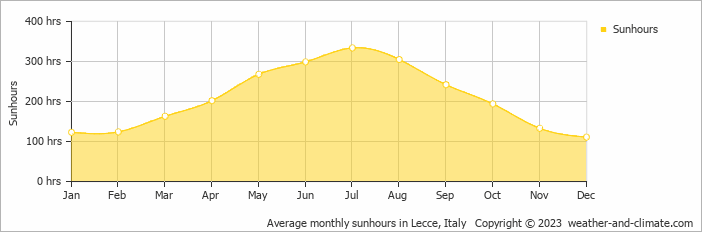
If you're visiting Giurdignano, timing is key. In July, you can enjoy up to 334 hours of sunshine, while the shorter days of December provide just 111 hours. The total annual amount of sun is 2498 hours.
Daily hours of sunshine
Seasonal changes in sunshine hours are quite obvious in Giurdignano. While July receives considerable daily sunshine with up to 11.1 hours, December marks the darkest time of the year, where sunshine is scarce with only 3.7 hours of sunlight per day.
Giurdignano vs Major Cities: Sunshine Compared
Giurdignano enjoys an average of 2498 hours of sunshine annually. Let’s compare this with some popular tourist destinations:
In Barcelona, Spain, there are 2530 hours of sunshine annually and is a city that can be visited year-round.
Manchester, UK, experiences just around 1420 hours of sunshine annually.
Oslo, Norway, receives approximately 1690 hours of sunshine annually.
Melbourne, Australia, has 2380 hours of sunshine annually, with its famous “four seasons in a day” weather pattern.
Related Climate Data for Giurdignano
November, Giurdignano’s wettest month, receives 19 mm (0.7 in) of rainfall and has a maximum daytime temperature of 19°C (66°F). During the driest month July you can expect a temperature of 31°C (88°F).
For more detailed insights into the city’s temperatures, check out our Temperature page. To explore more about precipitation patterns, visit our Giurdignano Precipitation page.