














 Warm Sea Without Extreme Heat: 8 Beach Destinations With Comfortable Weather
Love warm seawater but not extreme heat? Compare eight beach destinations where the sea stays warm while daytime temperatures remain comfortable.
Average temperatures, rainfall, sunshine and the best time to visit San Francisco.
 –
–
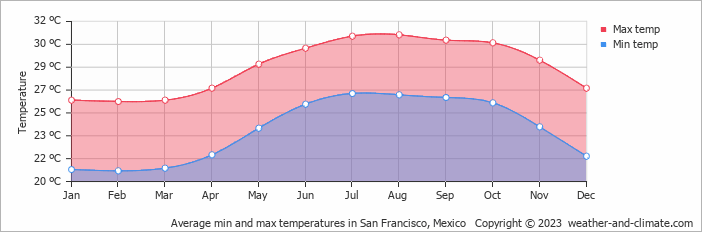
With consistently stable weather, San Francisco, Riviera Nayarit, Mexico, sees little seasonal temperature change. Daytime highs average 29°C (84°F), ranging from 31°C (88°F) in August to 26°C (79°F) in February.
Rainfall is high, totalling around 1002 mm (39 in) per year. September is the wettest month and April the driest. The city also experiences a distinct dry season from November to May.
Pick a month to see the average temperature, rainfall and sunshine in San Francisco - and find the best time to visit.
The climate in San Francisco remains fairly constant, offering comfortable temperatures throughout the year. Average maximum daytime temperatures range from a very warm 31°C (88°F) in August, the warmest time of the year, to a comfortable 26°C (79°F) during cooler months like February.
At night, you can expect temperatures ranging from 27°C (81°F) in August to around 21°C (70°F) during February.
Check out our detailed temperature page for more information.
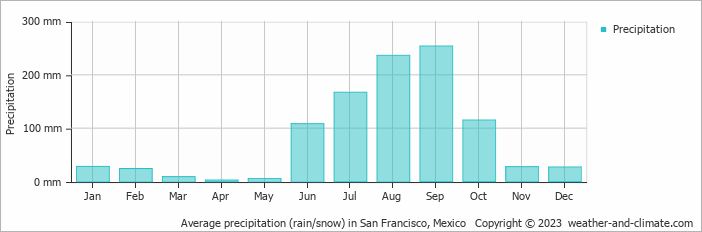
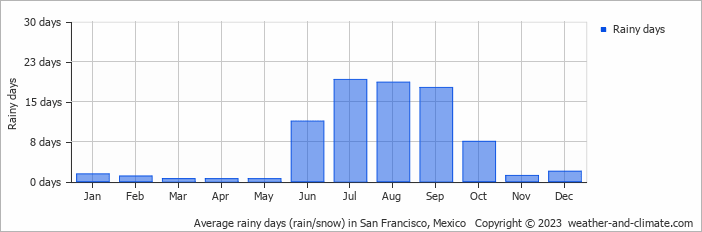
San Francisco is known for its substantial rainfall, with annual precipitation reaching 1002 mm (39 in). Significant seasonal changes in precipitation occur throughout the year. In the wettest month, September it receives heavy rainfall, averaging 254 mm (10 in) of precipitation, recorded across 18 rainy days. In contrast, the driest month April brings less rainfall, with 2.4 mm (0.1 in) over a single rainy day. For more details, please visit our San Francisco Precipitation page.
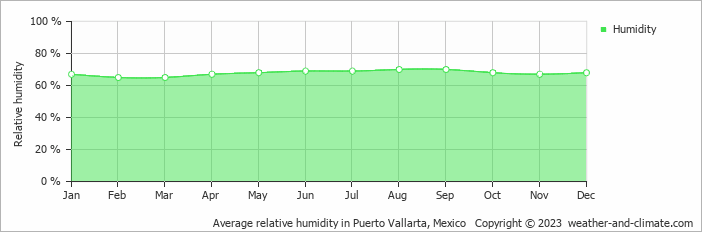
The relative humidity is high throughout the year in San Francisco.
The city experiences its highest humidity in August, reaching 70%. In February, the humidity drops to its lowest level at 65%. What does this mean? Read our detailed page on humidity levels for further details.
Monthly ratings reflect general weather comfort, based on daytime temperature and rainfall. Swimming and winter conditions are highlighted separately where relevant.
January, February, March, April, May, November and December typically offer the most optimal weather in San Francisco. In contrast, August and September tend to have less optimal conditions. San Francisco has a distinct dry season from November to May.
Daytime highs range from 26°C (79°F) in February to 31°C (88°F) in August. Nighttime lows range from 21°C (70°F) to 27°C (81°F). Temperatures stay relatively stable year-round.
Annual rainfall is around 1002 mm (39 in). September is the wettest month with 254 mm (10 in), while April is the driest with 2.4 mm (0.1 in).
San Francisco is highlighted - select any city to see its climate.
Where to go in October - average daytime high across popular destinations.
 Los Cabos32°C (90°F) Puerto Peñasco30°C (86°F) Tulum
 30°C (86°F) Puerto Vallarta29°C (84°F) Cancún30°C (86°F) Playa del Carmen30°C (86°F) Mexico City
 22°C (72°F)
 Need travel inspiration? Check out our bucket list articles and be inspired.
Warm Sea Without Extreme Heat: 8 Beach Destinations With Comfortable Weather
Love warm seawater but not extreme heat? Compare eight beach destinations where the sea stays warm while daytime temperatures remain comfortable.

 Best Spring Break Destinations for Great Weather and Fewer Crowds
Skip crowded spring break resorts. Compare March weather and travel style in Puerto Escondido, San Juan del Sur, Roatán, Caye Caulker and Curaçao.

 Warm Days, Cool Nights: 8 Destinations With the Perfect Day-Night Temperature
Prefer warm sunny days but cool evenings? Compare eight destinations with daytime temperatures of around 25–30°C, cooler nights, low rainfall and plenty of sunshine.

 Where to Travel in July and August: Mexico, Thailand, Indonesia or Somewhere Else?
Compare July and August weather in Mexico, Thailand, Indonesia, Zanzibar and Sri Lanka, using historical climate data for temperature, rainfall and sunshine.