















 10 Hidden gems in Asia you need to visit
Explore 10 hidden gems in Asia offering authentic experiences, from pristine beaches and remote islands to cultural treks and peaceful mountain villages.
Average temperatures, rainfall, sunshine and the best time to visit Nāmche Bāzār.
 –
–
Namche Bazaar, in Nepal, experiences a subarctic highland climate with significant seasonal temperature variation due to its high Himalayan elevation at 3,440 meters (11,286 ft). The area has cold summers and very cold winters and receives substantial precipitation throughout the year, primarily as rainfall during the monsoon season from June to September and as snowfall during the winter months.
This famous mountain town attracts tourists as the gateway to Mount Everest and the main trading hub of the Khumbu region. It's also known for hiring experienced Sherpa guides and spectacular panoramic views of Himalayan peaks. Let's now guide you through the climate details for a complete overview on the best time to visit.
Pick a month to see the average temperature, rainfall and sunshine in Nāmche Bāzār - and find the best time to visit.
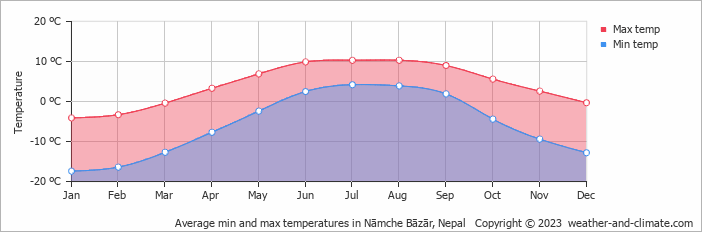
Depending on the time of the year, temperatures range from chilly to very cold in Nāmche Bāzār. Typically, average maximum daytime temperatures range from a chilly 10°C (50°F) in July to a very cold -4°C (25°F) in the coolest month, January.
Nights vary from 4°C (39°F) in July to around -17°C (1°F) during the colder months.
Check out our detailed temperature page for more information.
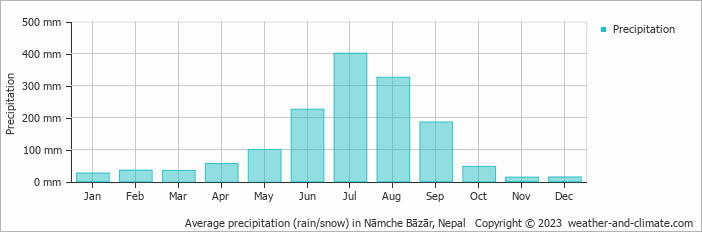
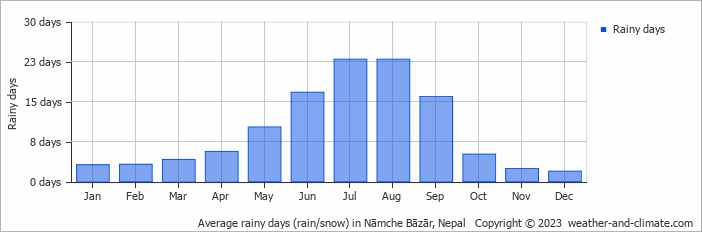
Nāmche Bāzār has a relatively rain/snowy climate with high precipitation levels, averaging 1459 mm (57 in) of rain/snowfall annually. The climate in Nāmche Bāzār shows significant variation throughout the year. Expect heavy rainfall in July, the wettest month, with an average of 400 mm (16 in) of precipitation over 23 rainy days.
In contrast, the driest month November offers drier and sunnier days, with around 13 mm (0.5 in) of snowfall over 2 snowy days. For more details, please visit our Nāmche Bāzār Precipitation page.
Monthly ratings reflect general weather comfort, based on daytime temperature and rainfall. Swimming and winter conditions are highlighted separately where relevant.
Nāmche Bāzār has distinct dry (November to March) and wet (June to September) seasons, with cold summers and very cold winters.
Daytime highs range from -4°C (25°F) in January to 10°C (50°F) in July. Nighttime lows range from -17°C (1°F) to 4°C (39°F). Temperatures vary considerably through the year.
Annual rainfall is around 1459 mm (57 in). July is the wettest month with 400 mm (16 in), while November is the driest with 13 mm (0.5 in).
Nāmche Bāzār is highlighted - select any city to see its climate.
Where to go in September - average daytime high across popular destinations.
 Rummindei
 33°C (91°F) Sauraha32°C (90°F) Pokhara30°C (86°F) Dhulikhel26°C (79°F) Bhaktapur26°C (79°F) Kathmandu26°C (79°F) Lalitpur26°C (79°F) Nagarkot26°C (79°F)
 Need travel inspiration? Check out our bucket list articles and be inspired.
10 Hidden gems in Asia you need to visit
Explore 10 hidden gems in Asia offering authentic experiences, from pristine beaches and remote islands to cultural treks and peaceful mountain villages.
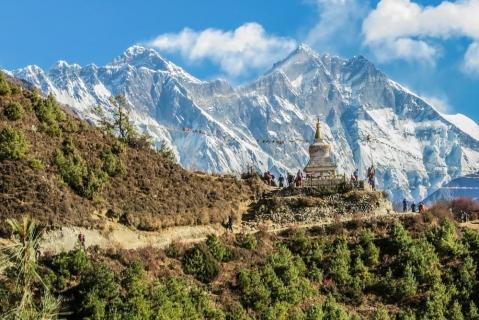 A pilgrimage through Nepal: from the Himalayas to the Heart
Go on a spiritual journey through Nepal, discovering its rich heritage, breathtaking Himalayas, sacred monasteries, and vibrant culture.
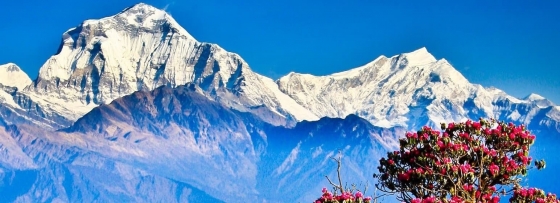 Jaljale Himal: Nepal’s Untouched Trekking Paradise
Explore Jaljale Himal in eastern Nepal, offering remote trekking, stunning peaks, and rich culture. Best time: October-December and February-March.
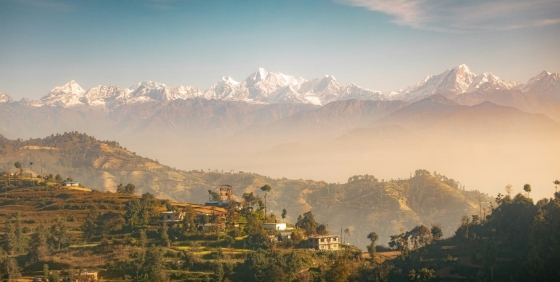 Nepal in November: Kathmandu, Pokhara or Chitwan?
Compare Nepal weather in November for Kathmandu, Pokhara, Sauraha, Bhaktapur and the mountains to plan a dry-season trip.