Port Saint Johnʼs Monthly Rainfall & Precipitation
This page shows both the average monthly rainfall and the number of rainy days in Port Saint Johnʼs, Eastern Cape, South Africa. These averages rely on historical data collected over 30 years, from 1990 to 2020. Now, let's break down all the details for a clearer picture.
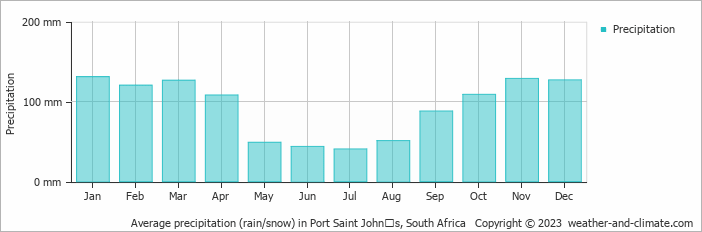
Port Saint Johnʼs has a notably wet climate with abundant precipitation, recording 1121 mm (44 in) of rainfall per year.
Monthly Rainfall & Rainy Days
Monthly Precipitation Levels
The average number of days each month with precipitation (> 0.2 mm (0.01 in))
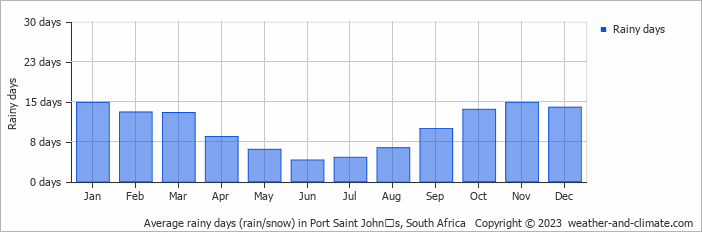
Significant seasonal changes in precipitation occur throughout the year. During the wettest month, January receives substantial rainfall, averaging 131 mm (5.2 in) of precipitation, recorded across 15 rainy days.
In contrast, the driest month, July brings less rainfall, with 41 mm (1.6 in) over 5 rainy days.
January, the wettest month, has a maximum daytime temperature of 27°C (81°F). During the driest month July you can expect a temperature of 23°C (73°F). For more detailed insights into the city's temperatures, visit our Port Saint Johnʼs Temperature page.
Annual Rainfall in South Africa: City Comparison
The map below shows the annual precipitation across South Africa. You can also select the different months in case you are interested in a specific month.
Port Saint Johnʼs vs World: Rainfall Compared
Port Saint Johnʼs's average annual precipitation is 1121 mm (44 in). Let's compare this to some popular worldwide tourist destinations:
New York City, USA, receives 1276 mm (50 in) of rainfall annually, with precipitation evenly distributed throughout the year.
Beijing, China, receives 560 mm (22 in) of annual precipitation, concentrated in the summer months.
In Brisbane, Australia, the annual precipitation is 979 mm (39 in), making it wetter than Sydney.
Ho Chi Minh City, Vietnam, receives 1955 mm (77 in) of annual rainfall, with a pronounced wet season from May to November, typical of its tropical monsoon climate.
Precipitation amounts are measured using specific gauges installed at weather stations, collecting both rain and snow and any other type of precipitation. Rainfall is measured directly in millimeters, while that from snow and ice is obtained by melting it. Automated systems often incorporate heaters to make this easier.
Information from these stations is transmitted via Wi-Fi, satellite, GPS, or telephone connections to central monitoring networks. This information is immediately updated and integrated into weather models and forecasts.
- Mawsynram in India is noted as being the wettest place on earth, with over 11 meters (36 feet) of rain falling every year.
- In contrast, Antofagasta in Chile is among the driest places on the planet, getting less than 0.1mm (0.004 inches) per year, with some years recording virtually no rainfall.
- Nearly 1,650 thunderstorm cells are estimated over the planet at any given time.
For more detailed information about Port Saint Johnʼs's weather, including sunshine hours, humidity levels, and temperature data, visit our Port Saint Johnʼs Climate page.
Port Saint Johnʼs Weather by Month
Pick a month to see the average temperature, rainfall and sunshine in Port Saint Johnʼs - and find the best time to visit.


Port Saint Johnʼs 3-Day Forecast
Temperature Rainfall Humidity
See the full Port Saint Johnʼs climate overview or explore weather in South Africa.
Popular this month
Where to go in September - average daytime high across popular destinations.

















Bucket list
Need travel inspiration? Check out our bucket list articles and be inspired.
 Visit Kruger Park in South Africa
Are you going to South Africa, then you cannot skip the Kruger Park. The Kruger Park is one of the most beautiful and largest safari parks in the world.
One of South Africa's most spectacular private game reserves
Sabi Sand Game Reserve is one of South Africa's most spectacular private game reserves. The chance that you see the entire Big Five is high in winter (June - August).
Stay in the world's largest open-air gallery
Vast mountains, beautiful nature, tranquility and the possibility of hiking and seeing fascinating rock paintings. This can all be experienced at the Cederberg Mountains.
Kwazulu Natal
Countless beautiful landscapes, a colorful collection of cultures, wildlife parks, busy and deserted beaches, lively cities, small villages and a subtropical climate.