















 The 10 most alternative cities in South America
Discover South America's top 10 alternative cities! From Valparaíso's vibrant streets to La Paz's high-altitude charm and Medellín's innovative spirit.
This page shows both the average monthly rainfall and the number of rainy days in Oruro, Bolivia. The numbers reflect climate data gathered over a 30-year period, from 1990 to 2020. Now, let's break down all the details for a clearer picture.
On average, Oruro receives a reasonable amount of rain/snowfall, with an annual precipitation of 637 mm (25 in). Despite this overall moderate level, the city experiences distinct dry season during certain months throughout the year, as illustrated in the precipitation charts below.
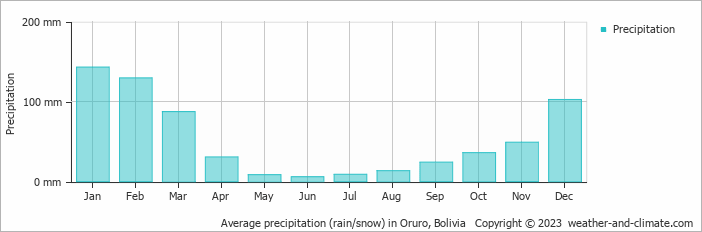
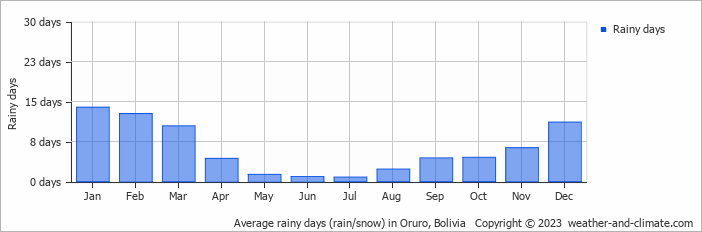
Significant seasonal changes in precipitation occur throughout the year. During the wettest month, January receives substantial rainfall, averaging 143 mm (5.6 in) of precipitation, recorded across 14 rainy days.
In contrast, the driest month, June brings less rainfall, with 5.7 mm (0.2 in) over a single rainy day.
January, the wettest month, has a maximum daytime temperature of 17°C (63°F). During the driest month June you can expect a temperature of 16°C (61°F). For more detailed insights into the city's temperatures, visit our Oruro Temperature page.
Average daily rainfall for each day of the month based on long-term records. 48-year average (1976-2025)
Browse day-by-day precipitation records for Oruro spanning 51 years. Select any month and year to see actual rainfall and snowfall recorded on each day.
The map below shows the annual precipitation across Bolivia. You can also select the different months in case you are interested in a specific month.
Oruro's average annual precipitation is 637 mm (25 in). Let's compare this to some popular worldwide tourist destinations:
In Barcelona, Spain, the average annual precipitation is 644 mm (25 in), evenly distributed across the year with no extreme wet or dry seasons.
In Seoul, South Korea, the average annual precipitation is 1237 mm (49 in), with most rain falling during the summer monsoon season.
Perth, Australia, receives 565 mm (22 in) of rainfall annually, mostly during the winter months.
Singapore, situated near the equator, gets 2581 mm (102 in) of rainfall annually, with no distinct dry season and consistent monthly precipitation.
Precipitation amounts are measured using specific gauges installed at weather stations, collecting both rain and snow and any other type of precipitation. Rainfall is measured directly in millimeters, while that from snow and ice is obtained by melting it. Automated systems often incorporate heaters to make this easier.
Information from these stations is transmitted via Wi-Fi, satellite, GPS, or telephone connections to central monitoring networks. This information is immediately updated and integrated into weather models and forecasts.
Precipitation has a very strong role in determining the local climate and ecosystem:
For more detailed information about Oruro's weather, including sunshine hours, humidity levels, and temperature data, visit our Oruro Climate page.
Pick a month to see the average temperature, rainfall and sunshine in Oruro - and find the best time to visit.
Temperature Rainfall
See the full Oruro climate overview or explore weather in Bolivia.
Where to go in September - average daytime high across popular destinations.
 Santa Cruz de la Sierra
 31°C (88°F) Sucre23°C (73°F) Tarija21°C (70°F) Cochabamba19°C (66°F) Potosí18°C (64°F) Uyuni17°C (63°F) La Paz
 15°C (59°F) Copacabana14°C (57°F)
 Need travel inspiration? Check out our bucket list articles and be inspired.
The 10 most alternative cities in South America
Discover South America's top 10 alternative cities! From Valparaíso's vibrant streets to La Paz's high-altitude charm and Medellín's innovative spirit.
 The best place in Bolivia to spot a jaguar
Bolivia is a beautiful country for spotting animals. The chance that you will see a jaguar is very likely if you go to the right places.
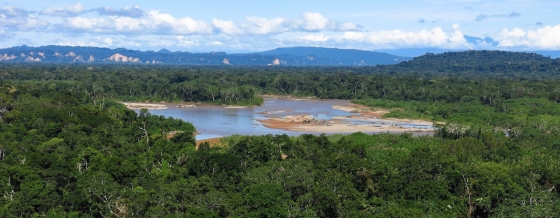 Madidi National Park: a must-visit for nature lovers
Explore Bolivia's biodiverse Madidi National Park, with untouched wilderness from snow-capped peaks to Amazonian rainforest.
 The Witches' Market of La Paz
Discover the Witches' Market in La Paz, where Andean magic meets tradition. Explore mystical rituals, herbal remedies, and sacred offerings to Pachamama.