













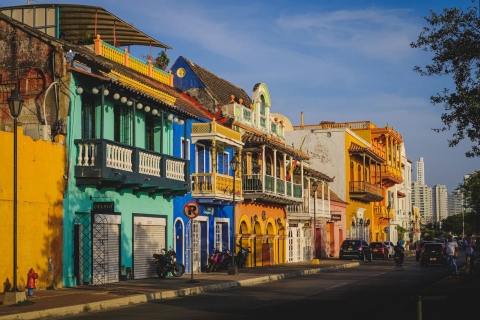
 The 10 most alternative cities in South America
Discover South America's top 10 alternative cities! From Valparaíso's vibrant streets to La Paz's high-altitude charm and Medellín's innovative spirit.
This page shows both the average monthly rainfall and the number of rainy days in Ilha de Boipeba, Bahia, Brazil. This average is based on long-term data collected between 1990 and 2020. Let's now guide you through the details for a complete overview.
Ilha de Boipeba has a notably wet climate with abundant precipitation, recording 1475 mm (58 in) of rainfall per year.
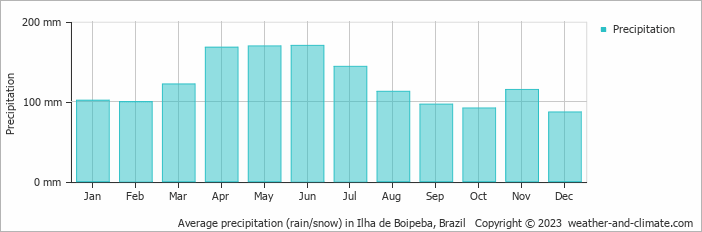
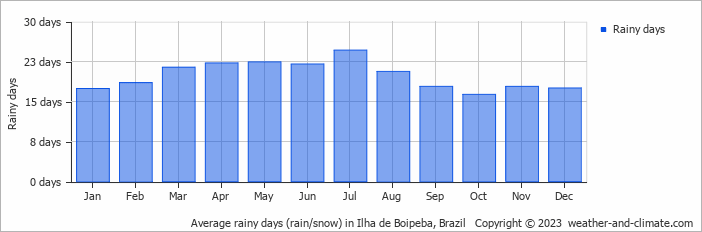
While rainfall varies throughout the year, each season offers its own charm. June brings wetter days averaging 170 mm (6.7 in) of precipitation, spread over 22 rainy days.
In contrast, December experiences a drier climate, with about 87 mm (3.4 in) of rainfall spread across 18 rainy days.
June, the wettest month, has a maximum daytime temperature of 27°C (81°F). During the driest month December you can expect a temperature of 29°C (84°F). For more detailed insights into the city's temperatures, visit our Ilha de Boipeba Temperature page.
The map below shows the annual precipitation across Brazil. You can also select the different months in case you are interested in a specific month.
Ilha de Boipeba's average annual precipitation is 1475 mm (58 in). Let's compare this to some popular worldwide tourist destinations:
Athens, Greece, receives an average annual precipitation of 400 mm (16 in), making it one of the drier Mediterranean climates with rainfall mostly in winter.
In Seoul, South Korea, the average annual precipitation is 1237 mm (49 in), with most rain falling during the summer monsoon season.
Melbourne, Australia, has 690 mm (27 in) of rainfall annually, spread fairly evenly throughout the year.
Bangkok, Thailand, experiences a tropical monsoon climate with 1668 mm (66 in) of annual rainfall, with the heaviest precipitation occurring during September and October.
Precipitation amounts are measured using specific gauges installed at weather stations, collecting both rain and snow and any other type of precipitation. Rainfall is measured directly in millimeters, while that from snow and ice is obtained by melting it. Automated systems often incorporate heaters to make this easier.
Information from these stations is transmitted via Wi-Fi, satellite, GPS, or telephone connections to central monitoring networks. This information is immediately updated and integrated into weather models and forecasts.
The proximity of a location to a large body of water can significantly affect its rainfall patterns:
For more detailed information about Ilha de Boipeba's weather, including sunshine hours, humidity levels, and temperature data, visit our Ilha de Boipeba Climate page.
Pick a month to see the average temperature, rainfall and sunshine in Ilha de Boipeba - and find the best time to visit.
Temperature Rainfall
See the full Ilha de Boipeba climate overview or explore weather in Brazil.
Where to go in October - average daytime high across popular destinations.
 Fortaleza
 31°C (88°F) Rio de Janeiro
 28°C (82°F) Salvador
 28°C (82°F) Sao Paulo27°C (81°F) Búzios
 25°C (77°F) Paraty
 25°C (77°F) Gramado24°C (75°F) Florianópolis24°C (75°F)
 Need travel inspiration? Check out our bucket list articles and be inspired.
The 10 most alternative cities in South America
Discover South America's top 10 alternative cities! From Valparaíso's vibrant streets to La Paz's high-altitude charm and Medellín's innovative spirit.
 The 5 most tranquil retreats in the Amazon Rainforest, Brazil
Discover top sustainable lodges in the Amazon. Enjoy unique wildlife, eco-friendly stays, and immersive experiences at Anavilhanas, Cristalino, and more.
 Brazil in November: Where Is the Best Weather?
Discover where Brazil has the best weather in November, comparing Fortaleza, Salvador, Rio, São Paulo, Florianópolis, Brasília and Foz do Iguaçu.
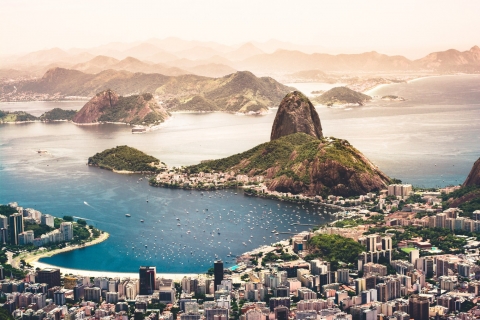 An alternative way to discover Rio de Janeiro
Don't feel like seeing the traditional tourist sights in Rio de Janeiro? We have made an overview of the sights in Rio de Janeiro that you must see if you want to visit Rio in an alternative way.