

















 Warm Sea Without Extreme Heat: 8 Beach Destinations With Comfortable Weather
Love warm seawater but not extreme heat? Compare eight beach destinations where the sea stays warm while daytime temperatures remain comfortable.
This page shows both the average monthly rainfall and the number of rainy days in Blue Bay, Curaçao. The figures are based on a 30-year period (1990–2020) to provide a reliable average. Now, let's break down all the details for a clearer picture.
Generally, Blue Bay has a moderate amount of precipitation, averaging 861 mm (34 in) of rainfall annually. However, it does experience a distinct dry season during certain months. Take a look at our detailed charts below to see the seasonal variation.
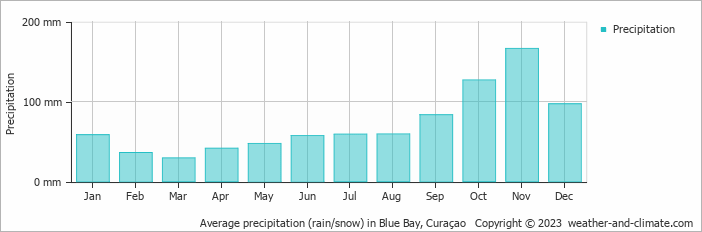

The climate in Blue Bay shows significant variation throughout the year. Expect 166 mm (6.5 in) of precipitation during the wettest month November, distributed over 15 rainy days.
In contrast, March offers drier and sunnier days, with around 29 mm (1.1 in) of rainfall over 7 rainy days.
November, the wettest month, has a maximum daytime temperature of 29°C (84°F). The city receives 236 hours of sunshine in this period. During the driest month March you can expect a temperature of 28°C (82°F). For more detailed insights into the city's temperatures, visit our Blue Bay Temperature page.
Browse day-by-day precipitation records for Blue Bay spanning 51 years. Select any month and year to see actual rainfall and snowfall recorded on each day.
The map below shows the annual precipitation across Curaçao. You can also select the different months in case you are interested in a specific month.
Blue Bay's average annual precipitation is 861 mm (34 in). Let's compare this to some popular worldwide tourist destinations:
The city of Rome, Italy, has an average annual precipitation of 832 mm (33 in), spread fairly evenly throughout the year.
Beijing, China, receives 560 mm (22 in) of annual precipitation, concentrated in the summer months.
Perth, Australia, receives 565 mm (22 in) of rainfall annually, mostly during the winter months.
Bangkok, Thailand, experiences a tropical monsoon climate with 1668 mm (66 in) of annual rainfall, with the heaviest precipitation occurring during September and October.
Precipitation amounts are measured using specific gauges installed at weather stations, collecting both rain and snow and any other type of precipitation. Rainfall is measured directly in millimeters, while that from snow and ice is obtained by melting it. Automated systems often incorporate heaters to make this easier.
Information from these stations is transmitted via Wi-Fi, satellite, GPS, or telephone connections to central monitoring networks. This information is immediately updated and integrated into weather models and forecasts.
The proximity of a location to a large body of water can significantly affect its rainfall patterns:
For more detailed information about Blue Bay's weather, including sunshine hours, humidity levels, and temperature data, visit our Blue Bay Climate page.
Pick a month to see the average temperature, rainfall and sunshine in Blue Bay - and find the best time to visit.
Temperature Rainfall Sunshine Humidity
See the full Blue Bay climate overview or explore weather in Curaçao.
Where to go in October - average daytime high across popular destinations.
 Dorp Sint Michiel
 30°C (86°F) Dorp Soto30°C (86°F) Fontein30°C (86°F) Jan Thiel30°C (86°F) Willibrordus30°C (86°F) Lagun30°C (86°F) Sabana Westpunt30°C (86°F) Willemstad30°C (86°F)
 Need travel inspiration? Check out our bucket list articles and be inspired.
Warm Sea Without Extreme Heat: 8 Beach Destinations With Comfortable Weather
Love warm seawater but not extreme heat? Compare eight beach destinations where the sea stays warm while daytime temperatures remain comfortable.

 Best Spring Break Destinations for Great Weather and Fewer Crowds
Skip crowded spring break resorts. Compare March weather and travel style in Puerto Escondido, San Juan del Sur, Roatán, Caye Caulker and Curaçao.
 Why Curacao is an excellent place for eco-tourism
If you are looking for a new and natural travel experience, eco-tourism is the answer. Curacao is a beautiful island paradise in the Caribbean Sea, with miles of pristine beaches and vibrant coral reefs.

 Visit the Rainbow Mountains
The Rainbow Mountain (Vinicunca) is acolored rainbow mountain that will steal your heart forever and the view from the top will take your breath away.