


















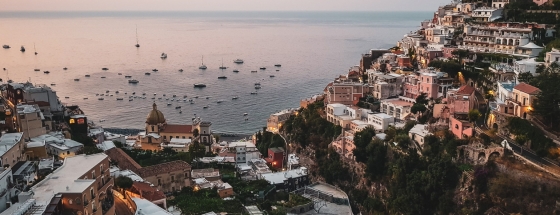
 The 10 most beautiful historical towns in Italy
Discover Italy's top 10 historic towns, featuring breathtaking medieval architecture and deep-rooted history, ideal for enthusiasts of extraordinary cities.
This page shows both the average monthly rainfall and the number of rainy days in Seborga, Liguria, Italy. The numbers reflect climate data gathered over a 30-year period, from 1990 to 2020. Let's explore the details to provide you with a complete overview.
Generally, Seborga has a moderate amount of precipitation, averaging 908 mm (36 in) of rainfall annually.
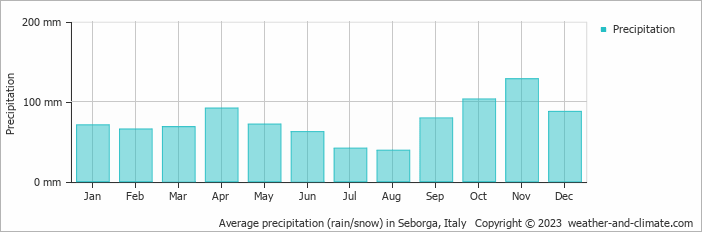
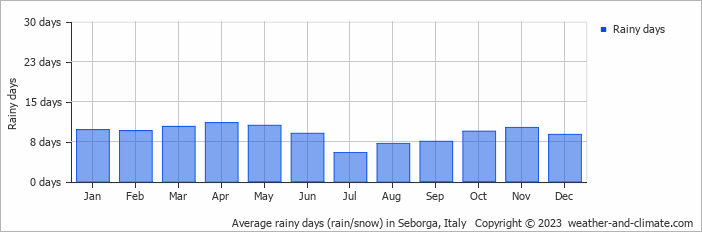
Significant seasonal changes in precipitation occur throughout the year. During the wettest month, November receives substantial rainfall, averaging 128 mm (5 in) of precipitation, recorded across 10 rainy days.
In contrast, the driest month, August brings less rainfall, with 39 mm (1.5 in) over 7 rainy days.
November, the wettest month, has a maximum daytime temperature of 14°C (57°F). The city receives 158 hours of sunshine in this period. During the driest month August you can expect a temperature of 25°C (77°F). For more detailed insights into the city's temperatures, visit our Seborga Temperature page.
The map below shows the annual precipitation across Italy. You can also select the different months in case you are interested in a specific month.
Seborga's average annual precipitation is 908 mm (36 in). Let's compare this to some popular worldwide tourist destinations:
New York City, USA, receives 1276 mm (50 in) of rainfall annually, with precipitation evenly distributed throughout the year.
Beijing, China, receives 560 mm (22 in) of annual precipitation, concentrated in the summer months.
In Brisbane, Australia, the annual precipitation is 979 mm (39 in), making it wetter than Sydney.
Singapore, situated near the equator, gets 2581 mm (102 in) of rainfall annually, with no distinct dry season and consistent monthly precipitation.
Precipitation amounts are measured using specific gauges installed at weather stations, collecting both rain and snow and any other type of precipitation. Rainfall is measured directly in millimeters, while that from snow and ice is obtained by melting it. Automated systems often incorporate heaters to make this easier.
Information from these stations is transmitted via Wi-Fi, satellite, GPS, or telephone connections to central monitoring networks. This information is immediately updated and integrated into weather models and forecasts.
For more detailed information about Seborga's weather, including sunshine hours, humidity levels, and temperature data, visit our Seborga Climate page.
Pick a month to see the average temperature, rainfall and sunshine in Seborga - and find the best time to visit.
Temperature Rainfall Sunshine Water Temp
See the full Seborga climate overview or explore weather in Italy.
Where to go in October - average daytime high across popular destinations.
Need travel inspiration? Check out our bucket list articles and be inspired.
The 10 most beautiful historical towns in Italy
Discover Italy's top 10 historic towns, featuring breathtaking medieval architecture and deep-rooted history, ideal for enthusiasts of extraordinary cities.
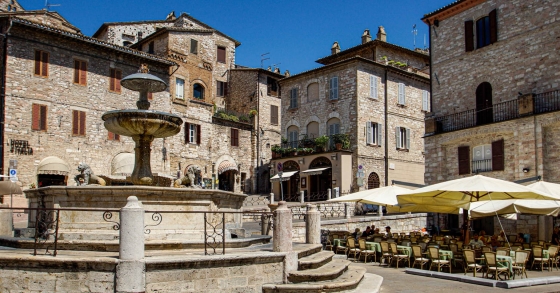 Experience mystical Assisi
Assisi is the most famous town in Umbria and best known because of Saints Francis and Clare of Assisi. Many visitors come to see the breathtaking San Francesco basilica.
 The Battle of Oranges
This is one of the most unusual festivals in Italy. The festival is held in the middle of winter during the winter carnival. The entire city of Ivrea near Turin turns into a battlefield.
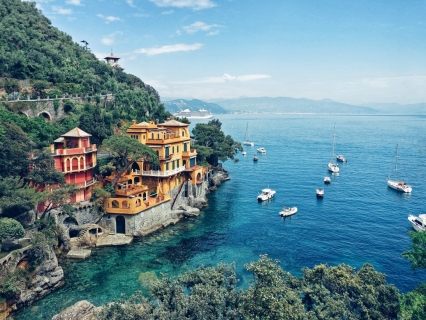 The most beautiful fishing village of Italy
Portofino is the most beautiful fishing village in Italy and maybe even in the world. We absolutely recommend that you add this beautiful place to your bucket list.