














 The 10 most alternative cities in South America
Discover South America's top 10 alternative cities! From Valparaíso's vibrant streets to La Paz's high-altitude charm and Medellín's innovative spirit.
The average annual maximum temperature in Punta Arenas, Magallanes, Chile is 10°C (50°F), with daytime highs ranging from 6°C (43°F) in July to 14°C (57°F) in February. This page covers monthly averages, day-night differences, and how Punta Arenas compares to cities worldwide.
Punta Arenas experiences balanced seasonal shifts, with noticeable but moderate temperature variations. At night, minimum temperatures range from 8°C (46°F) in February to 1°C (34°F) in July.
The chart below illustrates the average maximum day and minimum night temperatures in Punta Arenas by month:
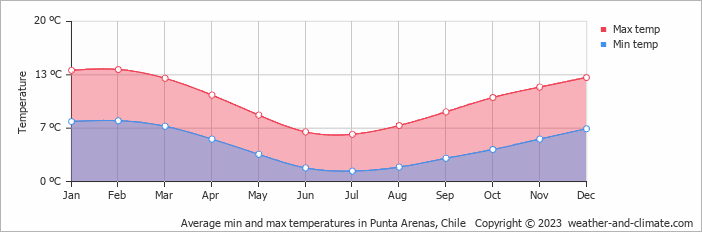
The coolest part of the day is typically between 4 AM and 6 AM, while 3 PM is usually the warmest, when solar heating is at its peak. February, the city's warmest month, averages 185 hours of sunshine.
The chart below shows the average temperature throughout the year:
Average high and low temperatures for each day of the month based on long-term records. 50-year average (1976-2025)
Browse day-by-day temperature records for Punta Arenas spanning 51 years. Select any month and year to see actual high and low temperatures recorded on each day.
The map below shows the annual temperature across Chile. You can also select individual months if you want to compare a specific time of year.
Punta Arenas's average annual maximum temperature is 10°C (50°F). To put that in context, here's how it compares to a few well-known destinations:
Lisbon, Portugal averages 21°C (70°F) annually, warm summers, mild winters, and rain mainly in the cooler months.
On the cooler end, Oslo, Norway averages just 10°C (50°F) annually, with pleasant summers but long, cold winters.
Osaka, Japan averages 22°C (72°F) annually, with hot humid summers, mild winters, and pleasant spring and autumn seasons.
Adelaide, Australia averages 21°C (70°F) a year, with warm summers, mild winters, and relatively low rainfall year-round.
Temperature alone doesn't tell the whole story, humidity plays a big role in how warm or cold it actually feels. High humidity in summer makes the heat feel more intense, particularly once temperatures climb above 25°C. In winter, the same humidity can make cold air feel sharper than the thermometer suggests.
In the cooler months, when temperatures drop below 10°C, high humidity makes the cold feel more cutting than it would in dry conditions.
In Punta Arenas, July is the coolest month, with average highs of 6°C (43°F) and humidity around 84%, considered very high. For a full picture, see our humidity page.
Climate temperature data is typically calculated as a 30-year average. This smooths out year-to-year variability and gives a more reliable picture of what a place is actually like, rather than what happened in any single unusual year.
The readings come from a range of sources, land-based weather stations, ocean buoys, ships, and satellites. That data is collected by weather services around the world, then pooled, quality-checked, and averaged to produce the climate records you see here.
Whether a city sits on the coast or deep inland makes a significant difference to its climate. Coastal areas tend to have more stable temperatures year-round, large bodies of water absorb heat slowly in summer and release it gradually in winter, keeping extremes in check. Cities far from the sea don't benefit from that buffer, which is why continental climates tend to have hotter summers and colder winters than their coastal counterparts at the same latitude.
For more on Punta Arenas's weather, including monthly rainfall, sunshine hours, and humidity, visit our Punta Arenas climate page.
Pick a month to see the average temperature, rainfall and sunshine in Punta Arenas - and find the best time to visit.
Temperature Rainfall Sunshine Humidity Wind Speed
See the full Punta Arenas climate overview or explore weather in Chile.
Where to go in October - average daytime high across popular destinations.
 San Pedro de Atacama
 23°C (73°F) Hanga Roa
 21°C (70°F) Santiago21°C (70°F) La Serena
 21°C (70°F) Viña del Mar17°C (63°F) Valparaíso16°C (61°F) Pucón
 15°C (59°F)
 Need travel inspiration? Check out our bucket list articles and be inspired.
The 10 most alternative cities in South America
Discover South America's top 10 alternative cities! From Valparaíso's vibrant streets to La Paz's high-altitude charm and Medellín's innovative spirit.
 Torres del Paine
Torres del Paine is an huge national park on the border with Argentina. It is possible to walk here along craters, high-rising mountain ridges, over glaciers and through vast majestic tundra.
 Explore Patagonia
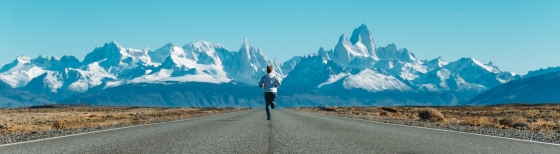
A tour through Patagonia brings you to the end of the world. That’s why Patagonia is a bucket list destination for many. We recommend to visit Patagonia from November to early March.
 Enjoy the silence and peace in a spectacular landscape
This lodge guarantees privacy and exclusivity for those seeking to get away from mass tourism and enjoy the silence and peace in a spectacular landscape.