
















 The rugged landscape of the Norwegian fjords
This landscape is rated as the most beautiful in the world and it is something you need to experience at least once in your life.
Average temperatures, rainfall, sunshine and the best time to visit Tvedestrand.
 –
–
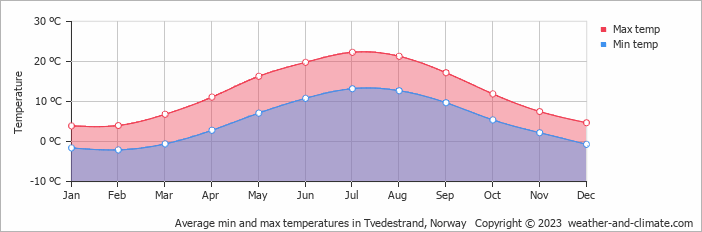
Temperatures in Tvedestrand, Aust-Agder, Norway, vary greatly throughout the year. July is the hottest month at 22°C (72°F), while January is the coldest at 4°C (39°F).
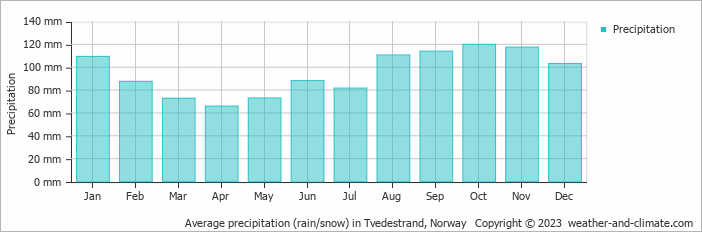
Rain/snowfall is high, totalling around 1143 mm (45 in) per year. October is the wettest month and April the driest. The city also experiences warm summers and cold winters.
Pick a month to see the average temperature, rainfall and sunshine in Tvedestrand - and find the best time to visit.
The climate in Tvedestrand is known for significant temperature differences throughout the year, making the weather dynamic. Average maximum daytime temperatures range from a comfortable 22°C (72°F) in July, the warmest time of the year, to a chilly 4°C (39°F) during cooler months like January.
At night, you can expect temperatures ranging from 13°C (55°F) in July to around -2°C (28°F) during January.
Check out our detailed temperature page for more information.
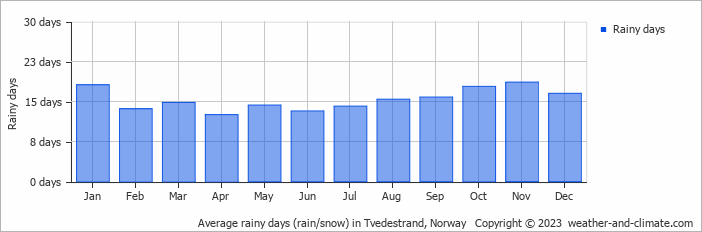
Tvedestrand has a notably wet climate with abundant precipitation, recording 1143 mm (45 in) of rain/snowfall per year. While rainfall varies throughout the year, each season offers its own charm. October brings wetter days averaging 120 mm (4.7 in) of precipitation, spread over 18 rainy days.
In contrast, the driest month April experiences a drier climate, with about 66 mm (2.6 in) of rainfall spread across 13 rainy days. For more details, please visit our Tvedestrand Precipitation page.
Monthly ratings reflect general weather comfort, based on daytime temperature and rainfall. Swimming and winter conditions are highlighted separately where relevant.
June and July typically offer the most optimal weather in Tvedestrand. In contrast, January, February, March, October, November and December tend to have less optimal conditions. Tvedestrand has warm summers and cold winters.
Daytime highs range from 4°C (39°F) in January to 22°C (72°F) in July. Nighttime lows range from -2°C (28°F) to 13°C (55°F). Temperatures vary considerably through the year.
Annual rainfall is around 1143 mm (45 in). October is the wettest month with 120 mm (4.7 in), while April is the driest with 66 mm (2.6 in).
Tvedestrand is highlighted - select any city to see its climate.
Where to go in October - average daytime high across popular destinations.
Kristiansand 12°C (54°F) Stavanger12°C (54°F) Bergen11°C (52°F) Reine
 9°C (48°F) Trondheim9°C (48°F) Oslo9°C (48°F) Tromsø5°C (41°F) Hemsedal5°C (41°F)
 Need travel inspiration? Check out our bucket list articles and be inspired.
The rugged landscape of the Norwegian fjords
This landscape is rated as the most beautiful in the world and it is something you need to experience at least once in your life.
 Discover Norway's Hidden Gem: The Littleisland Lighthouse
Explore Littleisland Lighthouse in Norway - a serene getaway offering unique stays, breathtaking views, and a journey into tranquil simplicity.
 The Majestic Geirangerfjord: Norway's Crown Jewel
Explore Norway's stunning Geirangerfjord, famous for its dramatic cliffs, waterfalls, and scenic routes. Breathtaking landscapes and outdoor adventures
 Swimming with orcas in Norway
The best travel period to travel to Norway for the orcas are the months October, November December, January and February. Swimming with orcas in Norway might be the bucket list trip of your life.