















 Visit the Rainbow Mountains
The Rainbow Mountain (Vinicunca) is acolored rainbow mountain that will steal your heart forever and the view from the top will take your breath away.
Average temperatures, rainfall, sunshine and the best time to visit Sicuani.
 –
–
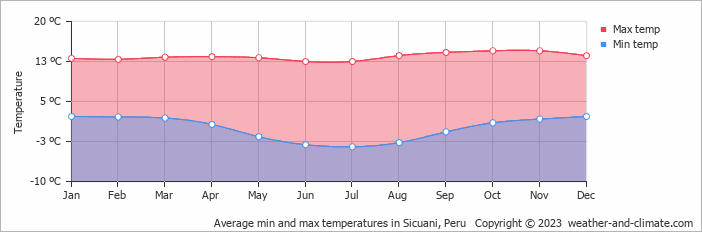
With consistently stable weather, Sicuani, Cusco, Peru, sees little seasonal temperature change. Daytime highs average 13°C (55°F), ranging from 15°C (59°F) in October to 13°C (55°F) in June.
The city has a wet climate, receiving around 1513 mm (60 in) of rain/snowfall per year. Despite the high annual total, it has distinct dry (May to August) and wet (December to March) seasons. February is the wettest month.
Pick a month to see the average temperature, rainfall and sunshine in Sicuani - and find the best time to visit.
The climate in Sicuani remains fairly constant, offering moderate temperatures throughout the year. On average, daytime temperatures range from a moderate 15°C (59°F) in October to a moderate 13°C (55°F) in June.
Nighttime temperatures range from 2°C (36°F) in October to -4°C (25°F) in June.
Check out our detailed temperature page for more information.
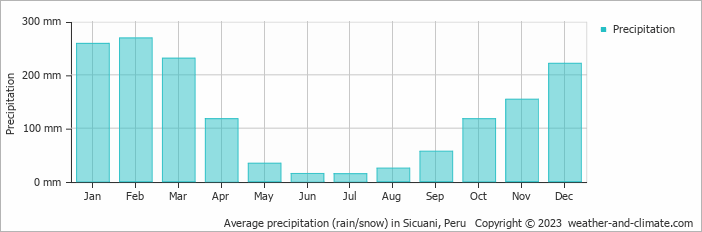
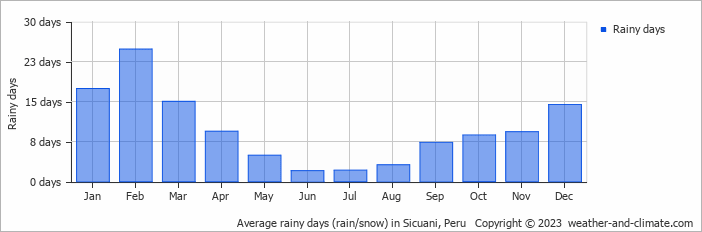
Sicuani is known for its substantial rain/snowfall, with annual precipitation reaching 1513 mm (60 in). The seasons in Sicuani bring significant changes in precipitation. The wettest month, February, receives heavy rainfall, with an average of 269 mm (11 in) of precipitation. This rainfall is distributed across 25 rainy days.
In contrast, the driest month, July, experiences much less rainfall, totaling 14 mm (0.6 in) over 2 rainy days. These distinct seasonal differences provide diverse experiences throughout the year. For more details, please visit our Sicuani Precipitation page.
Monthly ratings reflect general weather comfort, based on daytime temperature and rainfall. Swimming and winter conditions are highlighted separately where relevant.
August typically offers the most optimal weather in Sicuani. In contrast, January, February, March, April and December tend to have less optimal conditions. Sicuani has distinct dry (May to August) and wet (December to March) seasons.
Daytime highs range from 13°C (55°F) in June to 15°C (59°F) in October. Nighttime lows range from -4°C (25°F) to 2°C (36°F). Temperatures stay relatively stable year-round.
Annual rainfall is around 1513 mm (60 in). February is the wettest month with 269 mm (11 in), while July is the driest with 14 mm (0.6 in).
Sicuani is highlighted - select any city to see its climate.
Where to go in September - average daytime high across popular destinations.
Iquitos 32°C (90°F) Trujillo22°C (72°F) Lima20°C (68°F) Arequipa
 20°C (68°F) Puno17°C (63°F) Cusco
 17°C (63°F) Machu Picchu15°C (59°F) Urubamba14°C (57°F)
 Need travel inspiration? Check out our bucket list articles and be inspired.
Visit the Rainbow Mountains
The Rainbow Mountain (Vinicunca) is acolored rainbow mountain that will steal your heart forever and the view from the top will take your breath away.
 "The other" Machu Picchu: the Inca City of Choquequirao
Discover Choquequirao, the hidden Inca city near Cusco. Hike through stunning landscapes and explore ancient ruins with fewer crowds than Machu Picchu.
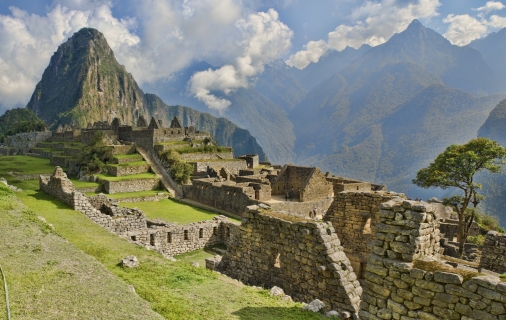 Hike the inca Trail
Few walking tours speak so much to the imagination as the Inca Trail to Machu Picchu. The tour leads through beautiful mountain landscapes and it is called the 'Royal Highway'
 The Inkaterra Reserva Amazonica
One of your highlights during a trip in Peru might be this eco-luxury lodge in front of the Madre de Dios River, called Inkaterra Reserva Amazonica.