


















 Stockholm is one of the most beautiful cities in the world
The Swedish capital is special because of the mix of culture, nature and city. It's a city that should be on everyone's bucket list.
Average temperatures, rainfall, sunshine and the best time to visit Leksand.
 –
–
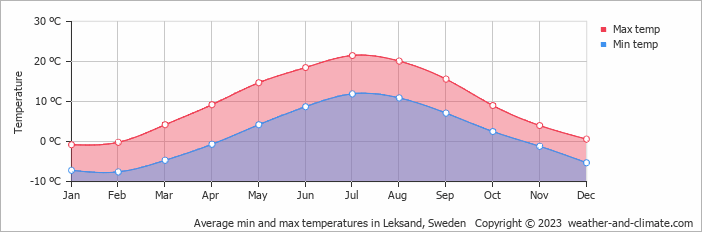
The climate in Leksand, Dalarna, Sweden, is marked by large temperature swings across the seasons, ranging from 22°C (72°F) in July to -1°C (30°F) in January.
The city receives around 716 mm (28 in) of rain/snowfall per year. It experiences a distinct dry season from February to March, with pleasant summers and very cold winters. August is the wettest month and March the driest. Sunshine peaks in June, when the city sees around 8.6 hours of sunshine per day.
Pick a month to see the average temperature, rainfall and sunshine in Leksand - and find the best time to visit.
In Leksand, temperatures differ significantly between summer and winter months. On average, daytime temperatures range from a pleasant 22°C (72°F) in July to a very cold -1°C (30°F) in January.
Nighttime temperatures range from 12°C (54°F) in July to -8°C (18°F) in January.
Check out our detailed temperature page for more information.
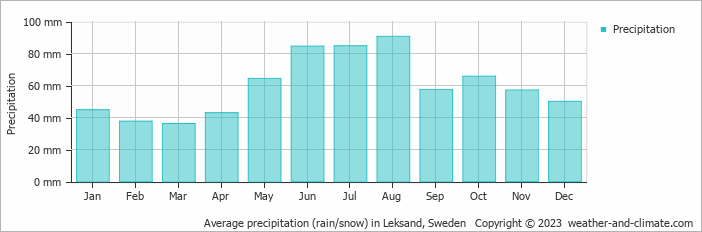
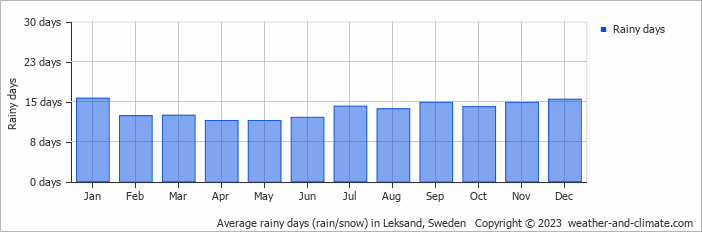
On average, Leksand receives a reasonable amount of rain/snowfall, with an annual precipitation of 716 mm (28 in). The seasons in Leksand bring significant changes in precipitation. The wettest month, August, receives moderate rainfall, with an average of 91 mm (3.6 in) of precipitation. This rainfall is distributed across 14 rainy days.
In contrast, the driest month, March, experiences much less snow/rainfall, totaling 36 mm (1.4 in) over 12 snowy/rainy days. These distinct seasonal differences provide diverse experiences throughout the year. For more details, please visit our Leksand Precipitation page.
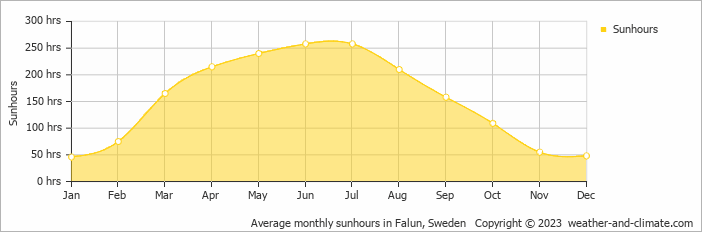
In Leksand, summer days are longer and more sunny, with daily sunshine hours peaking at 8.6 hours in June. As the darker season arrives, the brightness of the sun becomes less. January sees a soft sun for only 1.5 hours per average day.
Visit our detailed sunshine hours page for more information.
Monthly ratings reflect general weather comfort, based on daytime temperature and rainfall. Swimming and winter conditions are highlighted separately where relevant.
July and August typically offer the most optimal weather in Leksand. In contrast, January, February, March, April, October, November and December tend to have less optimal conditions. Leksand has a distinct dry season from February to March, with pleasant summers and very cold winters.
Daytime highs range from -1°C (30°F) in January to 22°C (72°F) in July. Nighttime lows range from -8°C (18°F) to 12°C (54°F). Temperatures vary considerably through the year.
Annual rainfall is around 716 mm (28 in). August is the wettest month with 91 mm (3.6 in), while March is the driest with 36 mm (1.4 in).
Leksand receives around 1,837 hours of sunshine per year. June is the sunniest month with 258 hours, while January is the cloudiest with just 46 hours.
Leksand is highlighted - select any city to see its climate.
Where to go in October - average daytime high across popular destinations.
Malmö 13°C (55°F) Lund13°C (55°F) Karlskrona12°C (54°F) Falkenberg12°C (54°F) Simrishamn13°C (55°F) Gothenburg12°C (54°F) Visby12°C (54°F) Stockholm11°C (52°F)
 Need travel inspiration? Check out our bucket list articles and be inspired.
Stockholm is one of the most beautiful cities in the world
The Swedish capital is special because of the mix of culture, nature and city. It's a city that should be on everyone's bucket list.
 Nordic skating in Sweden
In between the snowy hills and dense pine forests you will find an innumerable amount of lakes in Sweden, large and small ones on which you can skate wonderfully.
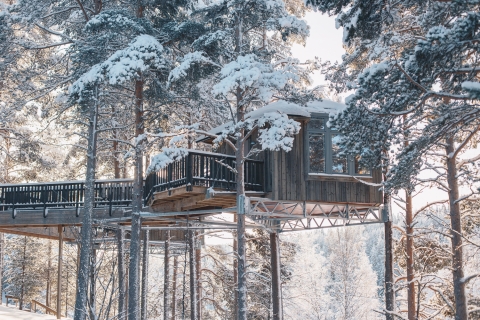 Sleep among the trees in Sweden
If you are looking for a tranquil retreat in Swedish Lapland we recommend to stay at Granó Beckasin. It has a fantastic location on the Ume river where you will experience silence and tranquility.
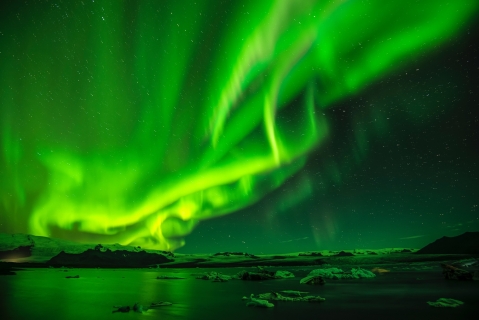
 See the northern lights
The northern lights, polar light or Aarora Borealis is a true spectacle of nature! Green, sometimes purple, red and yellow streaks of light colors the dark skies.