

















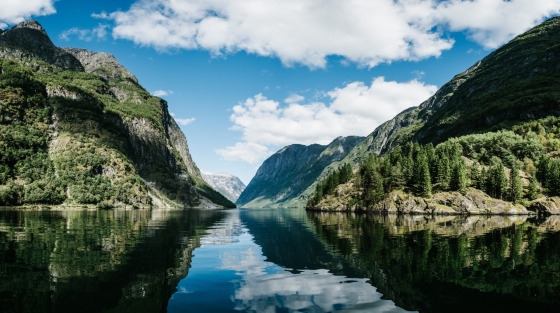
 The rugged landscape of the Norwegian fjords
This landscape is rated as the most beautiful in the world and it is something you need to experience at least once in your life.
Average temperatures, rainfall, sunshine and the best time to visit Bodø.
 –
–
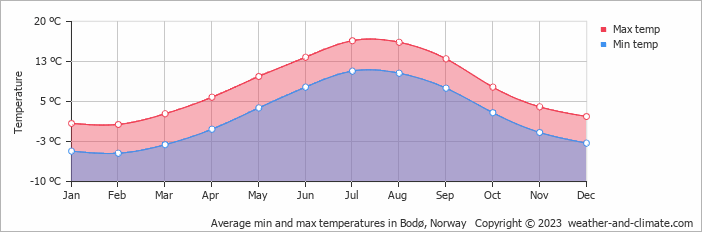
Bodø, Nordland, Norway, experiences significant temperature variation throughout the year. Summers bring daytime highs of 16°C (61°F) in July, while winters cool to 1°C (34°F) in February.
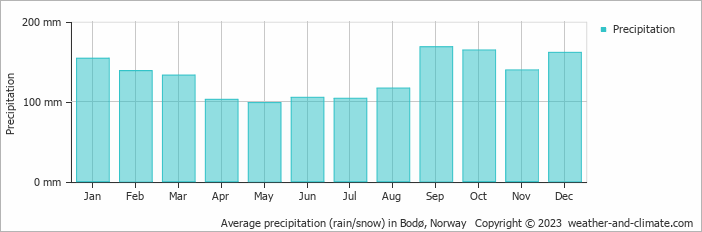
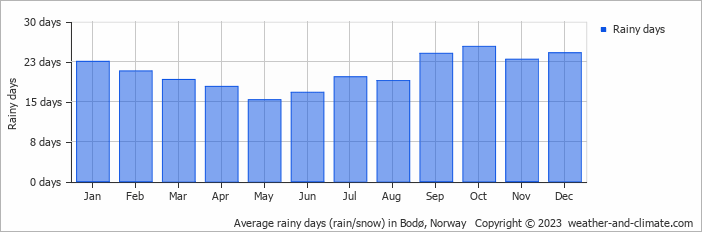
The city receives considerable rain/snowfall, with around 1584 mm (62 in) annually. September is the wettest month. It has mild summers and very cold winters. The most sunshine falls in June, with an average of 7.4 hours of daily sunshine.
Pick a month to see the average temperature, rainfall and sunshine in Bodø - and find the best time to visit.
Depending on the time of the year, temperatures range from moderate to very cold in Bodø. Typically, average maximum daytime temperatures range from a moderate 16°C (61°F) in July to a very cold 1°C (34°F) in the coolest month, February.
Nights vary from 11°C (52°F) in July to around -5°C (23°F) during the colder months.
Check out our detailed temperature page for more information.
Bodø has a relatively rain/snowy climate with high precipitation levels, averaging 1584 mm (62 in) of rain/snowfall annually. Bodø offers a pleasant mix of wetter and slightly drier months. The difference in precipitation between the wettest month September (168 mm (6.6 in)) and the driest month May (98 mm (3.9 in)) is not too significant. For more details, please visit our Bodø Precipitation page.
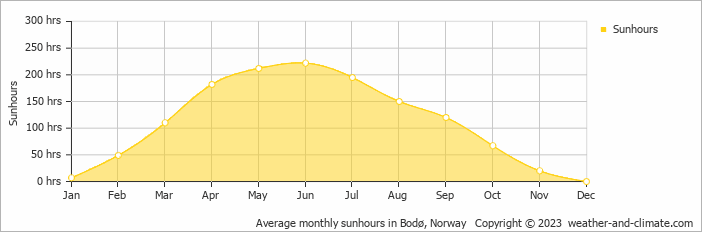
For those who appreciate different seasons, Bodø serves as an ideal destination. Expect longer, more sun-filled days in June with an average of 7.4 hours of sunshine daily, and embrace the darker days in December, offering only 0.0 hours of daily sunlight.
Visit our detailed sunshine hours page for more information.
Monthly ratings reflect general weather comfort, based on daytime temperature and rainfall. Swimming and winter conditions are highlighted separately where relevant.
July and August typically offer the most optimal weather in Bodø. In contrast, January, February, March, April, May, June, September, October, November and December tend to have less optimal conditions. Bodø has mild summers and very cold winters.
Daytime highs range from 1°C (34°F) in February to 16°C (61°F) in July. Nighttime lows range from -5°C (23°F) to 11°C (52°F). Temperatures vary considerably through the year.
Annual rainfall is around 1584 mm (62 in). September is the wettest month with 168 mm (6.6 in), while May is the driest with 98 mm (3.9 in).
Bodø receives around 1,334 hours of sunshine per year. June is the sunniest month with 222 hours, while December is the cloudiest with just 0 hours.
Bodø is highlighted - select any city to see its climate.
Where to go in September - average daytime high across popular destinations.
Kristiansand 17°C (63°F) Oslo16°C (61°F) Stavanger
 16°C (61°F) Bergen16°C (61°F) Trondheim16°C (61°F) Reine12°C (54°F) Tromsø12°C (54°F) Hemsedal11°C (52°F)
 Need travel inspiration? Check out our bucket list articles and be inspired.
The rugged landscape of the Norwegian fjords
This landscape is rated as the most beautiful in the world and it is something you need to experience at least once in your life.
 Discover Norway's Hidden Gem: The Littleisland Lighthouse
Explore Littleisland Lighthouse in Norway - a serene getaway offering unique stays, breathtaking views, and a journey into tranquil simplicity.
 The Majestic Geirangerfjord: Norway's Crown Jewel
Explore Norway's stunning Geirangerfjord, famous for its dramatic cliffs, waterfalls, and scenic routes. Breathtaking landscapes and outdoor adventures
 Swimming with orcas in Norway
The best travel period to travel to Norway for the orcas are the months October, November December, January and February. Swimming with orcas in Norway might be the bucket list trip of your life.