














 Discover Kok Kood: a hidden gem in Thailand
Discover the hidden gem of Thailand - Koh Kood! Explore stunning beaches, waterfalls and eco-friendly resorts while enjoying a peaceful atmosphere away from the crowds.
Average temperatures, rainfall, sunshine and the best time to visit Ban Huai Yang.
 –
–
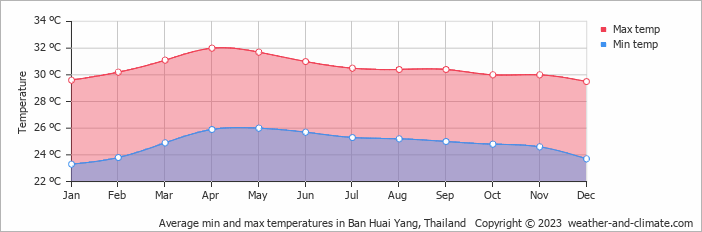
Ban Huai Yang, Prachuap Khiri Khan Province, Thailand, has a stable climate with little temperature variation across the year. Average daytime temperatures hover around 31°C (88°F), peaking in April at 32°C (90°F) and dipping in December to 30°C (86°F).
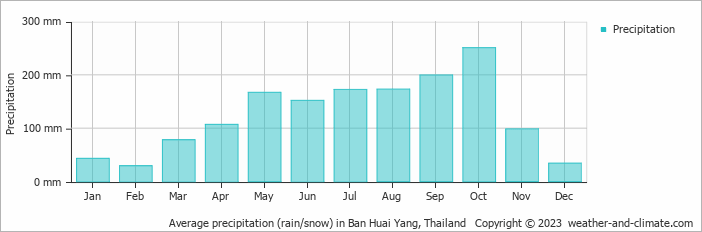
The city receives considerable rainfall, with around 1503 mm (59 in) annually. October is the wettest month. It has a distinct rainy season from July to October.
Pick a month to see the average temperature, rainfall and sunshine in Ban Huai Yang - and find the best time to visit.
With minimal seasonal shifts, Ban Huai Yang experiences a constant climate year-round. Typically, average maximum daytime temperatures range from a very warm 32°C (90°F) in April to a comfortable 30°C (86°F) in the coolest month, December.
Nights vary from 26°C (79°F) in April to around 23°C (73°F) during the colder months.
Check out our detailed temperature page for more information.
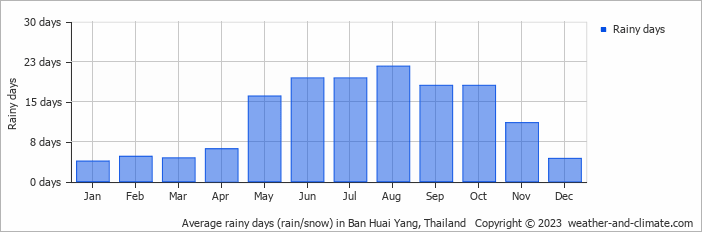
Ban Huai Yang has a notably wet climate with abundant precipitation, recording 1503 mm (59 in) of rainfall per year. The climate in Ban Huai Yang shows significant variation throughout the year. Expect heavy rainfall in October, the wettest month, with an average of 251 mm (9.9 in) of precipitation over 18 rainy days.
In contrast, the driest month February offers drier and sunnier days, with around 29 mm (1.1 in) of rainfall over 5 rainy days. For more details, please visit our Ban Huai Yang Precipitation page.
Monthly ratings reflect general weather comfort, based on daytime temperature and rainfall. Swimming and winter conditions are highlighted separately where relevant.
February typically offers the most optimal weather in Ban Huai Yang. In contrast, September and October tend to have less optimal conditions. Ban Huai Yang has a distinct rainy season from July to October.
Daytime highs range from 30°C (86°F) in December to 32°C (90°F) in April. Nighttime lows range from 23°C (73°F) to 26°C (79°F). Temperatures stay relatively stable year-round.
Annual rainfall is around 1503 mm (59 in). October is the wettest month with 251 mm (9.9 in), while February is the driest with 29 mm (1.1 in).
Ban Huai Yang is highlighted - select any city to see its climate.
Where to go in October - average daytime high across popular destinations.
Bangkok 33°C (91°F) Chiang Mai
 32°C (90°F) Jomtien Beach32°C (90°F) Ao Nang Beach30°C (86°F) Hua Hin31°C (88°F) Patong Beach29°C (84°F) Ko Lanta29°C (84°F)
 Need travel inspiration? Check out our bucket list articles and be inspired.
Discover Kok Kood: a hidden gem in Thailand
Discover the hidden gem of Thailand - Koh Kood! Explore stunning beaches, waterfalls and eco-friendly resorts while enjoying a peaceful atmosphere away from the crowds.

 Warm Days, Cool Nights: 8 Destinations With the Perfect Day-Night Temperature
Prefer warm sunny days but cool evenings? Compare eight destinations with daytime temperatures of around 25–30°C, cooler nights, low rainfall and plenty of sunshine.

 Where to Travel in July and August: Mexico, Thailand, Indonesia or Somewhere Else?
Compare July and August weather in Mexico, Thailand, Indonesia, Zanzibar and Sri Lanka, using historical climate data for temperature, rainfall and sunshine.
 Discover Thailand: An Ultimate Guide for Yogis
Explore Thailand's best for yogis: serene retreats, spiritual growth, and adventure. Dive into yoga, meditation, and nature's tranquility for an unforgettable journey.