
















 You will never forget this unique sustainable hotel in Mauritius
This hotel is leading the way in terms of sustainability. Salt truly offers a new approach and shows how the future of travel could look like.
Average temperatures, rainfall, sunshine and the best time to visit Baie du Tombeau.
 –
10-day forecastForecast
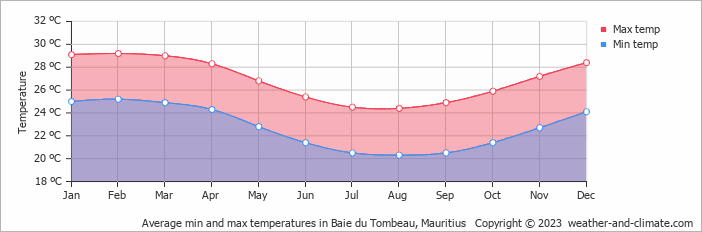
Baie du Tombeau, Mauritius, has a stable climate with little temperature variation across the year. Average daytime temperatures hover around 27°C (81°F), peaking in February at 29°C (84°F) and dipping in August to 24°C (75°F).
Baie du Tombeau sees a moderate amount of rainfall, totalling around 894 mm (35 in) per year. It experiences a distinct dry season from June to October, creating some seasonal variation. The sunniest month is December, with 9.4 hours of sunshine per day on average.
Pick a month to see the average temperature, rainfall and sunshine in Baie du Tombeau - and find the best time to visit.
With minimal seasonal shifts, Baie du Tombeau experiences a constant climate year-round. Average maximum daytime temperatures range from a comfortable 29°C (84°F) in February, the warmest time of the year, to a comfortable 24°C (75°F) during cooler months like August.
At night, you can expect temperatures ranging from 25°C (77°F) in February to around 20°C (68°F) during August.
Check out our detailed temperature page for more information.
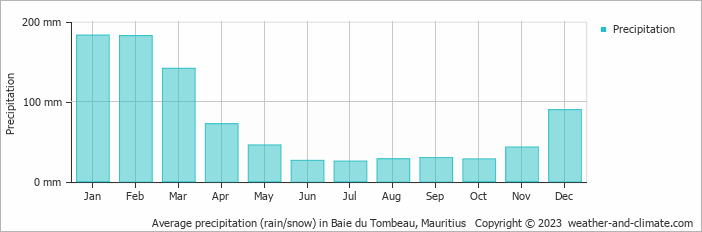
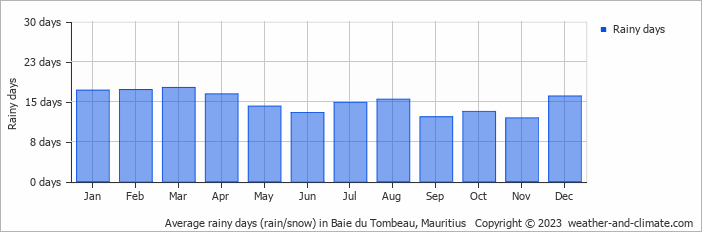
Generally, Baie du Tombeau receives mid-range precipitation levels, with 894 mm (35 in) annually. Significant seasonal changes in precipitation occur throughout the year. In the wettest month, January it receives heavy rainfall, averaging 183 mm (7.2 in) of precipitation, recorded across 17 rainy days. In contrast, the driest month July brings less rainfall, with 25 mm (1 in) over 15 rainy days. For more details, please visit our Baie du Tombeau Precipitation page.
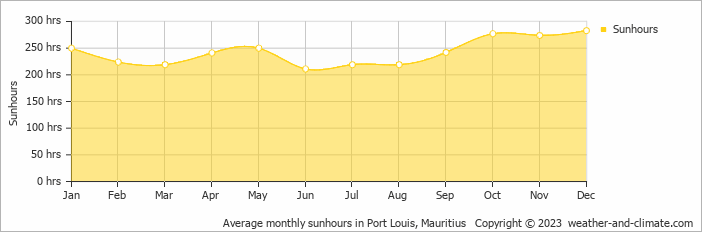
While the amount of sunshine in Baie du Tombeau varies throughout the year, all seasons offer their own charm. Enjoy up to 9.4 hours of daily sun in December, and experience slightly darker atmosphere in June, with about 7.0 hours of daily sunlight.
Visit our detailed sunshine hours page for more information.
Monthly ratings reflect general weather comfort, based on daytime temperature and rainfall. Swimming and winter conditions are highlighted separately where relevant.
April, May, June, July, August, September, October, November and December typically offer the most optimal weather in Baie du Tombeau. In contrast, January and February tend to have less optimal conditions. Baie du Tombeau has a distinct dry season from June to October.
Daytime highs range from 24°C (75°F) in August to 29°C (84°F) in February. Nighttime lows range from 20°C (68°F) to 25°C (77°F). Temperatures stay relatively stable year-round.
Annual rainfall is around 894 mm (35 in). January is the wettest month with 183 mm (7.2 in), while July is the driest with 25 mm (1 in).
Baie du Tombeau receives around 2,909 hours of sunshine per year. December is the sunniest month with 283 hours, while June is the cloudiest with just 211 hours. Overall, Baie du Tombeau enjoys abundant sunshine.
Baie du Tombeau is highlighted - select any city to see its climate.
Where to go in October - average daytime high across popular destinations.
Port Louis 26°C (79°F) Curepipe26°C (79°F) Flic-en-Flac26°C (79°F) Bel Ombre26°C (79°F) Grand Baie26°C (79°F) Port Maturin25°C (77°F) Port Mathurin25°C (77°F)
Need travel inspiration? Check out our bucket list articles and be inspired.
You will never forget this unique sustainable hotel in Mauritius
This hotel is leading the way in terms of sustainability. Salt truly offers a new approach and shows how the future of travel could look like.
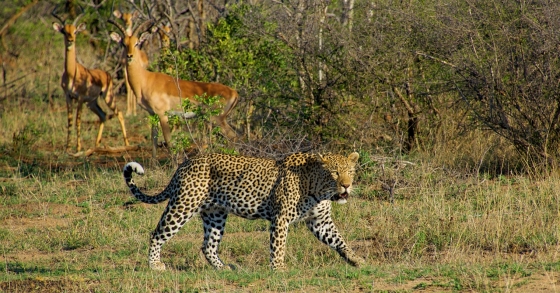
 Visit Kruger Park in South Africa
Are you going to South Africa, then you cannot skip the Kruger Park. The Kruger Park is one of the most beautiful and largest safari parks in the world.
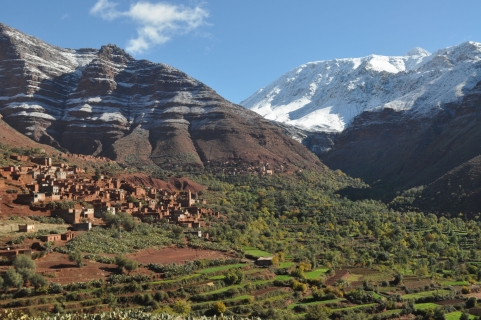
 The Atlas Mountains in Morocco
This mountain range is the second highest mountains in the world and is certainly one of the most natural and wonderful mountains you could ever visit. One for the bucket list for sure.
 One of South Africa's most spectacular private game reserves
Sabi Sand Game Reserve is one of South Africa's most spectacular private game reserves. The chance that you see the entire Big Five is high in winter (June - August).