













 The 10 most alternative cities in South America
Discover South America's top 10 alternative cities! From Valparaíso's vibrant streets to La Paz's high-altitude charm and Medellín's innovative spirit.
Average temperatures, rainfall, sunshine and the best time to visit Aracaju.
 –
10-day forecastForecast
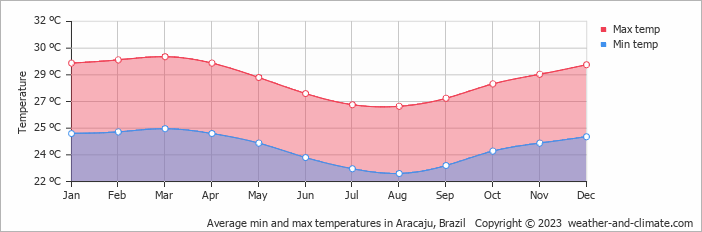
Aracaju, Sergipe, Brazil, has a stable climate with little temperature variation across the year. Average daytime temperatures hover around 28°C (82°F), peaking in March at 30°C (86°F) and dipping in August to 27°C (81°F).
The city receives considerable rainfall, with around 1177 mm (46 in) annually. May is the wettest month. The sunniest month is January, with 8.9 hours of sunshine per day on average.
Pick a month to see the average temperature, rainfall and sunshine in Aracaju - and find the best time to visit.
With minimal seasonal shifts, Aracaju experiences a constant climate year-round. Typically, average maximum daytime temperatures range from a comfortable 30°C (86°F) in March to a comfortable 27°C (81°F) in the coolest month, August.
Nights vary from 25°C (77°F) in March to around 23°C (73°F) during the colder months.
Check out our detailed temperature page for more information.
Aracaju has a notably wet climate with abundant precipitation, recording 1177 mm (46 in) of rainfall per year. The climate in Aracaju shows significant variation throughout the year. Expect heavy rainfall in May, the wettest month, with an average of 176 mm (6.9 in) of precipitation over 26 rainy days.
In contrast, the driest month December offers drier and sunnier days, with around 39 mm (1.5 in) of rainfall over 16 rainy days. For more details, please visit our Aracaju Precipitation page.


Aracaju offers a pleasant mix of sunny and slightly overcast days. The difference in sunshine hours between January (8.9 hours daily) and June (5.9 hours daily) provides a bit of variety for visitors and residents.
Visit our detailed sunshine hours page for more information.

The relative humidity is high throughout the year in Aracaju.
The city experiences its highest humidity in April, reaching 80%. In February, the humidity drops to its lowest level at 77%. What does this mean? Read our detailed page on humidity levels for further details.

Monthly ratings reflect general weather comfort, based on daytime temperature and rainfall. Swimming and winter conditions are highlighted separately where relevant.
January, September, October, November and December typically offer the most optimal weather in Aracaju. In contrast, February and March tend to have less optimal conditions.
Daytime highs range from 27°C (81°F) in August to 30°C (86°F) in March. Nighttime lows range from 23°C (73°F) to 25°C (77°F). Temperatures stay relatively stable year-round.
Annual rainfall is around 1177 mm (46 in). May is the wettest month with 176 mm (6.9 in), while December is the driest with 39 mm (1.5 in).
Aracaju receives around 2,729 hours of sunshine per year. January is the sunniest month with 266 hours, while June is the cloudiest with just 177 hours. Overall, Aracaju enjoys abundant sunshine.
Aracaju is highlighted - select any city to see its climate.
Where to go in October - average daytime high across popular destinations.
 Fortaleza
 31°C (88°F) Rio de Janeiro
 28°C (82°F) Salvador
 28°C (82°F) Sao Paulo27°C (81°F) Búzios25°C (77°F) Paraty
 25°C (77°F) Gramado24°C (75°F) Florianópolis24°C (75°F)
Need travel inspiration? Check out our bucket list articles and be inspired.
The 10 most alternative cities in South America
Discover South America's top 10 alternative cities! From Valparaíso's vibrant streets to La Paz's high-altitude charm and Medellín's innovative spirit.
 The 5 most tranquil retreats in the Amazon Rainforest, Brazil
Discover top sustainable lodges in the Amazon. Enjoy unique wildlife, eco-friendly stays, and immersive experiences at Anavilhanas, Cristalino, and more.
 Brazil in November: Where Is the Best Weather?
Discover where Brazil has the best weather in November, comparing Fortaleza, Salvador, Rio, São Paulo, Florianópolis, Brasília and Foz do Iguaçu.
 An alternative way to discover Rio de Janeiro
Don't feel like seeing the traditional tourist sights in Rio de Janeiro? We have made an overview of the sights in Rio de Janeiro that you must see if you want to visit Rio in an alternative way.