Norah Monthly Rainfall & Precipitation
This page shows both the average monthly rainfall and the number of rainy days in Norah, Australia. The numbers reflect climate data gathered over a 30-year period, from 1990 to 2020. Now, let's explore all the details to give you a full picture.
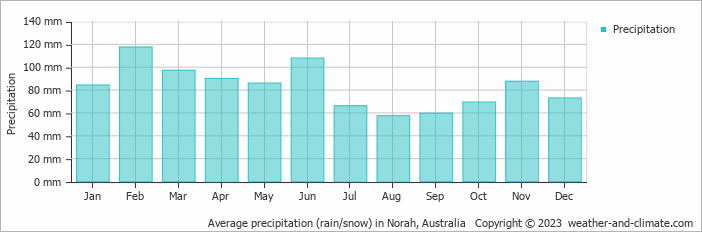
Generally, Norah receives mid-range precipitation levels, with 996 mm (39 in) annually.
Monthly Rainfall & Rainy Days
Monthly Precipitation Levels
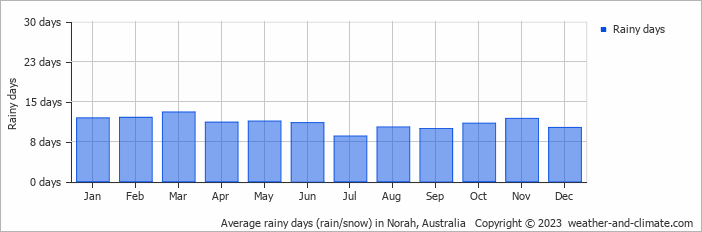
The average number of days each month with precipitation (> 0.2 mm (0.01 in))
Norah offers a pleasant mix of wetter and slightly drier months. The difference in precipitation between February (118 mm (4.6 in)) and August (57 mm (2.2 in)) is not too significant, making the climate enjoyable for visitors and residents alike.
February, the wettest month, has a maximum daytime temperature of 26°C (79°F). During the driest month August you can expect a temperature of 19°C (66°F). For more detailed insights into the city's temperatures, visit our Norah Temperature page.
Annual Rainfall in Australia: City Comparison
The map below shows the annual precipitation across Australia. You can also select the different months in case you are interested in a specific month.
Norah vs World: Rainfall Compared
Norah's average annual precipitation is 996 mm (39 in). Let's compare this to some popular worldwide tourist destinations:
Chicago, USA, sees an annual precipitation of 1062 mm (42 in), with rain and snow contributing to its humid climate.
Osaka, Japan, experiences 1507 mm (59 in) of rainfall annually, spread across the year with wetter summers.
In Brisbane, Australia, the annual precipitation is 979 mm (39 in), making it wetter than Sydney.
Ho Chi Minh City, Vietnam, receives 1955 mm (77 in) of annual rainfall, with a pronounced wet season from May to November, typical of its tropical monsoon climate.
Precipitation amounts are measured using specific gauges installed at weather stations, collecting both rain and snow and any other type of precipitation. Rainfall is measured directly in millimeters, while that from snow and ice is obtained by melting it. Automated systems often incorporate heaters to make this easier.
Information from these stations is transmitted via Wi-Fi, satellite, GPS, or telephone connections to central monitoring networks. This information is immediately updated and integrated into weather models and forecasts.
- Mawsynram in India is noted as being the wettest place on earth, with over 11 meters (36 feet) of rain falling every year.
- In contrast, Antofagasta in Chile is among the driest places on the planet, getting less than 0.1mm (0.004 inches) per year, with some years recording virtually no rainfall.
- Nearly 1,650 thunderstorm cells are estimated over the planet at any given time.
For more detailed information about Norah's weather, including sunshine hours, humidity levels, and temperature data, visit our Norah Climate page.
Norah Weather by Month
Pick a month to see the average temperature, rainfall and sunshine in Norah - and find the best time to visit.

Norah 3-Day Forecast
Temperature Rainfall Humidity
See the full Norah climate overview or explore weather in Australia.
Popular this month
Where to go in August - average daytime high across popular destinations.

















Bucket list
Need travel inspiration? Check out our bucket list articles and be inspired.
 An alternative way to discover Sydney
We have made an overview of the sights in Sydney that you must see if you want to visit Sydney in an alternative way.
The most relaxed and alternative area of Australia is called the Byron Shire
The Byron Shire is one of the most pretty areas in the world. Not only in terms on natural beauty, also the relaxed vibe and people make this an area that remains close to your heart.
Sail the Whitsunday islands
The best travel period to sail the Whitsunday islands is “winter” between June and October, with pleasant temperatures around 23 degrees Celsius (74 Fahrenheit).
The best dive spots in Australia
Explore Australia's best dive spots: from the Great Barrier Reef to HMAS Perth. Discover vibrant corals, marine life, and historic wrecks.