
















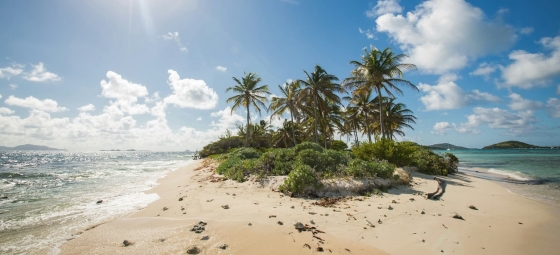
 10 Hidden gems in Asia you need to visit
Explore 10 hidden gems in Asia offering authentic experiences, from pristine beaches and remote islands to cultural treks and peaceful mountain villages.
This page shows both the average monthly rainfall and the number of rainy days in Marawila, Puttalam District, Sri Lanka. Long-term data from 1990 to 2020 was used to calculate these averages. Let's now guide you through the details for a complete overview.
Marawila is known for its substantial rainfall, with annual precipitation reaching 2133 mm (84 in). While the overall climate is wet, there are notable seasonal patterns that create interesting contrasts, as demonstrated in our graph below.
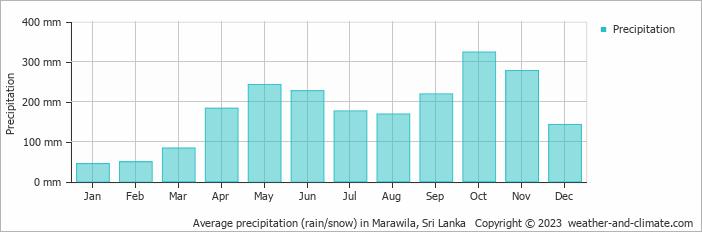
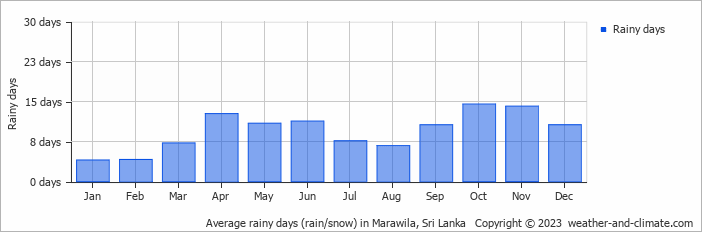
Significant seasonal changes in precipitation occur throughout the year. During the wettest month, October receives substantial rainfall, averaging 323 mm (13 in) of precipitation, recorded across 15 rainy days.
In contrast, the driest month, January brings less rainfall, with 44 mm (1.7 in) over 4 rainy days.
October, the wettest month, has a maximum daytime temperature of 30°C (86°F). The city receives 202 hours of sunshine in this period. During the driest month January you can expect a temperature of 31°C (88°F). For more detailed insights into the city's temperatures, visit our Marawila Temperature page.
The map below shows the annual precipitation across Sri Lanka. You can also select the different months in case you are interested in a specific month.
Marawila's average annual precipitation is 2133 mm (84 in). Let's compare this to some popular worldwide tourist destinations:
In Barcelona, Spain, the average annual precipitation is 620 mm (24 in), evenly distributed across the year with no extreme wet or dry seasons.
In Shanghai, China, the annual average precipitation is 1347 mm (53 in), with a humid subtropical climate.
In Brisbane, Australia, the annual precipitation is 979 mm (39 in), making it wetter than Sydney.
Mumbai, India, experiences a tropical monsoon climate with 1860 mm (73 in) of annual rainfall, with the majority of precipitation happening during the monsoon season from June to September.
Precipitation amounts are measured using specific gauges installed at weather stations, collecting both rain and snow and any other type of precipitation. Rainfall is measured directly in millimeters, while that from snow and ice is obtained by melting it. Automated systems often incorporate heaters to make this easier.
Information from these stations is transmitted via Wi-Fi, satellite, GPS, or telephone connections to central monitoring networks. This information is immediately updated and integrated into weather models and forecasts.
Precipitation has a very strong role in determining the local climate and ecosystem:
For more detailed information about Marawila's weather, including sunshine hours, humidity levels, and temperature data, visit our Marawila Climate page.
Pick a month to see the average temperature, rainfall and sunshine in Marawila - and find the best time to visit.
Temperature Rainfall Sunshine Humidity
See the full Marawila climate overview or explore weather in Sri Lanka.
Where to go in October - average daytime high across popular destinations.
 Colombo
 30°C (86°F) Negombo30°C (86°F) Unawatuna29°C (84°F) Galle29°C (84°F) Mirissa30°C (86°F) Hikkaduwa29°C (84°F) Kandy28°C (82°F) Nuwara Eliya27°C (81°F)
 Need travel inspiration? Check out our bucket list articles and be inspired.
10 Hidden gems in Asia you need to visit
Explore 10 hidden gems in Asia offering authentic experiences, from pristine beaches and remote islands to cultural treks and peaceful mountain villages.
 Where to Travel in July and August: Mexico, Thailand, Indonesia or Somewhere Else?
Compare July and August weather in Mexico, Thailand, Indonesia, Zanzibar and Sri Lanka, using historical climate data for temperature, rainfall and sunshine.
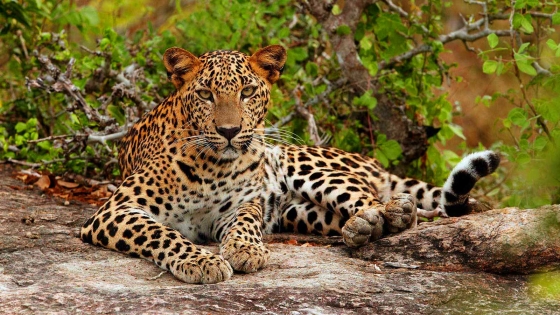 Safari at Yala West National Park
The best travel time is indicated by October to December. However from December to March you have the biggest chance to see leopards and elephants with March as the best month.
 From Hikkaduwa to Hiriketiya: where to stay on the South Coast of Sri Lanka
We have selected a few of our favorite places to stay for you. With beautiful gardens, welcoming hosts, great food - these should definitely be on your bucket list!