















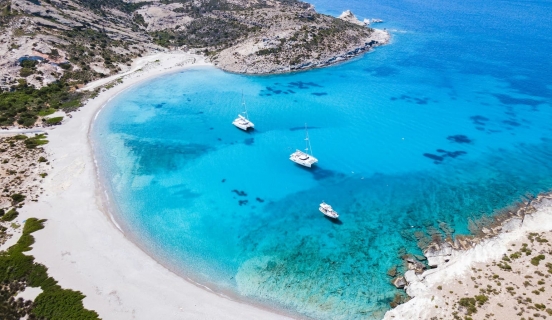
 Top 5 secluded beaches in Greece
Explore Greece's hidden gems: secluded beaches like Fokos, Seychelles, Potami, Kedrodasos, and Mouros for tranquil adventures away from crowds.
This page shows both the average monthly rainfall and the number of rainy days in Kynopiástai, Greece. These values are calculated using 30 years of data (1990–2020) to ensure accuracy. Now, let's break down all the details for a clearer picture.
Kynopiástai is known for its substantial rainfall, with annual precipitation reaching 1263 mm (50 in). While the overall climate is wet, there are notable seasonal patterns that create interesting contrasts, as demonstrated in our graph below.
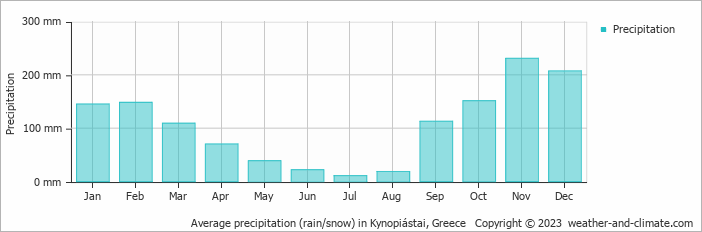
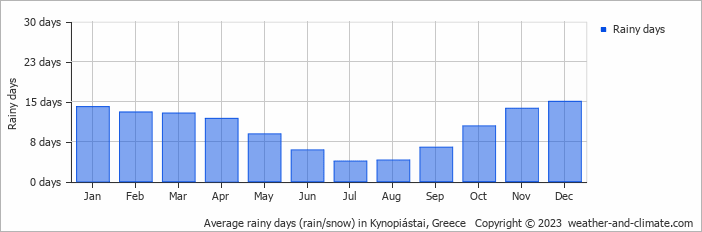
The climate in Kynopiástai shows significant variation throughout the year. Expect 231 mm (9.1 in) of precipitation during the wettest month November, distributed over 14 rainy days.
In contrast, July offers drier and sunnier days, with around 11 mm (0.4 in) of rainfall over 4 rainy days.
November, the wettest month, has a maximum daytime temperature of 19°C (66°F). The city receives 134 hours of sunshine in this period. During the driest month July you can expect a temperature of 27°C (81°F). For more detailed insights into the city's temperatures, visit our Kynopiástai Temperature page.
The map below shows the annual precipitation across Greece. You can also select the different months in case you are interested in a specific month.
Kynopiástai's average annual precipitation is 1263 mm (50 in). Let's compare this to some popular worldwide tourist destinations:
Athens, Greece, receives an average annual precipitation of 400 mm (16 in), making it one of the drier Mediterranean climates with rainfall mostly in winter.
Meanwhile, Buenos Aires, Argentina, enjoys a humid subtropical climate with 1000 mm (39 in) of annual rainfall, mostly in the summer.
Adelaide, Australia, enjoys 511 mm (20 in) of annual precipitation, with dry summers and wet winters.
Singapore, situated near the equator, gets 2581 mm (102 in) of rainfall annually, with no distinct dry season and consistent monthly precipitation.
Precipitation amounts are measured using specific gauges installed at weather stations, collecting both rain and snow and any other type of precipitation. Rainfall is measured directly in millimeters, while that from snow and ice is obtained by melting it. Automated systems often incorporate heaters to make this easier.
Information from these stations is transmitted via Wi-Fi, satellite, GPS, or telephone connections to central monitoring networks. This information is immediately updated and integrated into weather models and forecasts.
For more detailed information about Kynopiástai's weather, including sunshine hours, humidity levels, and temperature data, visit our Kynopiástai Climate page.
Pick a month to see the average temperature, rainfall and sunshine in Kynopiástai - and find the best time to visit.
Temperature Rainfall Sunshine Humidity Wind Speed Water Temp
See the full Kynopiástai climate overview or explore weather in Greece.
Where to go in October - average daytime high across popular destinations.
Athens 25°C (77°F) Hersonissos25°C (77°F) Naxos Chora
 22°C (72°F) Oía23°C (73°F) Fira23°C (73°F) Mýkonos City22°C (72°F) Kalambaka
 21°C (70°F) Chania Town22°C (72°F)
 Need travel inspiration? Check out our bucket list articles and be inspired.
Top 5 secluded beaches in Greece
Explore Greece's hidden gems: secluded beaches like Fokos, Seychelles, Potami, Kedrodasos, and Mouros for tranquil adventures away from crowds.
 Discover Zakynthos
On the Greek island you can discover the rugged coastline, authentic old villages, a beautiful interior and the caves with the beautiful azure water.
 Why Santorini should be on every Bucket List
This Greek island is home to some of the most stunning scenery globally, with its beautiful Caldera views, white-washed houses and crystal-clear waters.

 The 10 most charming villages in France
Discover France's top 10 beautiful villages. From Normandy to the Côte d'Azur, experience quaint squares and cobbled streets. Which one will you visit this summer?