

















 Do a pub crawl in Antwerp
You can visit Antwerp year round however May through September is the best time to go to Antwerp for a pub crawl. Late spring is recommended for its long days.
This page shows both the average monthly rainfall and the number of rainy days in Korbeek-Dijle, Flemish Brabant, Belgium. These values are calculated using 30 years of data (1990–2020) to ensure accuracy. Now, let's explore all the details to give you a full picture.
Generally, Korbeek-Dijle receives mid-range precipitation levels, with 833 mm (33 in) annually.
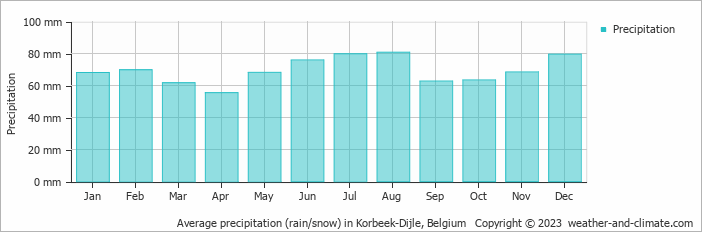
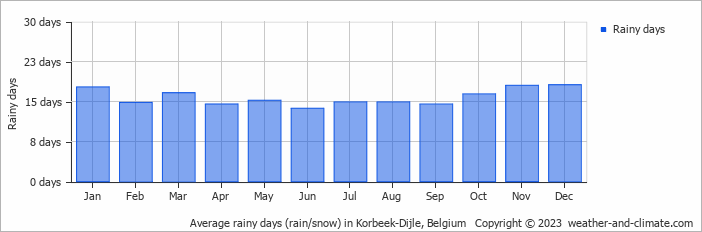
Year-round, Korbeek-Dijle has a balanced climate with minimal variation in precipitation. The difference between the wettest month, August, with 81 mm (3.2 in), and the driest month, April, with 55 mm (2.2 in), is minimal.
August, the wettest month, has a maximum daytime temperature of 24°C (75°F). The city receives 198 hours of sunshine in this period. During the driest month April you can expect a temperature of 16°C (61°F). For more detailed insights into the city's temperatures, visit our Korbeek-Dijle Temperature page.
The map below shows the annual precipitation across Belgium. You can also select the different months in case you are interested in a specific month.
Korbeek-Dijle's average annual precipitation is 833 mm (33 in). Let's compare this to some popular worldwide tourist destinations:
In Barcelona, Spain, the average annual precipitation is 620 mm (24 in), evenly distributed across the year with no extreme wet or dry seasons.
In Seoul, South Korea, the average annual precipitation is 1237 mm (49 in), with most rain falling during the summer monsoon season.
Perth, Australia, receives 565 mm (22 in) of rainfall annually, mostly during the winter months.
Ho Chi Minh City, Vietnam, receives 1955 mm (77 in) of annual rainfall, with a pronounced wet season from May to November, typical of its tropical monsoon climate.
Precipitation amounts are measured using specific gauges installed at weather stations, collecting both rain and snow and any other type of precipitation. Rainfall is measured directly in millimeters, while that from snow and ice is obtained by melting it. Automated systems often incorporate heaters to make this easier.
Information from these stations is transmitted via Wi-Fi, satellite, GPS, or telephone connections to central monitoring networks. This information is immediately updated and integrated into weather models and forecasts.
Precipitation has a very strong role in determining the local climate and ecosystem:
For more detailed information about Korbeek-Dijle's weather, including sunshine hours, humidity levels, and temperature data, visit our Korbeek-Dijle Climate page.
Pick a month to see the average temperature, rainfall and sunshine in Korbeek-Dijle - and find the best time to visit.
Temperature Rainfall Sunshine Humidity Wind Speed
See the full Korbeek-Dijle climate overview or explore weather in Belgium.
Where to go in September - average daytime high across popular destinations.
Ghent 21°C (70°F) Brussels21°C (70°F) Antwerp21°C (70°F) Bruges20°C (68°F) Blankenberge
 20°C (68°F) Knokke-Heist20°C (68°F) Durbuy19°C (66°F) Ostend19°C (66°F)
 Need travel inspiration? Check out our bucket list articles and be inspired.
Do a pub crawl in Antwerp
You can visit Antwerp year round however May through September is the best time to go to Antwerp for a pub crawl. Late spring is recommended for its long days.
 Discover the green beauty of Belgium's Ardennes
Uncover Belgium's Ardennes: Outdoor adventures, history, relaxation, and local delights await in this green travel paradise
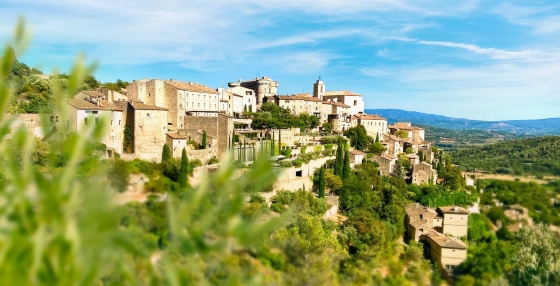
 The 10 most charming villages in France
Discover France's top 10 beautiful villages. From Normandy to the Côte d'Azur, experience quaint squares and cobbled streets. Which one will you visit this summer?
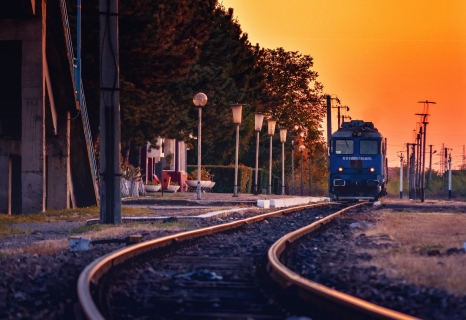
 The train journey from Bucharest to Brasov is one of the most beautiful in Romania
In three hours, you'll get from Bucharest to Brasov by train. It is one of the most beautiful routes in Romania, certainly the most beautiful that can be done by express train.