Aldrans Monthly Rainfall & Precipitation
This page shows both the average monthly rainfall and the number of rainy days in Aldrans, Austria. This average is based on long-term data collected between 1990 and 2020. Let's now guide you through the details for a complete overview.
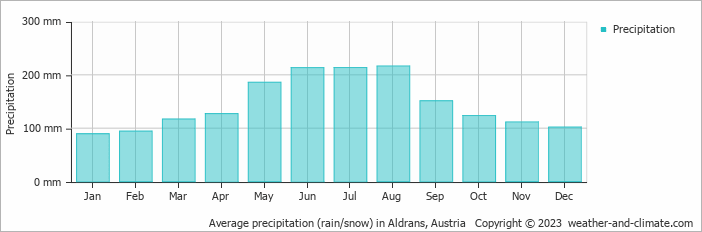
Aldrans is known for its substantial rain/snowfall, with annual precipitation reaching 1743 mm (69 in). While the overall climate is wet, there are notable seasonal patterns that create interesting contrasts, as demonstrated in our graph below.
Monthly Precipitation Levels
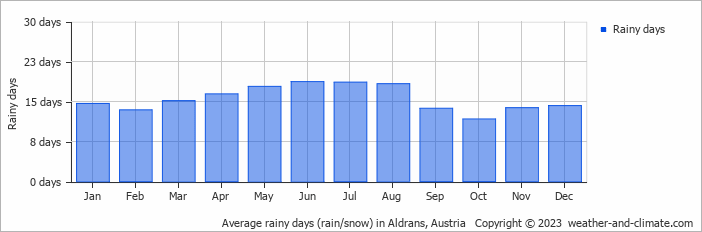
The average number of days each month with precipitation (> 0.2 mm (0.01 in))
Significant seasonal changes in precipitation occur throughout the year. During the wettest month, August receives substantial rainfall, averaging 216 mm (8.5 in) of precipitation, recorded across 18 rainy days.
In contrast, the driest month, January brings less snowfall, with 89 mm (3.5 in) over 15 snowy days.
August, the wettest month, has a maximum daytime temperature of 19°C (66°F). The city receives 210 hours of sunshine in this period. During the driest month January you can expect a temperature of -1°C (30°F). For more detailed insights into the city's temperatures, visit our Aldrans Temperature page.
Annual Rainfall in Austria: City Comparison
The map below shows the annual precipitation across Austria. You can also select the different months in case you are interested in a specific month.
heavy rainfall
high
moderate
low
almost none
Aldrans vs World: Rainfall Compared
Aldrans's average annual precipitation is 1743 mm (69 in). Let's compare this to some popular worldwide tourist destinations:
Seville, Spain, experiences 541 mm (21 in) of rainfall annually, with wet winters and dry summers typical of southern Spain.
Meanwhile, Buenos Aires, Argentina, enjoys a humid subtropical climate with 1000 mm (39 in) of annual rainfall, mostly in the summer.
In Tokyo, Japan, the average annual precipitation is 1528 mm (60 in), with significant summer rains due to typhoon season.
Mumbai, India, experiences a tropical monsoon climate with 1860 mm (73 in) of annual rainfall, with the majority of precipitation happening during the monsoon season from June to September.

Precipitation amounts are measured using specific gauges installed at weather stations, collecting both rain and snow and any other type of precipitation. Rainfall is measured directly in millimeters, while that from snow and ice is obtained by melting it. Automated systems often incorporate heaters to make this easier.
Information from these stations is transmitted via Wi-Fi, satellite, GPS, or telephone connections to central monitoring networks. This information is immediately updated and integrated into weather models and forecasts.
- Mawsynram in India is noted as being the wettest place on earth, with over 11 meters (36 feet) of rain falling every year.
- In contrast, Antofagasta in Chile is among the driest places on the planet, getting less than 0.1mm (0.004 inches) per year, with some years recording virtually no rainfall.
- Nearly 1,650 thunderstorm cells are estimated over the planet at any given time.
For more detailed information about Aldrans's weather, including sunshine hours, humidity levels, and temperature data, visit our Aldrans Climate page.