Wendover Monthly Rainfall & Precipitation
This page shows both the average monthly rainfall and the number of rainy days in Wendover, Buckinghamshire, United Kingdom. These averages rely on historical data collected over 30 years, from 1990 to 2020. Let's now guide you through the details for a complete overview.
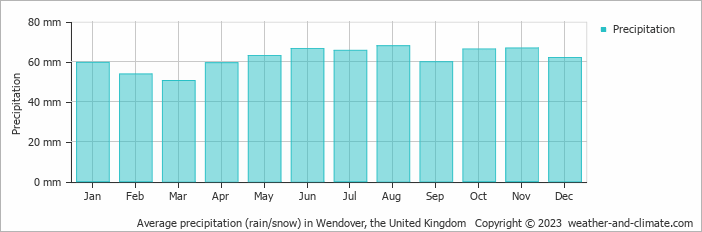
Generally, Wendover experiences moderate precipitation patterns, averaging 740 mm (29 in) yearly.
Monthly Rainfall & Rainy Days
Monthly Precipitation Levels
The average number of days each month with precipitation (> 0.2 mm (0.01 in))
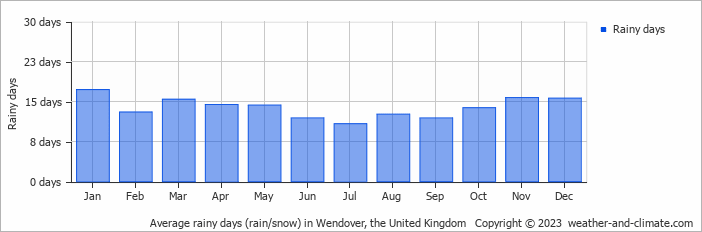
Precipitation levels in Wendover remain relatively steady throughout the year. August has the most rain, with 68 mm (2.7 in) over 13 days. In March, this drops slightly to 50 mm (2 in), making the city's climate fairly predictable.
August, the wettest month, has a maximum daytime temperature of 22°C (72°F). The city receives 188 hours of sunshine in this period. During the driest month March you can expect a temperature of 11°C (52°F). For more detailed insights into the city's temperatures, visit our Wendover Temperature page.
Annual Rainfall in the United Kingdom: City Comparison
The map below shows the annual precipitation across the United Kingdom. You can also select the different months in case you are interested in a specific month.
Wendover vs World: Rainfall Compared
Wendover's average annual precipitation is 740 mm (29 in). Let's compare this to some popular worldwide tourist destinations:
Boston, USA, experiences 1238 mm (49 in) of annual precipitation, including significant snowfall during the winter.
Meanwhile, Buenos Aires, Argentina, enjoys a humid subtropical climate with 1000 mm (39 in) of annual rainfall, mostly in the summer.
Adelaide, Australia, enjoys 511 mm (20 in) of annual precipitation, with dry summers and wet winters.
Bangkok, Thailand, experiences a tropical monsoon climate with 1668 mm (66 in) of annual rainfall, with the heaviest precipitation occurring during September and October.
Precipitation amounts are measured using specific gauges installed at weather stations, collecting both rain and snow and any other type of precipitation. Rainfall is measured directly in millimeters, while that from snow and ice is obtained by melting it. Automated systems often incorporate heaters to make this easier.
Information from these stations is transmitted via Wi-Fi, satellite, GPS, or telephone connections to central monitoring networks. This information is immediately updated and integrated into weather models and forecasts.
Climate change is affecting precipitation patterns worldwide, including Wendover:
- Changing Rainfall Patterns: Global warming causes drastic changes in the patterns of rainfall. Some areas have been experiencing increased frequency and intensity of rainfall, while other areas experience longer dry spells or even droughts.
- Local Impacts: Many regions are experiencing heavier rainfall in the winter months and drier, hotter summers. This affects agriculture, water resources, and ecosystems.
- The U.S. has a significant number of thunderstorms every year, with over 14.6 million taking place across the world annually.
- Approximately 70% of lightning bolts strike land rather than oceans.
- A storm named John was the longest-lasting Pacific tropical storm, continuing for 31 days. As it crossed the dateline twice, it changed status from a hurricane to a typhoon and back to a hurricane.
For more detailed information about Wendover's weather, including sunshine hours, humidity levels, and temperature data, visit our Wendover Climate page.
Wendover Weather by Month
Pick a month to see the average temperature, rainfall and sunshine in Wendover - and find the best time to visit.




Wendover 3-Day Forecast
Temperature Rainfall Sunshine
See the full Wendover climate overview or explore weather in the United Kingdom.
Popular this month
Where to go in August - average daytime high across popular destinations.















Bucket list
Need travel inspiration? Check out our bucket list articles and be inspired.
 Hike the South West Coast Path
The South West Coast Path means breathtaking nature, kind people and delicious food everywhere you go. It is an unforgettable experience and you need to add it to your bucket list.
Welcome to Totnes, the hidden treasure of South Devon
Totnes is a place where historical richness fuses effortlessly with a vibrant alternative culture and breathtaking natural surroundings. The town pulses with an amazing community spirit that you'll feel around every corner.
London's coolest neighborhoods you'll want to visit
Discover the 6 coolest neighborhoods in London for your trip! Explore vibrant Shoreditch, lively Soho, alternative Camden, and many more.
10 cities you should definitely visit in the UK
Discover the top 10 most fun and alternative cities in the UK, rich in art, culture, and adventure. Explore vibrant neighborhoods and unique places.