


















 El Hierro: The smallest Canary island without mass tourism
Mainly nature lovers and those seeking tranquility go to El Hierro. The island is know for its beautiful mountains and you can wonder around for days here.
Sa Torre in Balearic Islands, Spain sees significant seasonal temperature differences, with daytime highs between 15°C (59°F) in February and 30°C (86°F) in August, averaging 22°C (72°F) annually. Explore the full monthly breakdown below.
Visitors to Sa Torre can expect significant temperature changes throughout the year. Nighttime temperatures also vary widely, ranging from 24°C (75°F) in August to 10°C (50°F) in February.
The chart below illustrates the average maximum day and minimum night temperatures in Sa Torre by month:
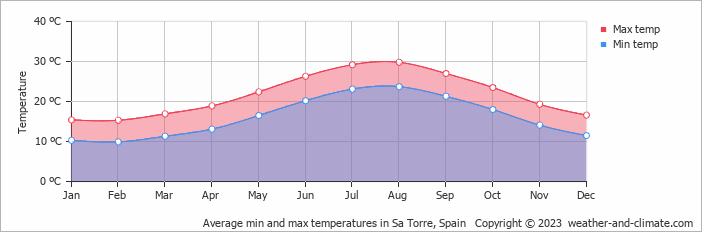
Daily lows are most common between 4 AM and 6 AM. By 3 PM temperatures reach their daily high, driven by peak solar heating. August, the warmest month of the year, receives 314 hours of sunshine.
The chart below shows the average temperature throughout the year:
The map below shows the annual temperature across Spain. You can also select individual months if you want to compare a specific time of year.
Sa Torre's average annual maximum temperature is 22°C (72°F). To put that in context, here's how it compares to a few well-known destinations:
Lisbon, Portugal averages 21°C (70°F) annually, warm summers, mild winters, and rain mainly in the cooler months.
Queenstown, New Zealand averages 10°C (50°F) annually, remember seasons are flipped, so its coldest months fall in June and July.
Chicago, USA averages 15°C (59°F) annually, known for extreme seasonal swings, from bitterly cold winters to warm summers.
Melbourne, Australia averages 20°C (68°F) annually, known for unpredictable weather, with four seasons sometimes happening in one day.
Climate temperature data is typically calculated as a 30-year average. This smooths out year-to-year variability and gives a more reliable picture of what a place is actually like, rather than what happened in any single unusual year.
The readings come from a range of sources, land-based weather stations, ocean buoys, ships, and satellites. That data is collected by weather services around the world, then pooled, quality-checked, and averaged to produce the climate records you see here.
For cities and regions with significant elevation, altitude is one of the biggest factors shaping local temperatures. As a rule of thumb, temperatures fall by around 6°C for every 1,000 metres gained, so a city at 2,000 metres will typically be around 12°C cooler than a city at sea level in the same region. Higher ground also tends to see more dramatic day-to-night temperature swings, since thinner air loses heat faster after sunset.
For more on Sa Torre's weather, including monthly rainfall, sunshine hours, and humidity, visit our Sa Torre climate page.
Pick a month to see the average temperature, rainfall and sunshine in Sa Torre - and find the best time to visit.
Temperature Rainfall Sunshine Water Temp
See the full Sa Torre climate overview or explore weather in Spain.
Where to go in September - average daytime high across popular destinations.
Need travel inspiration? Check out our bucket list articles and be inspired.
El Hierro: The smallest Canary island without mass tourism
Mainly nature lovers and those seeking tranquility go to El Hierro. The island is know for its beautiful mountains and you can wonder around for days here.
 Spain in October: Where Is It Warmest and Sunniest?
Discover where Spain is warmest in October, with climate comparisons for Seville, Alicante, Málaga, Tenerife, Madrid and Barcelona.
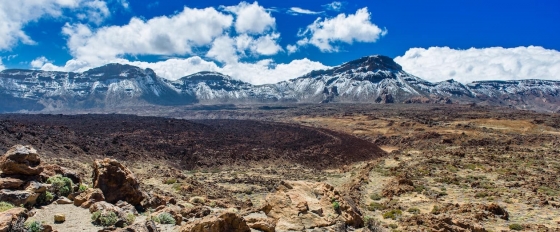 Visit national Park El Teide
This national park is truly a unique place that you should not miss. You will find landscapes that seem to come from another plane and you will feel tiny in these impressive surroundings.
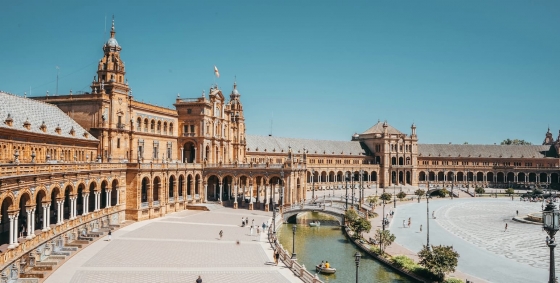 Sevilla: A Blend of Tradition, Culture, and Hidden Gems
Experience Sevilla in spring with Semana Santa processions and Feria de Abril festivities, set against the city's iconic landmarks and vibrant culture.