Marmoutier Temperature by Month
Marmoutier in Alsace, France sees significant seasonal temperature differences, with daytime highs between 6°C (43°F) in January and 26°C (79°F) in July, averaging 16°C (61°F) annually. Explore the full monthly breakdown below.
Marmoutier Monthly Temperatures
Visitors to Marmoutier can expect significant temperature changes throughout the year. Nighttime temperatures also vary widely, ranging from 15°C (59°F) in July to 0°C (32°F) in January.
The chart below illustrates the average maximum day and minimum night temperatures in Marmoutier by month:
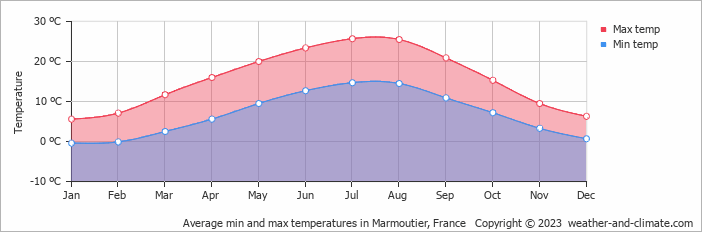
The minimum temperature is often recorded between 4 AM and 6 AM, while the highest temperature is usually reached at 3 PM, when the sun's heating effect is strongest. July, the warmest month, gets 229 hours of sunshine.
The chart below shows the average temperature throughout the year:
Temperature: Marmoutier vs France
The map below shows the annual temperature across France. You can also select individual months if you want to compare a specific time of year.
 very warm
 warm
warm
 pleasant
 moderate
 cold
cold
 very cold
Marmoutier vs World: Temperature Compared
Marmoutier's average annual maximum temperature is 16°C (61°F). To put that in context, here's how it compares to a few well-known destinations:
Barcelona, Spain has an annual average of around 21°C (70°F), with warm summers and mild, fairly short winters.
Zermatt, Switzerland averages just 4°C (39°F) annually due to its altitude, with very cold winters and cool summers even at its warmest.
Chicago, USA averages 15°C (59°F) annually — known for extreme seasonal swings, from bitterly cold winters to warm summers.
Brisbane, Australia averages 26°C (79°F) a year, with warm winters and hot, humid summers.
What Does the Temperature Feel Like in Marmoutier?
Temperature alone doesn't tell the whole story — humidity plays a big role in how warm or cold it actually feels. High humidity in summer makes the heat feel more intense, particularly once temperatures climb above 25°C. In winter, the same humidity can make cold air feel sharper than the thermometer suggests.
In the cooler months, when temperatures drop below 10°C, high humidity makes the cold feel more cutting than it would in dry conditions.
In Marmoutier, January is the coolest month, with average highs of 6°C (43°F) and humidity around 86% — considered very high. In July, the warmest month, temperatures average 26°C (79°F) with 72% humidity — conditions that feel high. For a full picture, see our humidity page.
Climate temperature data is typically calculated as a 30-year average. This smooths out year-to-year variability and gives a more reliable picture of what a place is actually like, rather than what happened in any single unusual year.
The readings come from a range of sources — land-based weather stations, ocean buoys, ships, and satellites. That data is collected by weather services around the world, then pooled, quality-checked, and averaged to produce the climate records you see here.
For cities and regions with significant elevation, altitude is one of the biggest factors shaping local temperatures. As a rule of thumb, temperatures fall by around 6°C for every 1,000 metres gained — so a city at 2,000 metres will typically be around 12°C cooler than a city at sea level in the same region. Higher ground also tends to see more dramatic day-to-night temperature swings, since thinner air loses heat faster after sunset.
For more on Marmoutier's weather — including monthly rainfall, sunshine hours, and humidity — visit our Marmoutier climate page.