

















 The 10 most alternative cities in South America
Discover South America's top 10 alternative cities! From Valparaíso's vibrant streets to La Paz's high-altitude charm and Medellín's innovative spirit.
The amount of sunshine is fundamental to comprehending a place's climate. This page shows the total number of hours of direct sunlight per month and the average hours per day in Natal, Rio Grande do Norte, Brazil. These averages rely on historical data collected over 30 years, from 1990 to 2020.
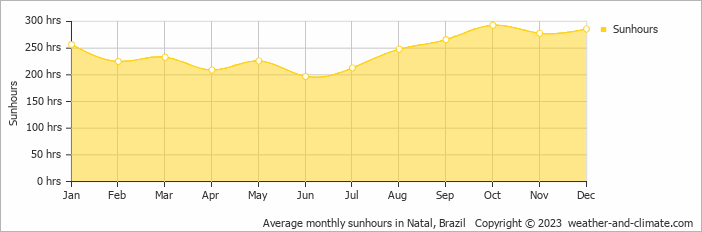
Across the seasons, sunshine hours in Natal vary. From a high of 293 hours in October, to a low of 197 hours in June, the city offers a balanced mix of sunny and overcast days. The total annual sunshine amounts to 2931 hours.
This means you can enjoy sunny spells year-round. October sees up to 9.8 hours of daily sunshine, perfect for a sunny trip. June, the least sunny month, still offers a generous 6.6 hours of sun despite this cloudier / rainier time of the year.
Natal enjoys an average of 2931 hours of sunshine annually. Let’s compare this with some popular tourist destinations:
Athens, Greece, enjoys 2769 hours of sunshine each year, making it one of the sunniest destinations in the Mediterranean region.
In contrast, Tromsø , Norway, receives only about 1270 hours of sunshine per year, known for the polar night with no sunlight for weeks during winter.
In Seoul, South Korea, there are approximately 2133 hours of sunshine per year, mostly during spring and autumn.
Perth, Australia, enjoys 3180 hours of sunshine annually, the highest among major Australian cities.
April, Natal’s wettest month, receives 121 mm (4.8 in) of rainfall and has a maximum daytime temperature of 30°C (86°F). During the driest month October you can expect a temperature of 29°C (84°F).
For more detailed insights into the city’s temperatures, check out our Temperature page. To explore more about precipitation patterns, visit our Natal Precipitation page.
Pick a month to see the average temperature, rainfall and sunshine in Natal - and find the best time to visit.
Temperature Rainfall Sunshine Humidity
See the full Natal climate overview or explore weather in Brazil.
Where to go in September - average daytime high across popular destinations.
Need travel inspiration? Check out our bucket list articles and be inspired.
The 10 most alternative cities in South America
Discover South America's top 10 alternative cities! From Valparaíso's vibrant streets to La Paz's high-altitude charm and Medellín's innovative spirit.

 The 5 most tranquil retreats in the Amazon Rainforest, Brazil
Discover top sustainable lodges in the Amazon. Enjoy unique wildlife, eco-friendly stays, and immersive experiences at Anavilhanas, Cristalino, and more.
 Brazil in November: Where Is the Best Weather?
Discover where Brazil has the best weather in November, comparing Fortaleza, Salvador, Rio, São Paulo, Florianópolis, Brasília and Foz do Iguaçu.
 An alternative way to discover Rio de Janeiro
Don't feel like seeing the traditional tourist sights in Rio de Janeiro? We have made an overview of the sights in Rio de Janeiro that you must see if you want to visit Rio in an alternative way.