To truly understand a climate, we must look at its sunshine.
This page shows the total number of hours of direct sunlight per month and the average hours per day in Lermoos, Tyrol, Austria.
The figures are based on a 30-year period (1990–2020) to provide a reliable average.
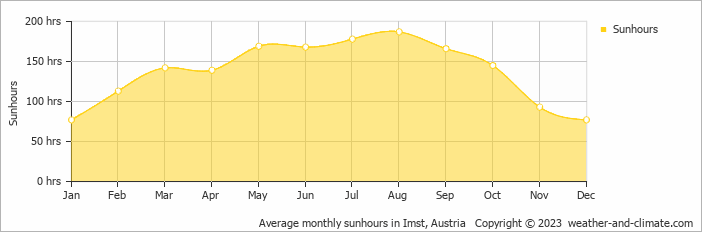
Monthly hours of sunshine
Data from: Imst, Austria (20 KM, 13 Miles).
Sunshine in Lermoos varies greatly throughout the year.
The sunniest month, August, reaches an impressive 187 hours,
while January, the darkest month, offers only 77 hours.
The total annual amount of sun is 1654 hours.
Daily hours of sunshine
Data from: Imst, Austria (20 KM, 13 Miles).
In Lermoos, summer days are longer and more sunny,
with daily sunshine hours peaking at 6.2 hours in August.
As the darker season arrives, the brightness of the sun becomes less.
January sees a soft sun for only 2.6 hours per day.
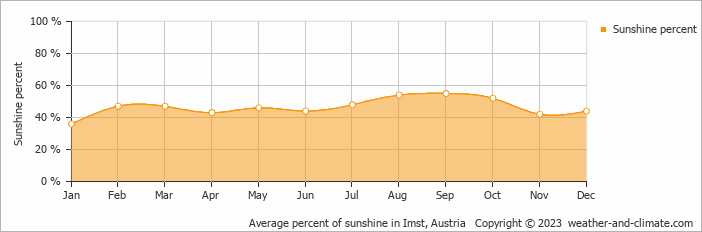
Average percent of sunshine
Data from: Imst, Austria (20 KM, 13 Miles).
On average the sun shines 55% of the time during the day in September, the highest percentage of any month.
January has the lowest percentage at 36%.





















 Ski Arlberg is the snow mecca of the Alps