When exploring climate, sunlight hours tell an important story.
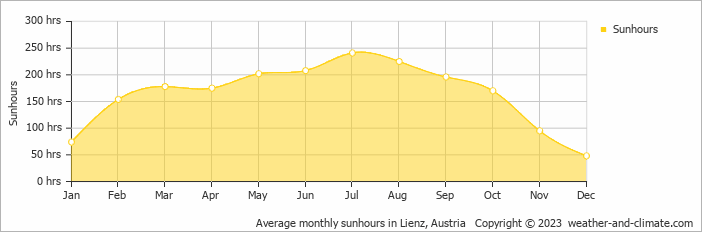
This page shows the total number of hours of direct sunlight per month and the average hours per day in Kals am Großglockner, Tyrol, Austria.
The figures are based on a 30-year period (1990–2020) to provide a reliable average.
Monthly hours of sunshine
Data from: Lienz, Austria (22 KM, 14 Miles).
If you're visiting Kals am Großglockner, timing is key.
In July, you can enjoy up to 241 hours of sunshine,
while the shorter days of December provide just 48 hours.
The total annual amount of sun is 1966 hours.
Daily hours of sunshine
Data from: Lienz, Austria (22 KM, 14 Miles).
This means the city can be enjoyed more throughout the sunniest month of July
under a blue sky, with approximately 8.0 hours of sunshine daily.
In contrast, the city experiences much darker days in December,
with only 1.6 hours of sunlight per day.
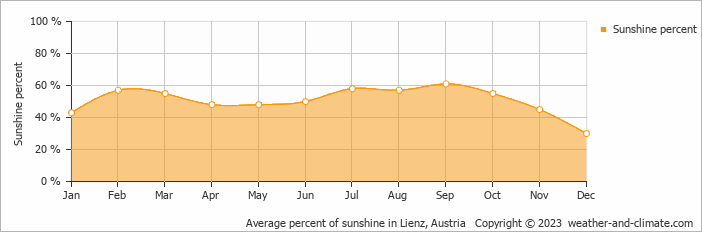
Average percent of sunshine
Data from: Lienz, Austria (22 KM, 14 Miles).
On average the sun shines 61% of the time during the day in September, the highest percentage of any month.
December has the lowest percentage at 30%.























 Ski Arlberg is the snow mecca of the Alps