














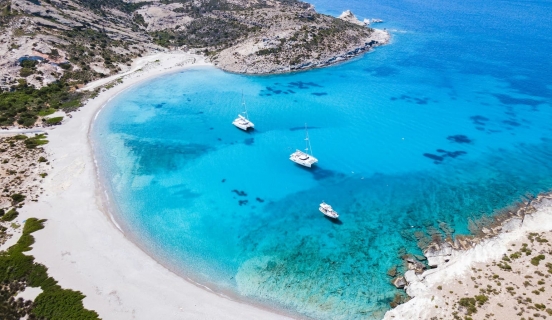
 Top 5 secluded beaches in Greece
Explore Greece's hidden gems: secluded beaches like Fokos, Seychelles, Potami, Kedrodasos, and Mouros for tranquil adventures away from crowds.
Average temperatures, rainfall, sunshine and the best time to visit Nohia.
 –
–
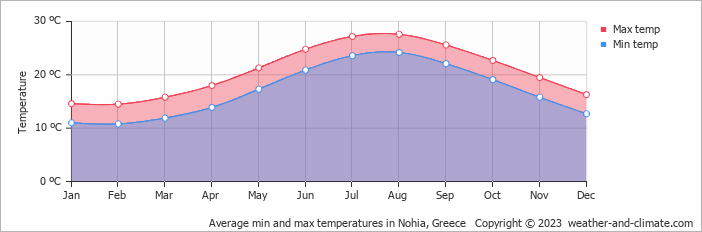
Nohia, Greece, experiences significant temperature variation throughout the year. Summers bring daytime highs of 28°C (82°F) in August, while winters cool to 15°C (59°F) in February.
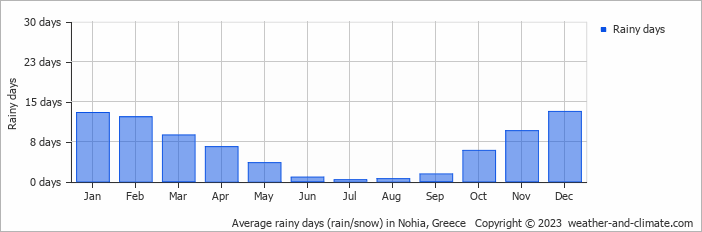
Annual rainfall is moderate at around 689 mm (27 in), with December being the wettest month. The city also has a distinct dry season from April to September, with warm summers and mild winters. The sunniest month is July, with 12.5 hours of sunshine per day on average.
Pick a month to see the average temperature, rainfall and sunshine in Nohia - and find the best time to visit.
Depending on the time of the year, temperatures range from comfortable to moderate in Nohia. Average daytime temperatures reach a comfortable 28°C (82°F) in August. In February, the coolest month of the year, temperatures drop to a moderate 15°C (59°F).
At night, temperatures range from around 24°C (75°F) in August to 11°C (52°F) in February.
Check out our detailed temperature page for more information.
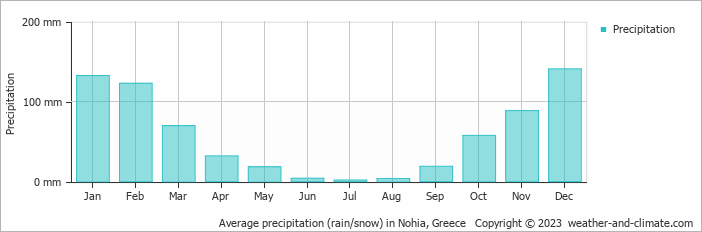
Generally, Nohia has a moderate amount of precipitation, averaging 689 mm (27 in) of rainfall annually. Nohia can be quite wet during December, receiving approximately 141 mm (5.6 in) of precipitation over 13 rainy days.
In contrast, during the driest month (July), you will experience much drier conditions, with 1.7 mm (0.1 in) of precipitation spread across 0 rainy days. For more details, please visit our Nohia Precipitation page.
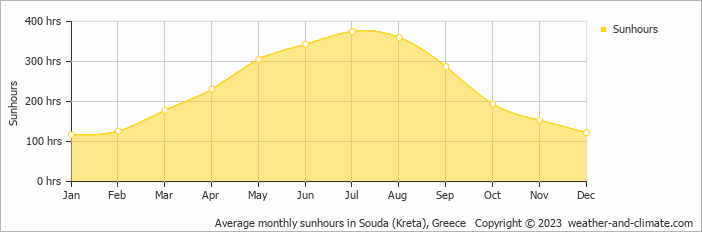
Nohia can be enjoyed more throughout the sunniest month of July under a blue sky, with approximately 12.5 hours of sunshine daily. In contrast, the city experiences much darker days in January, with only 3.9 hours of sunlight per day.
Visit our detailed sunshine hours page for more information.
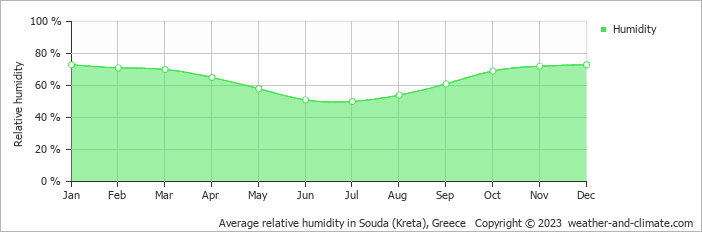
The relative humidity is high throughout the year in Nohia.
The city experiences its highest humidity in January, reaching 73%. In July, the humidity drops to its lowest level at 50%. What does this mean? Read our detailed page on humidity levels for further details.
Monthly ratings reflect general weather comfort, based on daytime temperature and rainfall. Swimming and winter conditions are highlighted separately where relevant.
May, June, July, August, September, October and November typically offer the most optimal weather in Nohia. In contrast, January, February and December tend to have less optimal conditions. Nohia has a distinct dry season from April to September, with warm summers and mild winters.
Daytime highs range from 15°C (59°F) in February to 28°C (82°F) in August. Nighttime lows range from 11°C (52°F) to 24°C (75°F). Temperatures vary considerably through the year.
Annual rainfall is around 689 mm (27 in). December is the wettest month with 141 mm (5.6 in), while July is the driest with 1.7 mm (0.1 in).
Nohia receives around 2,791 hours of sunshine per year. July is the sunniest month with 375 hours, while January is the cloudiest with just 117 hours. Overall, Nohia enjoys abundant sunshine.
Nohia is highlighted - select any city to see its climate.
Where to go in October - average daytime high across popular destinations.
Athens 25°C (77°F) Hersonissos25°C (77°F) Naxos Chora22°C (72°F) Oía23°C (73°F) Fira23°C (73°F) Mýkonos City22°C (72°F) Kalambaka
 21°C (70°F) Chania Town22°C (72°F)
 Need travel inspiration? Check out our bucket list articles and be inspired.
Top 5 secluded beaches in Greece
Explore Greece's hidden gems: secluded beaches like Fokos, Seychelles, Potami, Kedrodasos, and Mouros for tranquil adventures away from crowds.
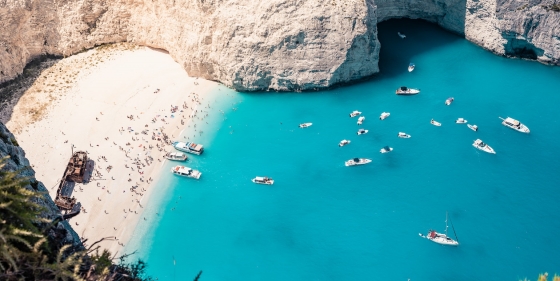 Discover Zakynthos
On the Greek island you can discover the rugged coastline, authentic old villages, a beautiful interior and the caves with the beautiful azure water.
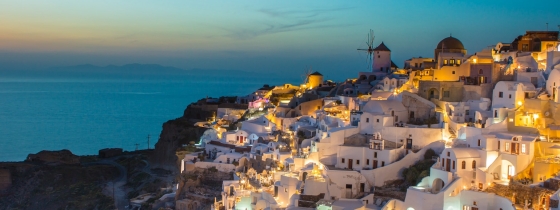 Why Santorini should be on every Bucket List
This Greek island is home to some of the most stunning scenery globally, with its beautiful Caldera views, white-washed houses and crystal-clear waters.
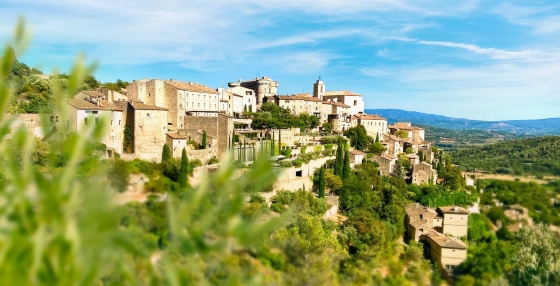
 The 10 most charming villages in France
Discover France's top 10 beautiful villages. From Normandy to the Côte d'Azur, experience quaint squares and cobbled streets. Which one will you visit this summer?