















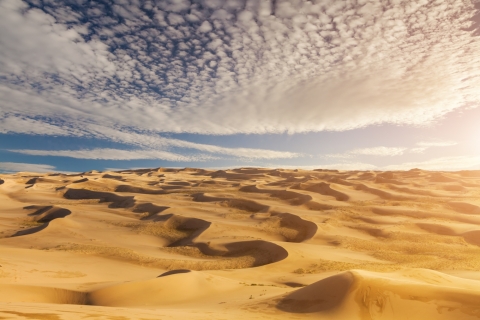
 See the Sahara in Tunisia
The best time to visit the Sahara is more towards the winter. This means more bearable temperatures in south of Tunisia.
Average temperatures, rainfall, sunshine and the best time to visit Nabeul.
 –
–
Nabeul, in Tunisia's Nabeul Governorate, experiences significant temperature changes throughout the year. Warm summers transition to mild winter periods, while the area tends toward drier weather patterns with relatively low precipitation year-round. The town is known for its beautiful beaches and serves as a quieter alternative to the busier resort areas of Hammamet nearby. Let's explore the climate details to provide you with a complete overview on when to visit.
Pick a month to see the average temperature, rainfall and sunshine in Nabeul - and find the best time to visit.
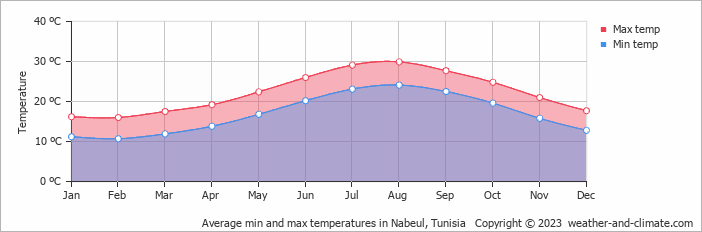
The climate in Nabeul is known for significant temperature differences throughout the year, making the weather dynamic. Average daytime temperatures reach a comfortable 30°C (86°F) in August. In February, the coolest month of the year, temperatures drop to a moderate 16°C (61°F).
At night, temperatures range from around 24°C (75°F) in August to 11°C (52°F) in February.
Check out our detailed temperature page for more information.
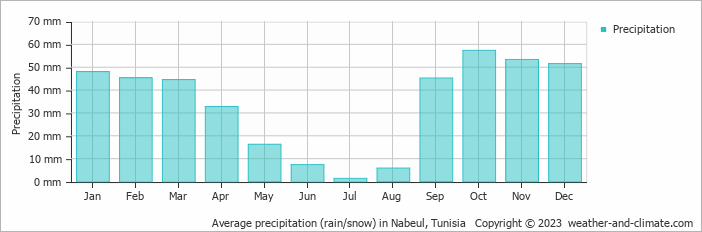
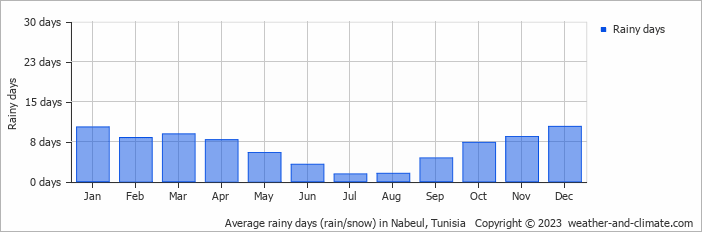
Nabeul maintains relatively dry conditions year-round, recording average annual precipitation of 408 mm (16 in). Nabeul can be quite wet during October, receiving approximately 57 mm (2.2 in) of precipitation over 7 rainy days.
In contrast, during the driest month (July), you will experience much drier conditions, with 1.3 mm (0.1 in) of precipitation spread across a single rainy day. For more details, please visit our Nabeul Precipitation page.
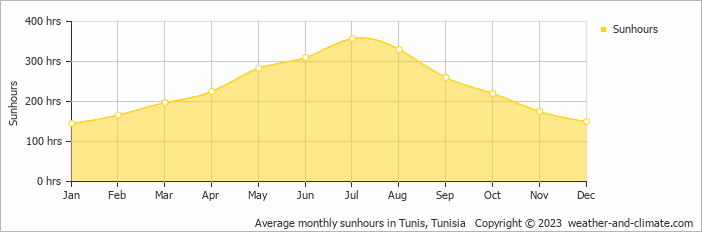
Nabeul can be enjoyed more throughout the sunniest month of July under a blue sky, with approximately 11.9 hours of sunshine daily. In contrast, the city experiences much darker days in January, with only 4.8 hours of sunlight per day.
Visit our detailed sunshine hours page for more information.
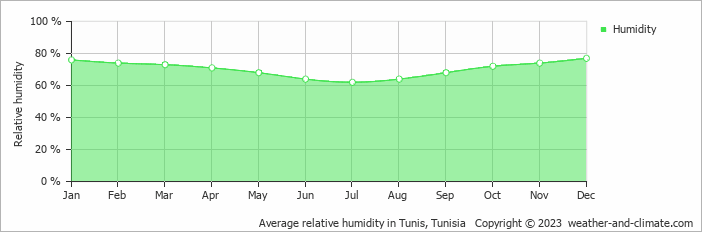
The relative humidity is high throughout the year in Nabeul.
The city experiences its highest humidity in December, reaching 77%. In July, the humidity drops to its lowest level at 62%. What does this mean? Read our detailed page on humidity levels for further details.
Monthly ratings reflect general weather comfort, based on daytime temperature and rainfall. Swimming and winter conditions are highlighted separately where relevant.
May, June, July, September, October and November typically offer the most optimal weather in Nabeul. In contrast, January and February tend to have less optimal conditions. Nabeul has a distinct dry season from April to August, with warm summers and mild winters.
Daytime highs range from 16°C (61°F) in February to 30°C (86°F) in August. Nighttime lows range from 11°C (52°F) to 24°C (75°F). Temperatures vary considerably through the year.
Annual rainfall is around 408 mm (16 in). October is the wettest month with 57 mm (2.2 in), while July is the driest with 1.3 mm (0.1 in).
Nabeul receives around 2,818 hours of sunshine per year. July is the sunniest month with 357 hours, while January is the cloudiest with just 145 hours. Overall, Nabeul enjoys abundant sunshine.
Nabeul is highlighted - select any city to see its climate.
Where to go in October - average daytime high across popular destinations.
Monastir28°C (82°F) Sousse27°C (81°F) Midoun 28°C (82°F) Port El Kantaoui27°C (81°F) Tunis26°C (79°F) Hammamet25°C (77°F) Ariana26°C (79°F) Nabeul25°C (77°F)
 Need travel inspiration? Check out our bucket list articles and be inspired.
See the Sahara in Tunisia
The best time to visit the Sahara is more towards the winter. This means more bearable temperatures in south of Tunisia.
 Visit Kruger Park in South Africa
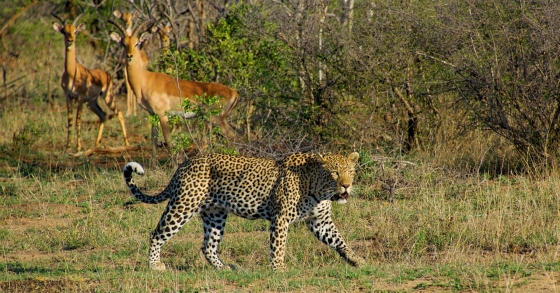
Are you going to South Africa, then you cannot skip the Kruger Park. The Kruger Park is one of the most beautiful and largest safari parks in the world.
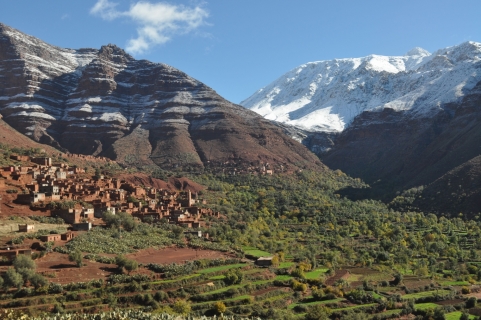
 The Atlas Mountains in Morocco
This mountain range is the second highest mountains in the world and is certainly one of the most natural and wonderful mountains you could ever visit. One for the bucket list for sure.
 One of South Africa's most spectacular private game reserves
Sabi Sand Game Reserve is one of South Africa's most spectacular private game reserves. The chance that you see the entire Big Five is high in winter (June - August).