














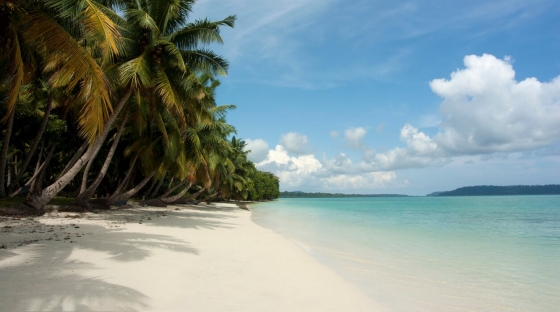
 A paradise called Andaman Islands
Though officially Indian, the Andamans are nearer Myanmar, Indonesia, and Thailand, resulting in amazing, budget-friendly white-sand beaches.
Average temperatures, rainfall, sunshine and the best time to visit Mogra.
 –
10-day forecastForecast
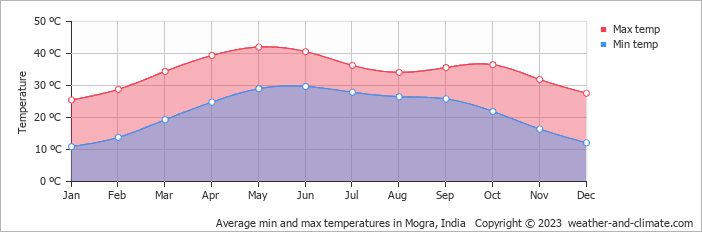
Mogra, India, experiences significant temperature variation throughout the year. Summers bring daytime highs of 42°C (108°F) in May, while winters cool to 26°C (79°F) in January.
With around 344 mm (14 in) of annual rainfall, Mogra has a fairly dry climate. However, it has a distinct dry season from October to June, with very hot summers and warm winters. The wettest month is July, while December sees the least rain. January is the sunniest month, averaging 10.0 hours of sunshine per day.
Pick a month to see the average temperature, rainfall and sunshine in Mogra - and find the best time to visit.
Depending on the time of the year, temperatures range from very hot to comfortable in Mogra. Average daytime temperatures reach a very hot 42°C (108°F) in May. In January, the coolest month of the year, temperatures drop to a comfortable 26°C (79°F).
At night, temperatures range from around 30°C (86°F) in May to 11°C (52°F) in January.
Check out our detailed temperature page for more information.
Mogra has a relatively dry climate with low precipitation, averaging 344 mm (14 in) of rainfall annually. Mogra can be quite wet during July, receiving approximately 125 mm (4.9 in) of precipitation over 6 rainy days.
In contrast, during the driest month (December), you will experience much drier conditions, with 0.9 mm (0.04 in) of precipitation spread across 0 rainy days. For more details, please visit our Mogra Precipitation page.


Mogra can be enjoyed more throughout the sunniest month of January under a blue sky, with approximately 10.0 hours of sunshine daily. In contrast, the city experiences much darker days in July, with only 3.1 hours of sunlight per day.
Visit our detailed sunshine hours page for more information.

The relative humidity is low throughout the year in Mogra.
The city experiences its highest humidity in August, reaching 57%. In April, the humidity drops to its lowest level at 19%. What does this mean? Read our detailed page on humidity levels for further details.

Monthly ratings reflect general weather comfort, based on daytime temperature and rainfall. Swimming and winter conditions are highlighted separately where relevant.
January, February and December typically offer the most optimal weather in Mogra. In contrast, March, April, May, June, July, August, September and October tend to have less optimal conditions. Mogra has a distinct dry season from October to June, with very hot summers and warm winters.
Daytime highs range from 26°C (79°F) in January to 42°C (108°F) in May. Nighttime lows range from 11°C (52°F) to 30°C (86°F). Temperatures vary considerably through the year.
Annual rainfall is around 344 mm (14 in). July is the wettest month with 125 mm (4.9 in), while December is the driest with 0.9 mm (0.04 in).
Mogra receives around 2,761 hours of sunshine per year. January is the sunniest month with 301 hours, while July is the cloudiest with just 94 hours. Overall, Mogra enjoys abundant sunshine.
Mogra is highlighted - select any city to see its climate.
Where to go in October - average daytime high across popular destinations.
New Delhi 34°C (93°F) Gurugram34°C (93°F) Jaipur35°C (95°F) Mumbai
 32°C (90°F) Hyderabad31°C (88°F) Chennai
 32°C (90°F) Bengaluru
 29°C (84°F) Kochi29°C (84°F)
Need travel inspiration? Check out our bucket list articles and be inspired.
A paradise called Andaman Islands
Though officially Indian, the Andamans are nearer Myanmar, Indonesia, and Thailand, resulting in amazing, budget-friendly white-sand beaches.
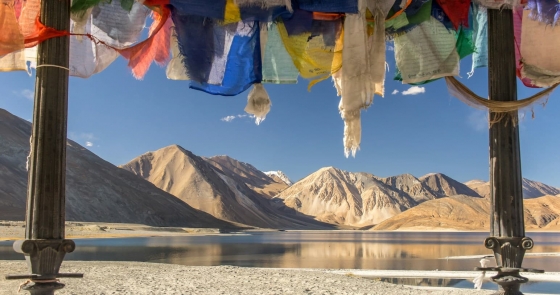 The 5 most beautiful monasteries in Ladakh
Explore Ladakh's spiritual essence through its incredible Buddhist monasteries. See architectural wonders, rich traditions, and serene landscapes in this guide.
 Sleeping under the stars and riding camels in Rajasthan
A desert safari in Jaisalmer is definitely one of the highlights during a visit to India. Spending a night in the desert is a great adventurous bucket list experience.
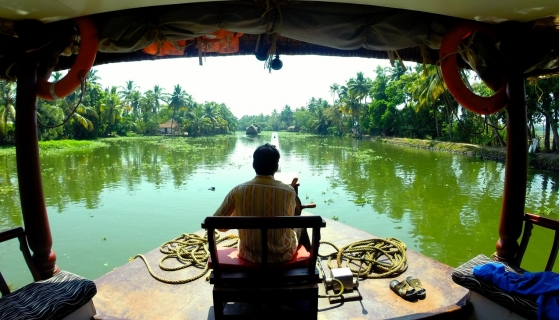 Avoid mass tourism on an eco boat in the backwaters of Kerala
We can tell you now how you can avoid being surrounded by tourists and at the same time minimize your impact on the environment.