

















 Warm Sea Without Extreme Heat: 8 Beach Destinations With Comfortable Weather
Love warm seawater but not extreme heat? Compare eight beach destinations where the sea stays warm while daytime temperatures remain comfortable.
Average temperatures, rainfall, sunshine and the best time to visit Covarrubias.
 –
10-day forecastForecast
Covarrubias, Castile and Leon, Spain, experiences significant temperature variation throughout the year. Summers bring daytime highs of 29°C (84°F) in August, while winters cool to 8°C (46°F) in January.
With around 736 mm (29 in) of annual rain/snowfall, the city has moderate precipitation levels. November is the wettest month and August the driest. It also has a distinct dry season from July to August, with warm summers and cold winters. The most sunshine falls in July, with an average of 10.7 hours of daily sunshine.
Pick a month to see the average temperature, rainfall and sunshine in Covarrubias - and find the best time to visit.
Depending on the time of the year, temperatures range from comfortable to chilly in Covarrubias. Typically, average maximum daytime temperatures range from a comfortable 29°C (84°F) in August to a chilly 8°C (46°F) in the coolest month, January.
Nights vary from 14°C (57°F) in August to around 1°C (34°F) during the colder months.
Check out our detailed temperature page for more information.
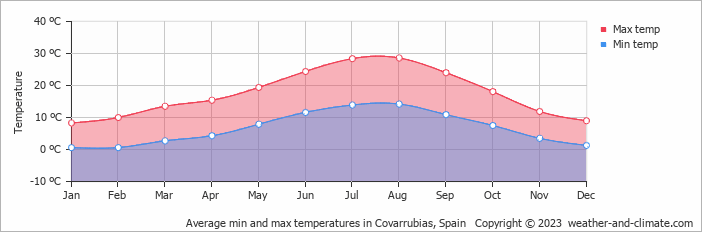
Generally, Covarrubias has a moderate amount of precipitation, averaging 736 mm (29 in) of rain/snowfall annually. The climate in Covarrubias shows significant variation throughout the year. Expect moderate rainfall in November, the wettest month, with an average of 84 mm (3.3 in) of precipitation over 14 rainy days.
In contrast, the driest month August offers drier and sunnier days, with around 22 mm (0.9 in) of rainfall over 7 rainy days. For more details, please visit our Covarrubias Precipitation page.


For those who appreciate different seasons, Covarrubias serves as an ideal destination. Expect longer, more sun-filled days in July with an average of 10.7 hours of sunshine daily, and embrace the darker days in December, offering only 2.7 hours of daily sunlight.
Visit our detailed sunshine hours page for more information.

Monthly ratings reflect general weather comfort, based on daytime temperature and rainfall. Swimming and winter conditions are highlighted separately where relevant.
June, July, August and September typically offer the most optimal weather in Covarrubias. In contrast, January, February and December tend to have less optimal conditions. Covarrubias has a distinct dry season from July to August, with warm summers and cold winters.
Daytime highs range from 8°C (46°F) in January to 29°C (84°F) in August. Nighttime lows range from 1°C (34°F) to 14°C (57°F). Temperatures vary considerably through the year.
Annual rainfall is around 736 mm (29 in). November is the wettest month with 84 mm (3.3 in), while August is the driest with 22 mm (0.9 in).
Covarrubias receives around 2,237 hours of sunshine per year. July is the sunniest month with 320 hours, while December is the cloudiest with just 80 hours. Overall, Covarrubias enjoys abundant sunshine.
Covarrubias is highlighted - select any city to see its climate.
Travelling soon? Check the weather on our 10-day Forecast Map for Spain
Where to go in November - average daytime high across popular destinations.
Not sure yet where to go? See where to go in Europe, month by month, in our weather planner.
Need travel inspiration? Check out our bucket list articles and be inspired.
Warm Sea Without Extreme Heat: 8 Beach Destinations With Comfortable Weather
Love warm seawater but not extreme heat? Compare eight beach destinations where the sea stays warm while daytime temperatures remain comfortable.

 El Hierro: The smallest Canary island without mass tourism
Mainly nature lovers and those seeking tranquility go to El Hierro. The island is know for its beautiful mountains and you can wonder around for days here.
 Spain in October: Where Is It Warmest and Sunniest?
Discover where Spain is warmest in October, with climate comparisons for Seville, Alicante, Málaga, Tenerife, Madrid and Barcelona.
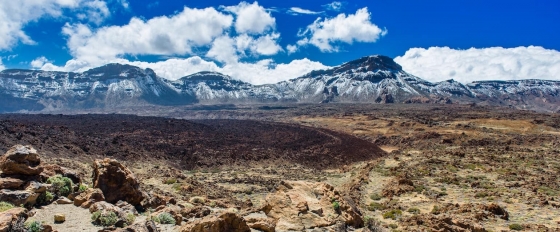 Visit national Park El Teide
This national park is truly a unique place that you should not miss. You will find landscapes that seem to come from another plane and you will feel tiny in these impressive surroundings.