

















 An alternative way to discover Sydney
We have made an overview of the sights in Sydney that you must see if you want to visit Sydney in an alternative way.
Average temperatures, rainfall, sunshine and the best time to visit Collie.
 –
–
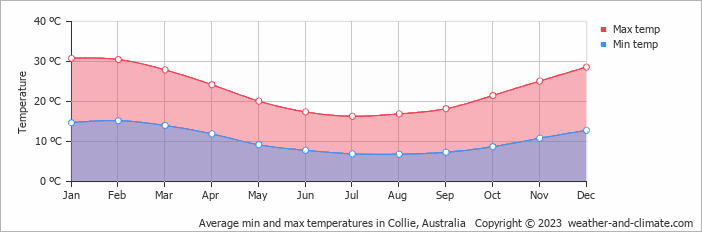
Collie, Western Australia, Australia, sees big temperature differences between seasons, with January peaking at 31°C (88°F) and July dropping to 16°C (61°F).
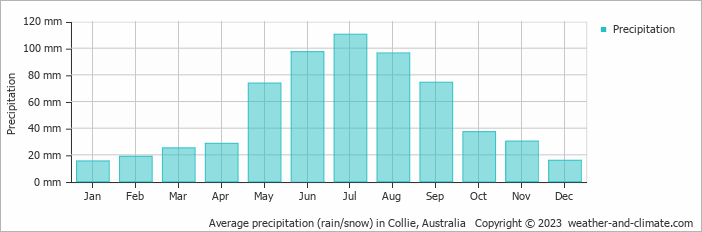
The city receives around 623 mm (25 in) of rainfall per year. It experiences a distinct dry season from October to April, with very warm summers and mild winters. July is the wettest month and January the driest.
Pick a month to see the average temperature, rainfall and sunshine in Collie - and find the best time to visit.
Visitors to Collie can expect significant temperature changes throughout the year. On average, daytime temperatures range from a very warm 31°C (88°F) in January to a moderate 16°C (61°F) in July.
Nighttime temperatures range from 15°C (59°F) in January to 7°C (45°F) in July.
Check out our detailed temperature page for more information.
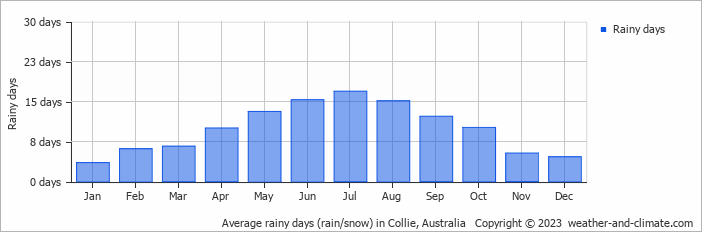
Generally, Collie experiences moderate precipitation patterns, averaging 623 mm (25 in) yearly. The seasons in Collie bring significant changes in precipitation. The wettest month, July, receives high rainfall, with an average of 110 mm (4.3 in) of precipitation. This rainfall is distributed across 17 rainy days.
In contrast, the driest month, January, experiences much less rainfall, totaling 15 mm (0.6 in) over 4 rainy days. These distinct seasonal differences provide diverse experiences throughout the year. For more details, please visit our Collie Precipitation page.
Monthly ratings reflect general weather comfort, based on daytime temperature and rainfall. Swimming and winter conditions are highlighted separately where relevant.
March, April, May, October, November and December typically offer the most optimal weather in Collie. In contrast, July tends to have less optimal conditions. Collie has a distinct dry season from October to April, with very warm summers and mild winters.
Daytime highs range from 16°C (61°F) in July to 31°C (88°F) in January. Nighttime lows range from 7°C (45°F) to 15°C (59°F). Temperatures vary considerably through the year.
Annual rainfall is around 623 mm (25 in). July is the wettest month with 110 mm (4.3 in), while January is the driest with 15 mm (0.6 in).
Collie is highlighted - select any city to see its climate.
Where to go in September - average daytime high across popular destinations.
Need travel inspiration? Check out our bucket list articles and be inspired.
An alternative way to discover Sydney
We have made an overview of the sights in Sydney that you must see if you want to visit Sydney in an alternative way.
 The most relaxed and alternative area of Australia is called the Byron Shire
The Byron Shire is one of the most pretty areas in the world. Not only in terms on natural beauty, also the relaxed vibe and people make this an area that remains close to your heart.
 Sail the Whitsunday islands
The best travel period to sail the Whitsunday islands is “winter” between June and October, with pleasant temperatures around 23 degrees Celsius (74 Fahrenheit).
 The best dive spots in Australia
Explore Australia's best dive spots: from the Great Barrier Reef to HMAS Perth. Discover vibrant corals, marine life, and historic wrecks.